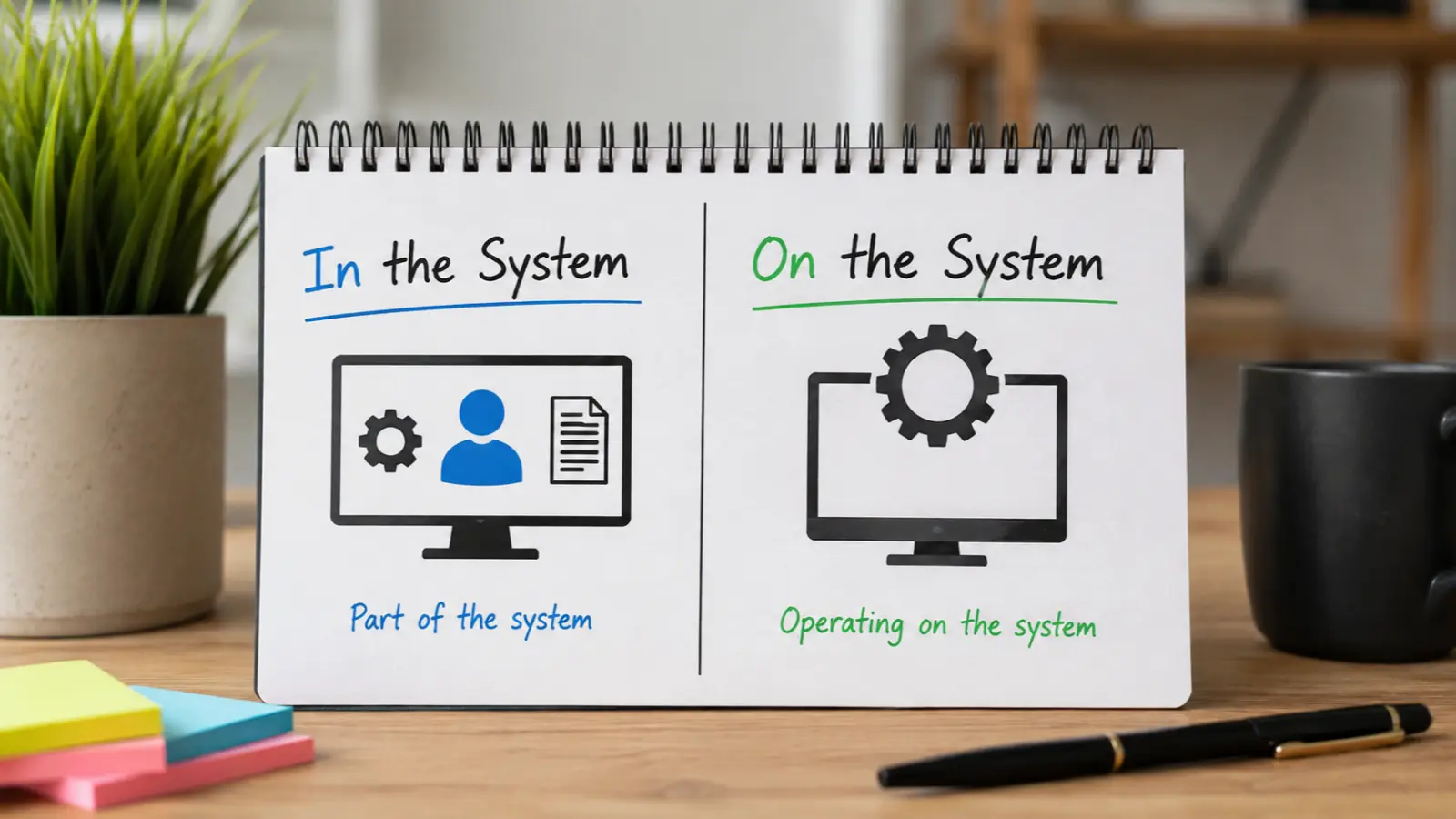
Learners often ask about in the system or on the system because both expressions appear in workplace and technical English. The prepositions in and on can change the relationship between an item and a system. English commonly uses in for stored information and on for activity involving a technical environment.
However, context matters. Understanding this distinction helps you write clearer emails, understand instructions, and speak more naturally in professional situations. Once you know whether you are describing something stored inside a system or an activity involving that system, choosing the correct preposition becomes much easier.
Why “in the system” and “on the system” Are Confusing
Learners frequently search for in the system or on the system because the two phrases have almost the same structure. Only the preposition changes, yet that small change can affect the meaning.
Similar pronunciation
The expressions sound similar because in and on are short, unstressed words in normal speech. In fast conversation, learners may not hear the difference clearly. This makes in the system or on the system seem more interchangeable than they really are.
Similar spelling
Both phrases contain the same words except for one preposition. This visual similarity encourages learners to treat them as alternatives without considering context.
Context confusion
A computer system can contain information and also provide an environment where programs and people perform tasks. Therefore, both in and on can appear naturally when discussing the same system.
For example, an account can be in the system, while a technician can be working on the system. The first describes stored information; the second describes activity.
Common learner mistakes
A common error when considering in the system or on the system is using on whenever the sentence mentions technology. Another is using in whenever something is related to software. The correct preposition depends on what you want to say.
“In the System” vs “On the System” Explained Simply
The simplest way to understand in the system or on the system is to decide whether you mean inside the system’s information or structure or activity involving the system.
“In the system” means contained, recorded, stored, or included within a system, while “on the system” often means working, operating, running, or being tested using a particular system or technical environment.
One-line distinction
In = contained or recorded; on = operating, using, or working with a system.
Examples
- Your customer details are in the system.
- The technician is working on the system.
In the first sentence, the details are recorded. In the second, the technician is performing an activity involving the system. This basic distinction is the most useful starting point when learning in the system or on the system.
Understanding Homophones in English
The confusion surrounding in the system or on the system is not actually a homophone problem. It is mainly a preposition and context problem.
What Are Homophones?
Homophones are words that have the same or very similar pronunciation but different meanings or spellings. For example, right and write sound alike but have different meanings.
The expressions in the system or on the system are not homophones because in and on do not sound the same. Instead, learners must choose the preposition that matches the intended relationship.
Why Homophones Cause Confusion
Homophones can make English difficult because listeners have to use context to understand meaning. With in the system or on the system, the challenge is slightly different: the learner must understand how English uses prepositions with abstract and technical nouns.
What Does “In the System” Mean?
Definition and Core Meaning
In the system normally means that something is contained, recorded, stored, registered, or included within a system. The system may be a database, computer network, administrative process, organization, or set of procedures.
If a customer service worker says, “Your order is in the system,” the worker usually means that the order has been entered into the records.
This is why in the system or on the system is not simply a choice based on personal preference. The intended meaning matters.
Origin and Historical Use
For in the system or on the system, the preposition in traditionally expresses the idea of being inside a physical place or container. English later extended this idea to abstract structures. Information can be thought of as being “inside” a database or record system, so in the system became a natural expression.
Modern Usage and Synonyms
The phrase can describe:
- information stored in a database
- a person’s name recorded in official records
- an application entered into a process
- a customer account registered in a system
- a file included in software
- data available in an information system
Useful alternatives include stored in the database, recorded in the system, entered into the system, and included in the records.
Example Sentences
- Your payment is in the system now.
- Her employee details are in the system.
- I checked, but your order is not in the system.
- The application is already in the system.
- The customer’s address is in the system.
These examples show why in the system or on the system requires attention to meaning: stored information is usually described with in.
What Does “On the System” Mean?
Definition and Core Meaning
On the system often describes activity, operation, or use involving a particular computer system, platform, network, or technical environment.
For example, “The engineer is working on the system” means the engineer is operating, repairing, configuring, testing, or modifying it. Likewise, “The program runs on the system” identifies the environment where the program operates.
Origin and Historical Context
For in the system or on the system, the preposition on originally expressed contact with a surface or position on something. In modern technology English, it also developed uses connected with devices, platforms, networks, and operating environments. We commonly say on the website, on the platform, on the network, and, in suitable contexts, on the system.
Modern Usage and Synonyms
Common uses include:
- working on a computer system
- repairing or maintaining a system
- running software on a system
- testing a program on a system
- making changes to a technical environment
- using a system to complete a task
Possible alternatives include using the system, working with the system, running on the platform, and through the system, depending on context.
Example Sentences
- The engineer is working on the system.
- We tested the program on the system.
- The update is running on the system.
- She is making changes on the system.
- The application works well on the system.
The main idea is activity or operation. That is the key point to remember when comparing in the system or on the system.
In the System vs On the System: Key Differences at a Glance
The comparison below makes in the system or on the system easier to understand.
| Word | Part of Speech | Meaning | Example Context |
|---|---|---|---|
| In the system | Prepositional phrase | Stored, recorded, contained, or included within a system | “Your account is in the system.” |
| On the system | Prepositional phrase | Operating, working, running, or being used through a system | “The engineer is working on the system.” |
A quick rule for in the system or on the system is:
- In → think about contents, records, or stored information.
- On → think about activity, operation, or a technical environment.
Still, English is flexible. In specialized technical contexts, the most natural expression can depend on the type of system and the exact action.
How to Remember the Difference Between In the System and On the System
Use these memory tricks to make in the system or on the system easier to remember.
1. Remember in the system or on the system with a container
Imagine the system as a box. Information stored inside the box is in the system.
The customer’s name is in the system.
2. Remember in the system or on the system through activity
Imagine a technician sitting at a computer and working with the system. The activity is on the system.
The technician is working on the system.
3. Ask one simple question
Ask yourself: “Is it stored, or is someone using or operating it?”
- Stored or recorded → in
- Used, operated, tested, or modified → often on
One memorable example
My name is in the system, but the technician is working on the system.
The name is stored information. The technician is performing an action.
This simple contrast is a reliable way to remember in the system or on the system when writing emails or speaking at work.
Common Mistakes and Confusions
Mistake 1: in the system or on the system for stored information
✘ Your customer record is on the system.
✔ Your customer record is in the system.
Why? The record is being described as stored within the database or information system.
Mistake 2: Technical work
✘ The technician is in the system fixing the problem.
✔ The technician is working on the system to fix the problem.
Why? The sentence focuses on work performed on or involving the technical system.
Mistake 3: Searching records
✘ I cannot find your application on the system.
✔ I cannot find your application in the system.
Why? The speaker is searching the system’s records for the application.
Mistake 4: Software operation
✘ The program is running in the system.
✔ The program is running on the system.
Why? On identifies the technical environment where the program operates.
Remember that some sentences may use different prepositions depending on the intended meaning. The goal is not to memorize one rigid rule for every situation, but to understand the relationship described by in the system or on the system.
Examples Section: Correct and Incorrect Usage
Example 1: Choosing in the system or on the system
✔ Correct: Your details are in the system.
✘ Incorrect: Your details are on the system.
The first sentence means the details have been recorded.
Example 2
✔ Correct: The engineer is working on the system.
✘ Incorrect: The engineer is working in the system.
The second version can suggest a different idea and is usually unnatural when the intended meaning is technical maintenance.
Example 3
✔ Correct: Your order is in the system.
✘ Incorrect: Your order is on the system.
The order is treated as stored information.
Example 4
✔ Correct: We tested the program on the system.
✘ Incorrect: We tested the program in the system.
The program was tested while operating in a particular technical environment.
Example 5
✔ Correct: Her name is in the system.
✘ Incorrect: Her name is on the system.
The name is part of the records.
Example 6
✔ Correct: The security tool is running on the system.
✘ Incorrect: The security tool is running in the system.
The focus is on where the tool operates.
These examples show the practical difference behind in the system or on the system.
Self Assessment: Test Your Knowledge
Choose in or on for each blank.
- Your account is already ___ the system.
- The technician is working ___ the system.
- I cannot find your name ___ the system.
- We installed the new application ___ the system.
Self Assessment Answers
- in — The account is stored or registered.
- on — The technician is performing work involving the system.
- in — The name is part of the system’s records.
- on — The application is installed and operates in a technical environment.
If you got all four correct, you have understood the main distinction in in the system or on the system.
FAQs
Is “in the system” correct English?
Yes. It is very common when information, records, accounts, applications, or other items are stored or included within a system.
Is “on the system” correct English?
Yes. It is also correct, particularly when describing work, operation, testing, or use involving a computer or technical environment.
Which is correct: “in the system or on the system”?
Both are correct in appropriate contexts. Use in when you mean something is contained or recorded. Use on when you mean activity or operation involving a system.
Should I say “data in the system” or “data on the system”?
Data in the system is usually natural when referring to information stored in a database or information system. Other on constructions may be appropriate when describing a device or platform.
Is “working on the system” correct?
Yes. It is natural when someone is repairing, maintaining, configuring, testing, or changing a system.
Can “in the system” refer to non-computer systems?
Yes. It can refer to administrative, organizational, educational, legal, or other systems. For example, an application can be in the system during an administrative process.
Is “on the system” always about computers?
No. Its meaning depends on context. However, it is especially common in technical and workplace English.
Final Conclusion: Using “In the System” and “On the System” Correctly
Choosing between in the system or on the system is mainly a matter of meaning and context. In the system usually describes something that is stored, recorded, registered, contained, or included within a system. On the system commonly describes work, activity, operation, testing, or software running through a particular technical environment. A simple memory trick can make the difference easier: think of in as inside the records and on as active on the technical environment.
For example, your name can be in the system, while a technician can be working on the system. Remember, however, that technical English can be flexible, so always consider what the sentence is actually describing. The more examples of in the system or on the system you read and hear, the more naturally you will recognize the correct preposition. Do not worry if the distinction feels small at first. Prepositions are difficult for many English learners, but regular practice makes them easier. Keep noticing how native speakers use these expressions, and soon in the system or on the system will become a much clearer choice in your everyday English.