English learners often wonder whether to use has or have after the word family. The confusion happens because family refers to several people, but grammatically it is usually treated as a singular collective noun in American English. In British English, however, a collective noun can sometimes take a plural verb when the members are considered individually.
Understanding family has or have is therefore less about memorizing one fixed rule and more about understanding whether the family is acting as one unit or as separate individuals. This guide explains the difference in simple English, with clear rules, examples, and practical tips to help you choose the correct verb confidently.
Why “family has or have” Are Confusing
The question family has or have can be confusing because family describes a group of people. Learners may naturally think that a group should always take a plural verb. However, English treats collective nouns in different ways depending on meaning, dialect, and context.
Similar pronunciation
The words has and have are both common auxiliary or main verbs. They appear frequently in everyday speech, so learners may hear different patterns and become unsure about which one follows family.
Similar spelling
The words are short and closely connected grammatically. Both are forms of the verb to have, but they are used with different subjects.
Context confusion
The main issue is whether the family is being viewed as one group or as individual members. For example, when the family owns one house together, the group acts as a unit. When individual family members have different opinions, the focus can shift to the people separately.
Common learner mistakes
A common mistake is assuming that every plural-looking meaning requires have. Another mistake is believing that family must always take has in every variety of English. The correct choice depends on the intended meaning and, sometimes, the variety of English being used.
Family Has or Have Explained Simply
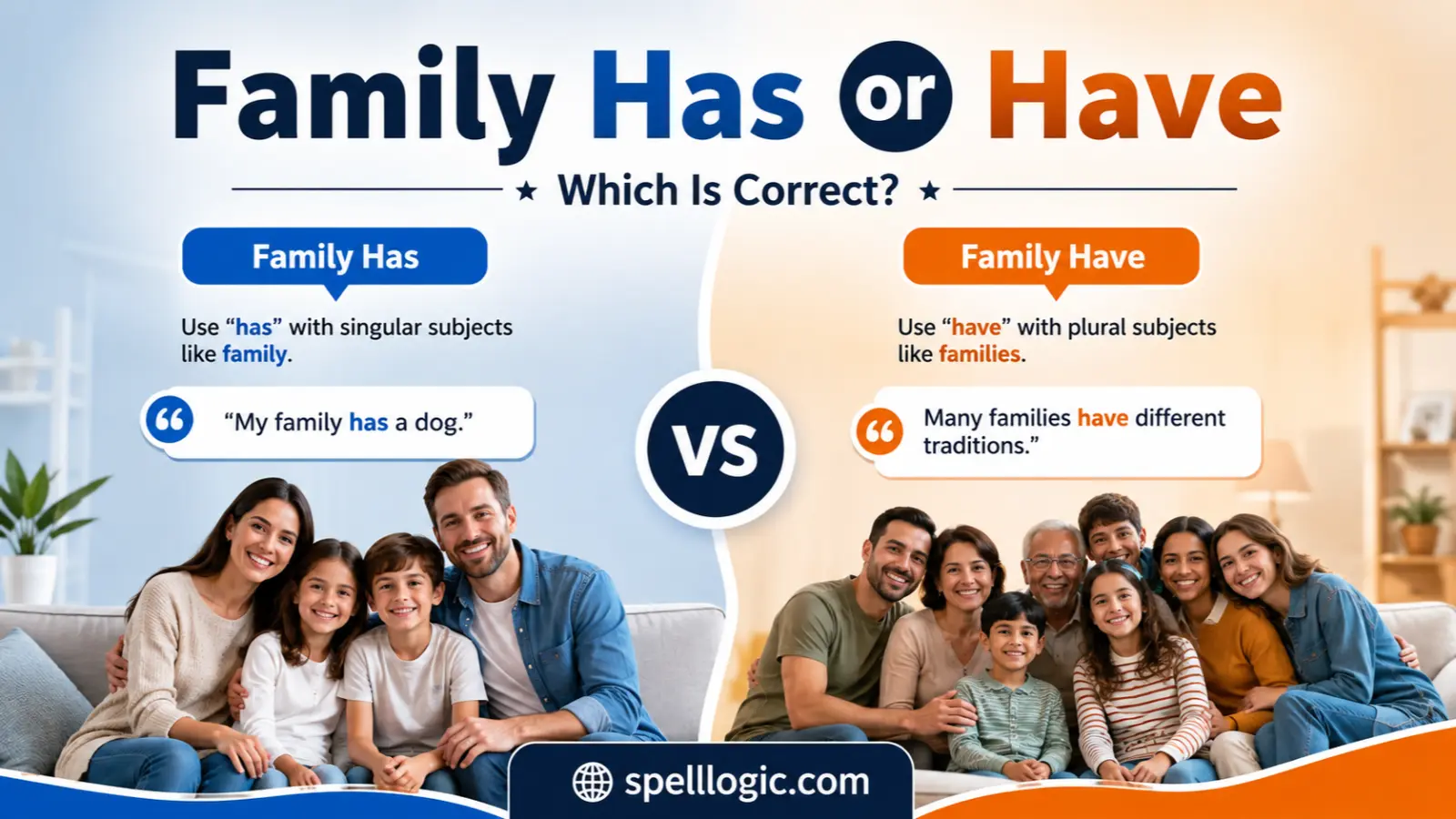
The simplest rule is this: use “has” when the family is treated as one unit; use “have” when the members are being considered individually, especially in British English.
In American English, family is generally treated as a singular collective noun, so has is normally preferred. British English allows either form depending on whether the group or its individual members are emphasized.
One-line distinction: Has usually treats the family as one unit, while have can emphasize the individual members of the family.
For example:
- My family has a house near the lake.
- The family have different opinions about where to travel.
The second sentence is particularly natural in British English because the members are acting or thinking separately.
When considering family has or have, remember that the subject family itself is singular in form. The verb depends on how the collective noun is being understood.
Understanding Homophones in English
The issue here is not actually a homophone problem. Instead, it is a subject-verb agreement problem involving a collective noun.
What Are Homophones?
Homophones are words that sound the same but have different meanings or spellings. For example, flower and flour sound alike but refer to completely different things.
Why Homophones Cause Confusion
Although family has or have is sometimes discussed alongside other confusing English expressions, has and have are not homophones. They are different forms of the same verb. The real challenge is selecting the correct form based on the subject and intended meaning.
For example:
- The family has a large garden.
- The family members have different schedules.
Here, the change from has to have follows the grammatical subject.
What Does “Family Has” Mean?
Definition and Core Meaning
The expression family has is used when family is treated as a singular collective noun. It means that the family, considered as one group, possesses something, experiences something, or performs an action.
This is especially common in American English.
Examples include:
- My family has a small business.
- Her family has lived here for many years.
- The family has a tradition of celebrating together.
- His family has a beautiful home in the countryside.
Origin and Historical Use
The word family comes through Old French familie from Latin familia, referring broadly to a household or group connected to a household. Over time, English developed the modern meaning of a group of related people.
English has long used collective nouns such as family, team, committee, and government. These nouns can represent a group as a single entity, which explains why a singular verb is often appropriate.
Modern Usage and Synonyms
Today, family has is especially common when the speaker is describing something belonging to or applying to the family as a whole.
Useful related expressions include:
- family owns
- family includes
- family lives
- family consists of
- family possesses
- household has
The structure is particularly straightforward in American English.
Example Sentences
- My family has three cars.
- The family has a holiday tradition.
- Our family has a large garden.
- Her family has several businesses.
- The family has agreed to sell the property.
In each example, the family is presented as one collective unit.
When learners ask family has or have, these examples provide the most common answer in standard American English: use has when the group is viewed collectively.
What Does “Family Have” Mean?
Definition and Core Meaning
The expression family have occurs when the people in a family are viewed as individuals rather than as one single unit. This construction is particularly common in British English and other varieties influenced by British usage.
For example:
- My family have different opinions about the move.
- The family have all arrived safely.
In these sentences, the focus is on the individual family members and their separate actions, opinions, or circumstances.
Origin and Historical Context
British English has traditionally allowed greater flexibility with collective nouns. Words such as family, team, government, and committee may take singular or plural verbs depending on whether the group is understood as one entity or as separate members.
American English generally prefers singular agreement with these nouns, while British English more readily permits plural agreement when individual members are emphasized.
Modern Usage and Synonyms
Family have is most useful when the sentence describes different actions, feelings, opinions, possessions, or decisions among family members.
Related structures include:
- family members have
- relatives have
- the household members have
- the parents have
- the children have
If you want to avoid uncertainty, you can replace the collective noun with family members. This makes plural agreement completely clear.
For example:
- The family members have different schedules.
Example Sentences
- The family have different ideas about the project.
- My family have all chosen different careers.
- The family have agreed among themselves.
- Her family have decided to stay in separate hotels.
- The family have their own opinions about the issue.
These examples focus on the people within the family rather than the family as a single organization.
Therefore, when examining family has or have, consider whether your sentence emphasizes unity or individual members.
Family Has or Have: Key Differences at a Glance
| Word | Part of Speech | Meaning | Example Context |
|---|---|---|---|
| Has | Verb | Treats the family as one unit | My family has a new car. |
| Have | Verb | Emphasizes family members individually | The family have different opinions. |
The table shows why family has or have does not have one universal answer for every English variety. The intended meaning matters.
In American English, the singular form is normally preferred:
- My family has a large house.
- My family has dinner together every Sunday.
In British English, plural agreement is also possible:
- My family have different views.
- My family have all gone home.
A useful alternative is to say family members when you want to make the plural meaning unmistakable.
How to Remember the Difference Between Family Has and Family Have
The easiest memory trick is:
One family = has. Individual members = have.
This is not an absolute rule across every dialect, but it is an excellent starting point for English learners.
Easy Memory Tricks
- Think of has as “the group is one.”
- Think of have as “the people are separate.”
- In standard American English, choose has after family in most situations.
- In British English, consider have when the members are acting individually.
Association Techniques
Imagine a family sitting around one table and doing the same thing together. Think:
The family has dinner.
Now imagine family members choosing different meals, jobs, or destinations. Think:
The family have different preferences.
Another safe strategy is to replace family with family members. If the sentence clearly refers to individuals, plural agreement becomes easier.
One Memorable Example
The family has one house, but the family members have different rooms.
The first part treats the group as one owner. The second part explicitly refers to individual people.
This simple contrast can help you remember the central idea behind family has or have.
Common Mistakes and Confusions
Mistake 1: Assuming “family” is always plural
✘ My family have a new car.
✔ My family has a new car.
In standard American English, the family is being treated as one unit, so has is the normal choice.
Mistake 2: Assuming “family” must always be singular
✘ The family has different opinions.
✔ The family have different opinions.
This version can be natural in British English because the focus is on individual family members.
However, American English would normally avoid the plural collective construction and say:
✔ The family has different opinions.
Or, even more clearly:
✔ The family members have different opinions.
Mistake 3: Confusing “family” with “family members”
The phrase family members is grammatically plural.
Therefore:
- My family has a house.
- My family members have separate rooms.
The noun that directly controls the verb is important.
Mistake 4: Ignoring dialect differences
Learners sometimes see family have in British sources and assume it is incorrect. It is not necessarily incorrect. British English commonly uses plural agreement with collective nouns when individual members are emphasized.
Similarly, learners should not assume that every British sentence requires a plural verb. Context still matters.
Examples Section: Correct and Incorrect Usage
Example 1
✔ Correct: My family has a dog.
✘ Incorrect: My family have a dog.
In standard American English, the family is considered one household unit.
Example 2
✔ Correct: The family members have different hobbies.
✘ Incorrect: The family members has different hobbies.
Family members is plural, so it takes have.
Example 3
✔ Correct: The family have different opinions about the decision. (British English)
✘ Incorrect: The family have different opinions about the decision. (when presented as standard American English)
The plural form can be natural in British English because the sentence emphasizes individual people. American English generally prefers has with family.
Example 4
✔ Correct: Our family has dinner together every Sunday.
✘ Incorrect: Our family have dinner together every Sunday. (in standard American English)
The group is acting together, so singular agreement is natural.
Example 5
✔ Correct: My family has a long history in this town.
✘ Incorrect: My family have a long history in this town. (in standard American English)
The family is treated as one collective unit.
Example 6
✔ Correct: The family have each chosen a different career. (British English)
✘ Incorrect: The family has each chosen a different career. (when emphasizing the individual members)
The phrase each chosen highlights the members separately.
Self Assessment: Test Your Knowledge
Fill in each blank with has or have.
- My family ______ a large garden.
- The family members ______ different responsibilities.
- The family ______ all arrived safely. (British English)
- Our family ______ dinner together every evening.
Self Assessment Answers
- has — The family is treated as one unit.
- have — Family members is plural.
- have — British English can use plural agreement when individual members are emphasized.
- has — The family is acting collectively.
These answers demonstrate the practical rule behind family has or have: look at both the grammatical subject and the meaning you want to express.
FAQs
1. Is “family has” grammatically correct?
Yes. Family has is grammatically correct when family is treated as a singular collective noun. It is the usual choice in American English.
2. Is “family have” grammatically correct?
Yes, depending on the variety of English and context. British English often allows family have when the sentence emphasizes individual family members.
3. Which is more common in American English?
Family has is generally more common in standard American English because family is normally treated as a singular collective noun.
4. Can I say “my family have”?
Yes, particularly in British English. If you are writing for an American audience, however, my family has will usually sound more natural.
5. Should I use “has” or “have” with “family members”?
Use have, because family members is plural.
Example: My family members have different schedules.
6. Why does British English use “family have”?
British English commonly treats collective nouns as either singular or plural depending on whether the group is viewed as one unit or as individual members.
7. What is the safest choice for English learners?
If you are following standard American English, family has is usually the safest choice. If you are writing British English, check whether the sentence emphasizes the group or its individual members.
Final Conclusion: Using “Family Has and Family Have” Correctly
Understanding family has or have becomes much easier once you recognize that family is a collective noun. When you think about the family as one unit, has is normally the correct choice, especially in American English. For example, “My family has a new house” treats the family as one group with one shared possession. On the other hand, British English can use have when attention is placed on individual family members, as in “The family have different opinions.” This does not mean that one form is always right and the other is always wrong. Instead, meaning, dialect, and context influence the choice.
For everyday American English, remember the simple rule: one group takes has; individual members take have. If you want to make the meaning especially clear, use family members when you are talking about people separately. This gives you a dependable structure such as “My family members have different interests.” With regular practice, examples like these will make subject-verb agreement feel natural. Keep reading, listening, and using English in real situations, and choosing between these two forms will become much easier.