English learners often notice the symbol “&” and the word “and” in signs, titles, business names, menus, and everyday writing. This can make & or and seem like a simple choice, but the two forms are not always interchangeable. Both connect words, phrases, or ideas, yet they have different roles in formal and informal writing.
Understanding & or and helps you choose a form that matches your audience, tone, and purpose. In most normal sentences, and is the standard choice. The ampersand (&) is mainly used in names, labels, headings, design, and other space-saving contexts. Once you understand this difference, choosing between them becomes easy.
Why “& or and” Are Confusing
People mix up & or and because the symbol and the word usually communicate the same basic relationship: they join two things. For example, “tea and coffee” and “tea & coffee” can point to the same two items. However, the writing situation changes which form sounds natural and professional.
Similar pronunciation
There is no true pronunciation difference when the symbol is read aloud. The symbol & is normally pronounced “and.” This makes & or and different from genuine word pairs that sound alike but have different meanings.
Similar spelling
The & or and forms do not have similar spelling because one is a symbol and the other is a word. Still, learners may treat them as interchangeable because both can appear between two nouns, adjectives, or other grammatical units.
Context confusion
Context is the biggest source of confusion. Formal prose usually prefers the written word and, while an ampersand is common in company names, titles, signs, labels, menus, logos, and compact designs.
For example, a school essay would normally say, “Sarah and David attended the meeting.” A business name might officially be written as “Smith & Jones.”
Common learner mistakes
Common errors include replacing every and with &, using an ampersand in formal academic sentences, or changing an official name from its registered spelling. Learners may also assume that using & always makes writing shorter and therefore better. In reality, the best choice depends on the purpose of the text.
& or and Explained Simply
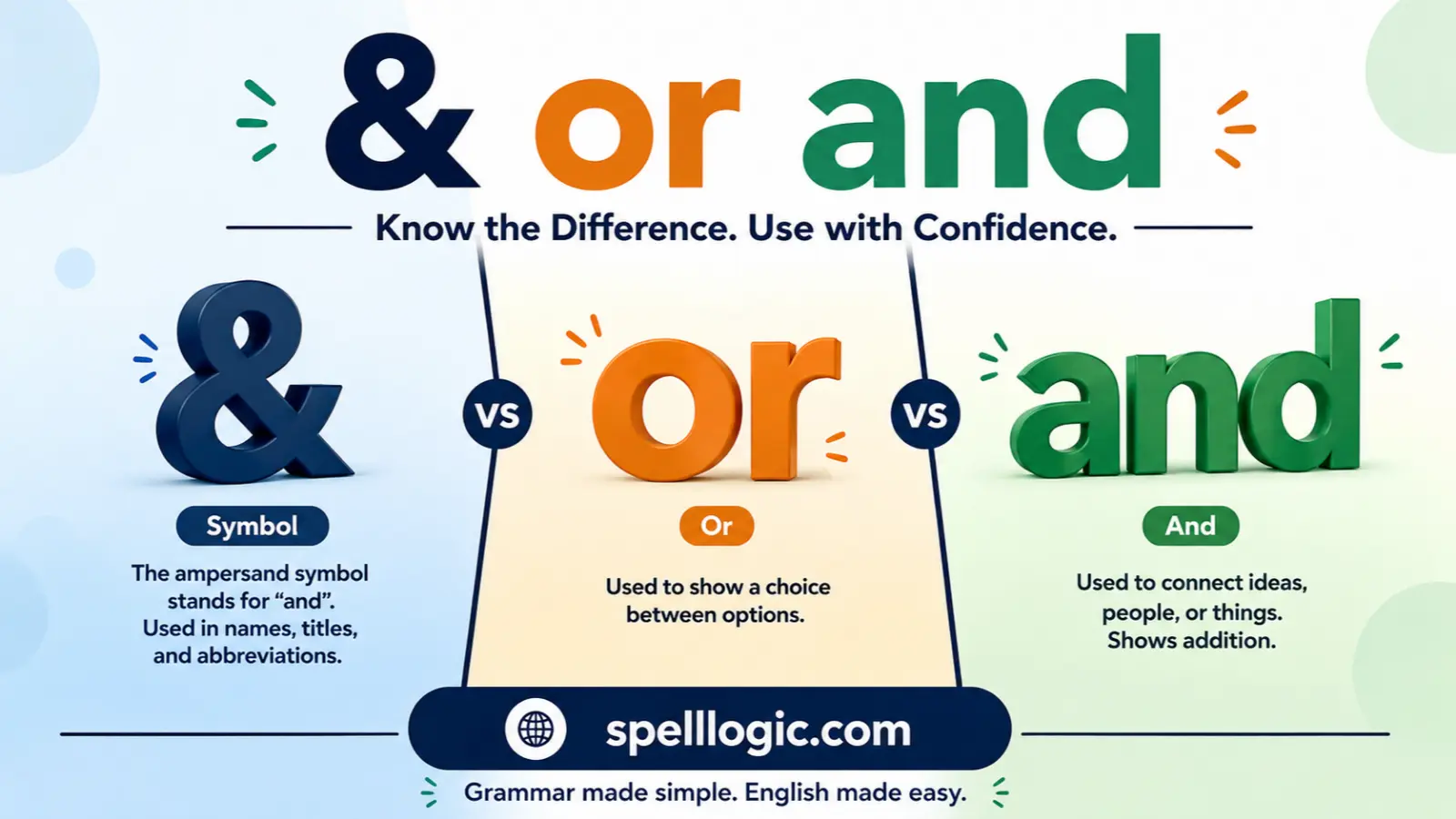
The simplest way to understand & or and is to remember that they usually express the same connecting idea, but they belong to different writing contexts.
Simple explanation: and is a normal English conjunction used in sentences; & is a symbol, called an ampersand, that commonly appears in names, headings, labels, and informal or space-limited writing.
One-line distinction: Use and in ordinary sentences; use & mainly when the style, name, design, or context specifically calls for it.
Example sentences:
- Maria and Ahmed prepared the report together.
- The store sells Books & Gifts.
In the first sentence, and fits normal sentence writing. In the second, the ampersand may be part of a business or sign style.
A useful rule for & or and is: if you are writing a normal sentence and there is no special reason to use a symbol, choose and.
Understanding Homophones in English
The topic of & or and is sometimes mistakenly connected with homophones. However, the two forms are not a typical homophone pair because one is a symbol and the other is the written word representing the same spoken conjunction.
What Are Homophones?
Homophones are words that have the same pronunciation but different meanings or spellings. For example, “right” and “write” sound alike, but they have different meanings and spellings.
The ampersand is different. When read aloud, & is normally pronounced “and,” so the symbol represents the spoken word rather than forming a separate homophone with it.
Why Homophones Cause Confusion
Homophones can confuse learners because sound alone does not reveal which spelling is correct. For example, someone may hear “write” and need context to decide whether the speaker means the verb “write” or the adjective “right.”
With & or and, the main issue is not pronunciation but writing style. Writers must decide whether a symbol or a full word is appropriate for the context.
What Does “&” Mean?
Definition and Core Meaning
The ampersand (&) is a typographic symbol meaning “and.” It connects two related words, names, phrases, or items.
The symbol is especially common when saving space or following an established name or design style is important.
Origin and Historical Use
The & or and distinction has a long history in written English and developed from a joined form of the Latin word et, meaning “and.” Over time, the letters were written together in a way that evolved into the modern & symbol.
The name “ampersand” itself developed from a phrase used when the symbol was traditionally recited as part of the alphabet.
Modern Usage and Synonyms
The & or and symbol has several modern uses:
- Business and organization names: “Barnes & Noble”
- Titles and headings: “Health & Safety”
- Forms and labels where space is limited
- Design and advertising
- Informal notes and messages
- Established names that officially contain the symbol
In terms of meaning, & can be understood as “and,” “together with,” or “along with,” depending on context. However, it is not normally a synonym that should replace the word and everywhere.
Example Sentences
- The sign says “Food & Drinks.”
- The company is called Johnson & Sons.
- Please bring your ID & ticket.
The third example can be acceptable in a short informal message, but “ID and ticket” is usually better in standard prose.
What Does “and” Mean?
Definition and Core Meaning
And is a coordinating conjunction used to connect words, phrases, clauses, or ideas. It can show addition, combination, sequence, or a relationship between two or more elements.
For English learners, and is one of the most important conjunctions because it appears constantly in speech and writing.
Origin and Historical Context
The word and is very old. It comes from Old English and related Germanic forms that expressed the idea of addition or connection. Its basic function has remained remarkably stable throughout the history of English.
Modern Usage and Synonyms
Today, and is used across nearly every type of English writing and speaking.
- Connects two nouns: “Ali and Sara”
- Connects adjectives: “simple and useful”
- Connects verbs: “read and write”
- Connects clauses: “I called, and she answered.”
- Adds another idea: “He studied and passed the test.”
- Shows a combination: “salt and pepper”
Depending on the sentence, related expressions can include “as well as,” “along with,” or “together with.” However, these alternatives do not always have exactly the same grammatical effect.
Example Sentences
- Tom and Lisa work together.
- I bought bread and milk.
- She opened the door and walked inside.
- The lesson is short and easy to understand.
For ordinary sentences, and is usually the safest and most natural choice.
& or and: Key Differences at a Glance
The main difference in & or and is not usually meaning. Instead, it is usage, style, and context.
| Word | Part of Speech | Meaning | Example Context |
|---|---|---|---|
| & | Symbol / typographic mark | and | Business names, signs, headings, labels |
| and | Coordinating conjunction | Connects words, phrases, or clauses | Everyday and formal sentences |
The table shows why and is more flexible. It is a grammatical word that functions inside sentence structure. The ampersand is a visual symbol that represents the same basic connecting idea but is governed more by style and convention.
How to Remember the Difference Between & and and
When learning & or and, use a simple memory rule: “Sentences use and; special styles may use &.”
Easy memory tricks
- and = everyday writing
- & = compact or styled writing
- If you are writing an essay, report, email, or formal paragraph, choose and unless a specific name requires &.
- If you are copying an official business name, keep its official spelling.
Association techniques
Think of & as a shortcut sign. It takes less space and looks more visual. Think of and as the full grammatical word that belongs naturally inside a sentence.
Another useful association is:
Sentence → and
Sign or name → &
One memorable example
Imagine two people opening a shop. In a sentence, you might write:
“Emma and Noah opened a shop.”
On the shop sign, the business might be called:
“Emma & Noah.”
The people are the same, but the writing context changes.
Common Mistakes and Confusions
Understanding & or and becomes easier when you recognize the most common errors.
Mistake 1: Using & in every sentence
✘ Wrong style: “I like tea & I drink it every morning.”
✔ Better: “I like tea and I drink it every morning.”
Explanation: The ampersand is unnecessary in ordinary prose. The full word and is more natural.
Mistake 2: Changing an official name
✘ “Johnson and Johnson” when reproducing the company’s official stylized name.
✔ “Johnson & Johnson”
Explanation: Proper names should normally be written according to their official form. A symbol may be an important part of a brand name.
Mistake 3: Assuming & is always informal
The & or and choice is not automatically incorrect or informal. It can be perfectly appropriate in an established organization name, title, label, or heading. The key is context.
Mistake 4: Using & in academic writing without a reason
✘ “The study examined age & gender.”
✔ “The study examined age and gender.”
Explanation: Academic prose generally favors complete words and clear grammatical structure.
Mistake 5: Thinking the two forms have completely different meanings
They normally communicate the same basic idea of connection. The important difference is how and where they are written.
Examples Section: Correct and Incorrect Usage
Example 1
✔ Correct: “David and Maria went to the library.”
✘ Incorrect: “David & Maria went to the library.”
Why? The first version is the standard choice for an ordinary sentence.
Example 2
✔ Correct: “The company name is Smith & Brown.”
✘ Incorrect: “The company name is Smith and Brown.”
Why? If Smith & Brown is the company’s official name, changing the symbol can make the name inaccurate.
Example 3
✔ Correct: “The course covers reading and writing.”
✘ Incorrect: “The course covers reading & writing.”
Why? Formal educational prose normally uses the full conjunction.
Example 4
✔ Correct: “The sign reads ‘Coffee & Snacks.’”
✘ Incorrect: “The sign reads ‘Coffee and Snacks’” when the actual sign specifically uses &.
Why? In a quotation or reproduction of a visual name or sign, preserve the original form when accuracy matters.
Example 5
✔ Correct: “Bring your notebook and pen.”
✘ Incorrect: “Bring your notebook & pen.”
Why? The full word is preferable in standard instructions unless the context is deliberately abbreviated.
Self Assessment: Test Your Knowledge
Fill in each blank with & or and.
- Sarah ___ Michael are classmates.
- The store sign says “Flowers ___ Gifts.”
- The report discusses education ___ technology.
- The organization’s official name is “Health ___ Care Foundation.”
Think about whether each blank appears in an ordinary sentence or an established name or sign.
Self Assessment Answers
- and — “Sarah and Michael are classmates.” This is an ordinary sentence.
- & — “Flowers & Gifts.” The symbol works naturally in a sign or compact label.
- and — “The report discusses education and technology.” This is standard prose.
- & — “Health & Care Foundation,” if that is the organization’s official name.
The answers demonstrate the central rule of & or and: grammar usually favors and, while names and designed text may use &.
FAQs
Is “&” the same as “and”?
Yes, the ampersand generally represents the word “and.” However, the two forms are used differently in writing.
Should I use “&” in formal writing?
Usually, no. In essays, reports, academic writing, and most professional sentences, and is the better choice unless a proper name or specific style requires &.
Is “&” a word or a symbol?
& is a symbol called an ampersand. It represents the conjunction and.
Can I use “&” in business names?
Yes. Many business and organization names officially use an ampersand. When writing such a name, preserve its official form.
Is “&” informal?
Not always. It is common in branding, headings, signs, and official names. Its appropriateness depends on context rather than being simply formal or informal.
Is “and” always better than “&”?
No. And is usually better in ordinary sentences, but & can be the correct choice in an official name, heading, label, or design.
Are “&” and “and” homophones?
Not exactly. & is a symbol that is normally read as “and.” The confusion is mainly about written form and context, not different words with different meanings.
Final Conclusion: Using “& or and” Correctly
Choosing between & or and is mostly a matter of context. The two forms usually express the same basic idea of connecting two or more things, but they do not serve exactly the same purpose in writing. And is the standard English conjunction, so it belongs naturally in everyday sentences, formal writing, academic work, reports, instructions, and most professional prose. The & or and symbol, &, is a typographic mark that represents “and” and is especially common in business names, organization names, signs, headings, labels, advertising, and space-limited designs.
A simple memory trick is “sentences use and; names and signs may use &.” When you are unsure, write the full word and. If you are reproducing an official name or a specific design, check whether the original uses & and keep it unchanged. Also remember that the issue is not really about pronunciation: the symbol is normally read aloud as “and.” With regular practice, & or and becomes an easy choice rather than a confusing grammar point. Keep reading authentic English, notice how professional writers use each form, and trust the context. Small distinctions like this can make your English clearer, more accurate, and more natural.