English learners often wonder whether some should be followed by a singular or plural noun. This question becomes confusing because some can be used with plural countable nouns as well as uncountable nouns. In everyday English, the correct choice depends on the type of noun that follows it, not simply on the word some itself.
Understanding this rule can help you write more natural sentences and avoid common grammar mistakes. In this guide, we explain some singular or plural usage in simple English, with clear rules, examples, memory tips, exercises, and answers. By the end, you will know exactly when to use some correctly.
Why “some singular or plural” Is Confusing
The question some singular or plural is common because learners sometimes think that some automatically means that the noun after it must be plural. That is only partly true.
Similar Pronunciation
There is no special pronunciation problem between some and singular or plural forms. However, learners may hear some in fast speech and focus more on the quantity than on the noun that follows it.
Similar Spelling
The spelling of some does not change when it is used with different nouns. This can make learners think that its grammar must also remain the same in every situation.
Context Confusion
The main difficulty is that some works with different types of nouns.
For example:
- some books
- some water
- some information
- some rice
Books is a plural countable noun, while water, information, and rice are uncountable nouns.
Common Learner Mistakes
Learners often make mistakes such as:
- ❌ some book when they mean several books
- ❌ some informations
- ❌ some waters
- ❌ some apple when they mean several apples
The correct form depends on whether the noun is countable or uncountable and, in some contexts, whether a singular noun has a special meaning.
“Some” and Singular or Plural Nouns Explained Simply
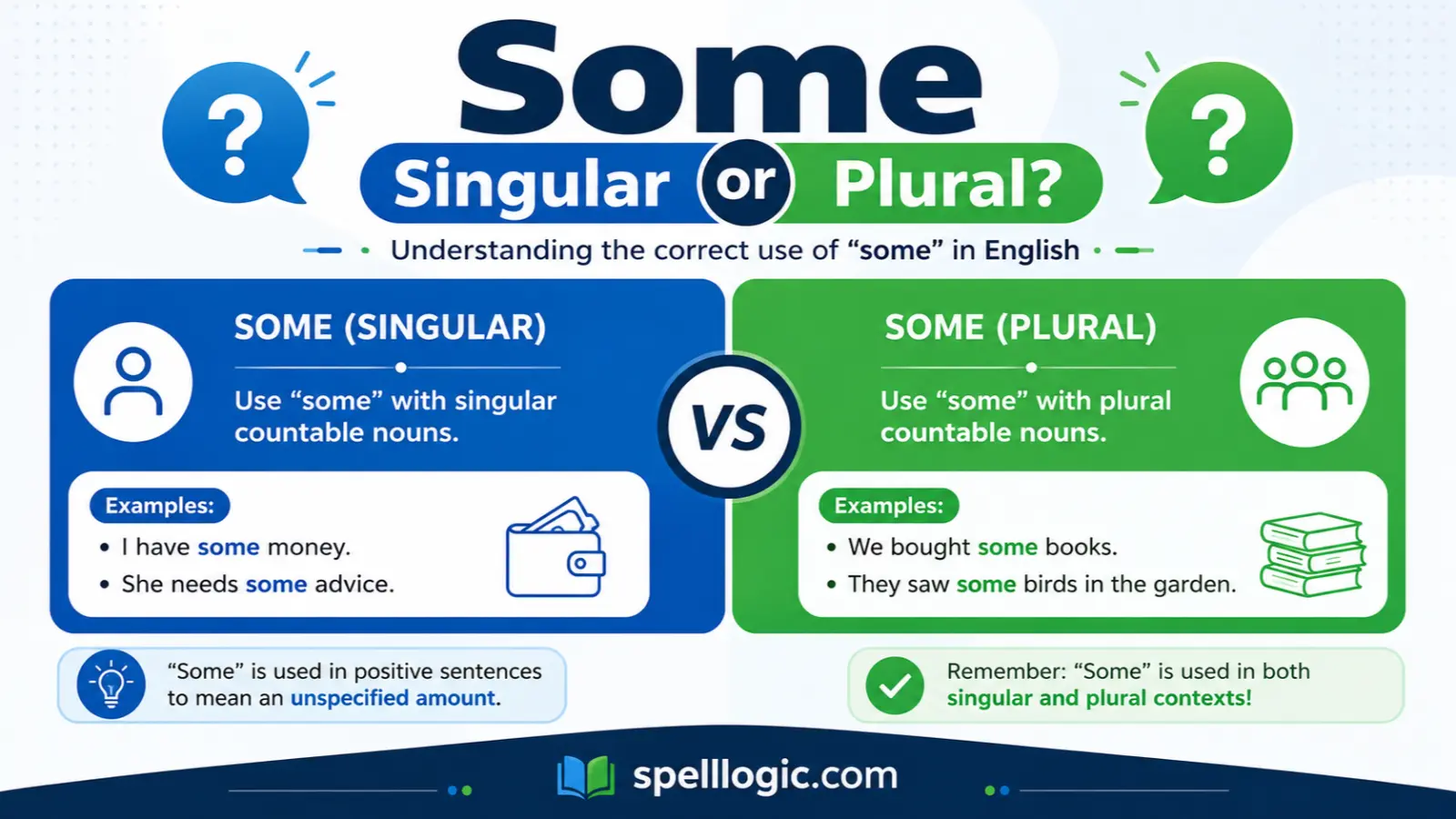
The easiest way to understand some singular or plural is to remember that some usually comes before plural countable nouns or uncountable nouns.
Simple explanation: Use some with more than one countable thing or with an amount of an uncountable thing.
One-line distinction: Some normally goes with plural countable nouns and uncountable nouns, not ordinary singular countable nouns.
Examples
- I bought some apples from the market.
- We need some water before we leave.
So, some can be followed by a plural countable noun or an uncountable noun. The important point is the noun type.
A singular countable noun normally needs another determiner:
- a book
- one book
- this book
- my book
- some book
The last example is grammatically possible, but it has a special meaning. It usually means an unspecified or unknown individual rather than several books.
Understanding Homophones in English
The question some singular or plural is about grammar and noun number, not homophones. Still, understanding homophones can help English learners distinguish different kinds of language confusion.
What Are Homophones?
Homophones are words that sound the same or nearly the same but have different meanings, spellings, or grammatical functions.
For example:
- right — correct
- write — to form words with a pen or keyboard
These words sound alike but have different meanings.
Why Homophones Cause Confusion
Homophones can cause mistakes because learners may choose a word based only on sound. For example, someone may write write when they mean right.
However, some does not have a homophone that creates the same kind of grammar issue. The challenge here is understanding noun number and countability.
What Does “Some” Mean?
Definition and Core Meaning
Some is a determiner, pronoun, or adjective-like quantifying word used to refer to an unspecified amount or number.
It often means an amount or number that is not exact.
Examples include:
- I need some sugar.
- She bought some flowers.
- We received some advice.
- There are some students outside.
Origin and Historical Use
The word some has a long history in English. It developed from older Germanic forms and has been used for an indefinite quantity or number for centuries. Its basic idea has remained quite stable: it refers to an amount or number that is not specifically identified.
Modern Usage and Synonyms
In modern English, some is extremely common in both speaking and writing.
Depending on context, related expressions include:
- a few
- several
- a certain amount of
- an unspecified amount of
- a number of
- part of
These expressions are not always exact synonyms. For example, a few normally refers to a small number of countable things, while some has a wider range of uses.
Important Grammar Points
- Use some with plural countable nouns: some chairs.
- Use some with uncountable nouns: some milk.
- Use some in offers and requests: Would you like some tea?
- Use some when the exact quantity is unknown or unimportant.
Example Sentences
- I have some questions.
- She needs some help.
- We bought some vegetables.
- He gave me some useful advice.
- Would you like some coffee?
What Does Singular or Plural Mean?
Definition and Core Meaning
Singular means one person, animal, object, place, or idea. Plural means more than one.
Examples:
- one book → singular
- two books → plural
- one child → singular
- three children → plural
When discussing some singular or plural, the important distinction is whether the noun is countable and whether it represents one or more than one item.
Origin and Historical Context
The terms singular and plural come from Latin. Singularis referred to something individual or single, while pluralis referred to more than one. English grammar adopted these terms to describe grammatical number.
Modern Usage and Synonyms
In grammar, related terms include:
- singular noun
- plural noun
- countable noun
- uncountable noun
- grammatical number
- singular form
- plural form
Examples of Singular and Plural Nouns
- cat → cats
- car → cars
- student → students
- apple → apples
- child → children
- person → people
Not every noun forms its plural by simply adding -s. For example, child becomes children, and person commonly becomes people.
Example Sentences
- The student is reading.
- The students are reading.
- One apple is on the table.
- Some apples are on the table.
- Some water is in the glass.
Some Singular or Plural: Key Differences at a Glance
The clearest way to understand some singular or plural is to compare the grammatical situations in which some appears.
| Word | Part of Speech | Meaning | Example Context |
|---|---|---|---|
| some | Determiner | An unspecified number or amount | some books |
| some | Determiner | An unspecified amount of an uncountable noun | some water |
| singular | Noun/adjective in grammar | One item or entity | one book |
| plural | Noun/adjective in grammar | More than one item or entity | three books |
A useful rule is:
Some + plural countable noun
- some books
- some cars
- some teachers
Some + uncountable noun
- some information
- some money
- some furniture
The pattern some + singular countable noun is possible only in particular contexts. It does not normally mean “more than one.”
For example:
Some person called you earlier.
Here, some person means an unspecified person. It does not mean several people.
Another example is:
Some day, I will visit Japan.
Here, some day means an unspecified day in the future.
How to Remember the Difference Between Some Singular or Plural
Learning some singular or plural becomes easier when you use a simple memory rule.
Memory Trick 1: Think “More Than One”
When you have a countable noun and mean an unspecified number greater than one, use:
some + plural noun
- some books
- some pens
- some houses
Memory Trick 2: Think “Amount”
When the noun cannot normally be counted individually, use:
some + uncountable noun
- some water
- some rice
- some advice
- some information
Memory Trick 3: Check the Noun
Before using some, ask:
“Can I count this noun as individual items?”
If yes, and you mean more than one, use the plural form.
If no, use the uncountable form.
Association Technique
Connect some with the idea of “an unknown quantity.”
For countable nouns:
some + plural
For uncountable nouns:
some + uncountable noun
One Memorable Example
Remember this sentence:
I bought some apples and some milk.
Apples are individual items, so the noun is plural. Milk is an uncountable substance, so it remains in its basic form.
Common Mistakes and Confusions
One major source of errors is assuming that some always requires a plural noun.
Mistake 1
✘ I bought some apple.
If you mean several apples, this is incorrect.
✔ I bought some apples.
However, some apple can be correct when referring to an unspecified amount of apple as food:
Would you like some apple?
This usage is less common in some varieties of English than some apple slices, but the grammatical idea is possible.
Mistake 2
✘ She gave me some informations.
✔ She gave me some information.
Information is normally uncountable in standard English. Do not add -s to it.
Mistake 3
✘ We need some furnitures.
✔ We need some furniture.
Furniture is also normally uncountable.
Mistake 4
✘ He bought some book yesterday.
If he bought several books, the sentence should be:
✔ He bought some books yesterday.
But some book can be correct when the speaker means an unspecified particular book:
Some book was left on my desk.
Mistake 5
✘ There is some students outside.
✔ There are some students outside.
Because students is plural, the verb should also be plural.
This shows that choosing the noun form is only part of the process. Subject-verb agreement matters too.
Examples Section: Correct and Incorrect Usage
Example 1
✔ Correct: I need some water.
✘ Incorrect: I need some waters.
Explanation: In its ordinary meaning, water is uncountable.
Example 2
✔ Correct: She bought some oranges.
✘ Incorrect: She bought some orange.
Explanation: If she bought several whole oranges, oranges must be plural.
Example 3
✔ Correct: We received some information.
✘ Incorrect: We received some informations.
Explanation: Information is normally uncountable in standard English.
Example 4
✔ Correct: Some students are waiting outside.
✘ Incorrect: Some student are waiting outside.
Explanation: Students is plural, so the noun and verb must agree.
Example 5
✔ Correct: Some person left a message for you.
✘ Incorrect: Some people left a message for you.
Explanation: Both sentences can be grammatically correct, but they have different meanings. The first refers to one unspecified person; the second refers to more than one person.
Example 6
✔ Correct: Would you like some tea?
✘ Incorrect: Would you like some teas?
Explanation: When tea refers to the drink as a substance, it is normally uncountable.
Self Assessment: Test Your Knowledge
Fill in each blank with the correct form.
- I bought some ______ at the supermarket.
(apple / apples) - We need some ______ before the meeting.
(information / informations) - There are some ______ in the garden.
(flower / flowers) - Would you like some ______?
(water / waters)
Self Assessment Answers
- apples — The sentence refers to more than one countable fruit.
- information — Information is normally an uncountable noun.
- flowers — Flowers are countable and the sentence refers to more than one.
- water — Water is normally uncountable.
FAQs
1. Is some singular or plural?
Some itself is not simply singular or plural. It is used with plural countable nouns and uncountable nouns. The noun following it determines the grammatical number.
2. Can some be used with a singular noun?
Yes. Some can occur before a singular countable noun when it means an unspecified or unknown person or thing.
Example:
Some man called while you were away.
This means one unknown man, not several men.
3. Is some apples singular or plural?
Some apples is plural because apples is the plural form of apple.
4. Should I say some information or some informations?
Use some information. In standard English, information is an uncountable noun and normally does not take -s.
5. Is some water singular or plural?
Water is normally uncountable. Therefore, we say some water, not some waters, when referring to the substance or drink.
6. Can some be used with uncountable nouns?
Yes. This is one of its most common uses.
Examples include:
- some money
- some advice
- some knowledge
- some rice
- some furniture
7. What is the easiest rule to remember?
Remember:
Some + plural countable noun or some + uncountable noun.
If some refers to one unspecified countable person or thing, a singular noun can sometimes follow it, but this has a special meaning.
Final Conclusion: Using Some Singular or Plural Correctly
Understanding some singular or plural is easier when you focus on the noun rather than the word some alone. In normal usage, some works with plural countable nouns such as some books, some students, and some apples. It also works with uncountable nouns such as some water, some information, and some furniture. Therefore, the basic rule is not that some is always singular or always plural. Instead, its grammatical behavior depends on the noun that follows it.
A singular countable noun can also follow some in special expressions such as some person, where the meaning is “an unspecified person.” When you are unsure, first identify whether the noun is countable or uncountable. If it is countable and you mean more than one, use the plural form. If it is uncountable, keep the noun in its standard uncountable form. With regular practice, these patterns will become natural. Keep checking your examples, notice how native speakers use the structure, and remember that understanding the noun is the key to using some confidently and correctly.