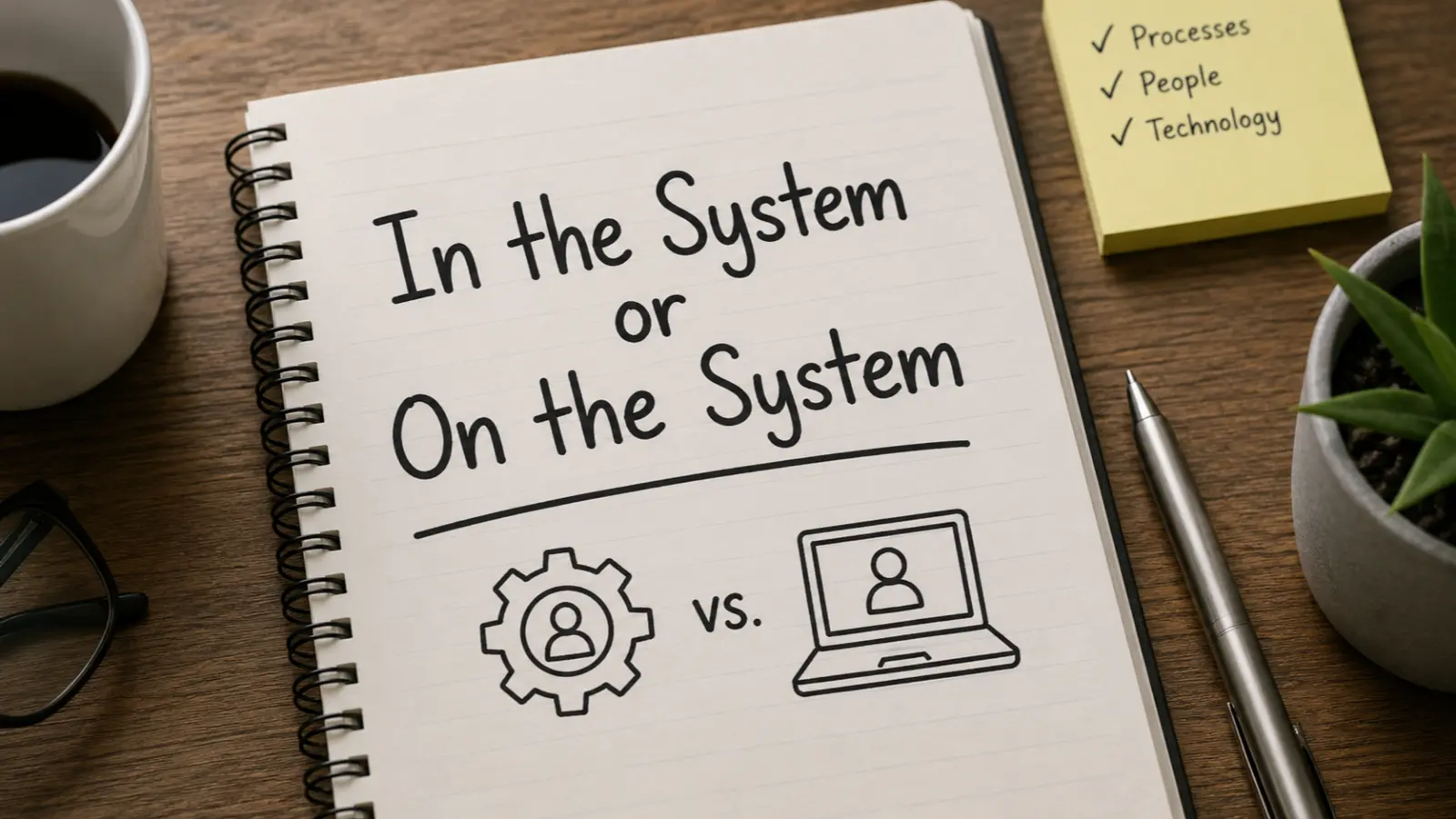
English learners often wonder whether to say “in the system” or “on the system” when talking about computers, software, databases, websites, or organizational processes. Both expressions are grammatically correct, but they are not always interchangeable. The correct choice depends on what you mean and how you view the system.
If something exists inside a system, “in the system” is usually appropriate. If you mean that something is available through, connected to, or operating on a computer or platform, “on the system” may be better. Understanding this small difference can make your English sound more natural and precise.
Why “In the System” and “On the System” Are Confusing
The expressions “in the system” and “on the system” are confusing because both can describe something related to a computer system, software platform, database, or organized process.
Similar Pronunciation
The words in and on are both short and commonly used prepositions. Because they frequently appear in sentences about technology, learners may choose one automatically without considering the intended meaning.
For example, a learner may hear:
- “Your information is in the system.”
- “The application is on the system.”
Both sentences sound natural, but they describe different relationships.
Similar Spelling
The expressions have almost identical structures. Only the preposition changes:
- in + the + system
- on + the + system
This small difference can create uncertainty, especially for learners who are still developing their understanding of English prepositions.
Context Confusion
The biggest problem is context.
Common Learner Mistakes
A common mistake is believing that one expression is always correct. In reality, both expressions can be correct.
Another mistake is translating directly from another language. English prepositions often do not match prepositions used in other languages, so learners should understand the relationship rather than translate word for word.
“In the System” vs “On the System” Explained Simply
One-Line Distinction
In = contained or recorded inside the system.
On = operating, installed, or available through the system.
Example Sentences
- Your employee information is in the system.
- The new software is on the system.
The first sentence focuses on stored information. The second focuses on software operating within a technological environment.
Understanding Homophones in English
Although learners sometimes associate these expressions with pronunciation problems, “in” and “on” are not homophones. They have different sounds and meanings.
What Are Homophones?
Homophones are words that sound the same or nearly the same but have different meanings, spellings, or both.
For example:
- right — correct
- write — to put words on paper
“In” and “on” do not belong to this category because they are pronounced differently.
Why Homophones Cause Confusion
Homophones can cause confusion because listeners may hear the same sound while needing to determine the meaning from context. Preposition confusion is slightly different. With in and on, learners must understand the relationship between an object and the place or system being discussed.
For example, “The information is in the database” describes stored content, while “The application is on the server” describes software operating through a technological environment.
What Does “In the System” Mean?
Definition and Core Meaning
“In the system” is used when something is contained, recorded, stored, included, or recognized within a system.
The word in often presents a system as a kind of container. The thing being discussed exists within its boundaries.
This is especially common when talking about:
- Information
- Records
- Customer details
- Employee data
- Orders
- Applications
- Requests
- Accounts
- Procedures
- Rules
- Databases
For example, if a receptionist says, “Your appointment is in the system,” the meaning is that the appointment has been entered and recorded in the relevant database or software.
Origin and Historical Use
The preposition in comes from Old English and has a long history of expressing location or position within something. Over time, its meaning expanded beyond physical spaces.
Today, English speakers use in for abstract environments as well as physical containers. A person can be in a company, in a program, in a database, or in a system.
Modern Usage and Synonyms
In modern English, this expression is especially common in workplaces, customer service, administration, healthcare, education, and information technology.
Depending on the context, similar expressions include:
- recorded in the system
- stored in the database
- entered in the system
- included in the records
- listed in the database
- registered in the system
- saved in the software
Example Sentences
- Your payment information is in the system.
- I checked, and your application is already in the system.
- The customer’s address is in the system.
- Her name is in the employee database.
- The order should be in the system by now.
- The request has been entered in the system.
In each example, the focus is on information or an item being contained, recorded, or recognized within an organized structure.
What Does “On the System” Mean?
Definition and Core Meaning
“On the system” is generally used when referring to something that operates, runs, is installed, or is available on a computer, network, platform, or technological environment.
Here, on emphasizes the technological platform or equipment being used.
For example:
The new application is on the system.
This suggests that the application has been installed or is available within the computer environment.
Origin and Historical Context
The preposition on has roots in Old English and traditionally expressed position or contact with a surface. Its modern meaning has expanded considerably.
With technology, English speakers use on for computers, devices, websites, platforms, networks, and digital services.
Consider these familiar expressions:
- on a computer
- on the internet
- on a website
- on the platform
- on the network
- on the server
- on the system
The idea is that a technological environment provides the platform where something operates or becomes accessible.
Modern Usage and Synonyms
In modern workplace and technology-related English, this expression may describe software, programs, applications, files, or processes associated with a computer environment.
Related expressions include:
- running on the system
- installed on the system
- available on the platform
- operating on the network
- hosted on the server
- available on the computer
Example Sentences
- The latest version is on the system.
- The software is already on the system.
- You can access the program on the system.
- The application runs on the system.
- The security update has been installed on the system.
- Several programs are currently running on the system.
The emphasis is generally on the technological environment rather than on information being stored inside a database.
“In the System” vs “On the System”: Key Differences at a Glance
| Word | Part of Speech | Meaning | Example Context |
|---|---|---|---|
| In | Preposition | Inside, contained, recorded, or included | “Your details are in the system.” |
| On | Preposition | Operating, installed, available, or accessed through a platform | “The software is on the system.” |
The important point is that neither preposition is automatically correct in every situation. The noun system can describe different things, so the surrounding context determines the best choice.
If you are talking about a record, entry, account, or piece of information, in is often the natural choice. If you are discussing software, hardware, or an application operating within a technological environment, on can be more appropriate.
There are also situations where both expressions are possible but communicate slightly different ideas.
Compare:
- “The program is in the system.” — The program is considered part of the system or integrated into it.
- “The program is on the system.” — The program is installed or operating on the technological environment.
How to Remember the Difference Between “In the System” and “On the System”
Easy Memory Tricks
Use this simple rule:
IN = information inside.
ON = technology operating.
When you imagine a system as a container, information goes in it.
When you imagine a computer or platform as the environment supporting software, software operates on it.
Association Techniques
Think of these two groups:
Use IN with stored information:
- in the system
- in the database
- in the records
- in the file
Use ON with technological platforms:
- on the computer
- on the server
- on the network
- on the platform
This association is not an absolute grammar rule, but it is a useful guide for everyday English.
One Memorable Example
Imagine an employee management program.
The employee’s address is in the system because it is stored there.
The employee management software is on the system because it operates on the computer environment.
That single picture can help you remember the difference.
Common Mistakes and Confusions
Mistake 1
✘ “Your customer record is on the system.”
✔ “Your customer record is in the system.”
Explanation: The record is stored or recorded within the system, so in is generally more natural.
Mistake 2
✘ “The software is in the computer system” when the intended meaning is simply that it is installed and operating there.
✔ “The software is on the computer system.”
Explanation: When focusing on the technological environment where software operates, on is often preferred.
Mistake 3
✘ “I cannot find your application on the database.”
✔ “I cannot find your application in the database.”
Explanation: A database is treated as a place containing records, so in normally works better.
Mistake 4
✘ “The program runs in the server.”
✔ “The program runs on the server.”
Explanation: English conventionally uses on when describing software operating on a server.
The best preposition therefore depends on the specific noun and meaning, not simply on the word “system.”
Examples Section: Correct and Incorrect Usage
Example 1
✔ Correct: Your application is in the system.
✘ Incorrect: Your application is on the system.
Why? If the meaning is that the application request has been entered or recorded, in is the natural choice.
Example 2
✔ Correct: The new software is on the system.
✘ Incorrect: The new software is in the system.
Why? When referring to software installed or operating on a technological environment, on is usually clearer.
Example 3
✔ Correct: I checked, and your details are in the system.
✘ Incorrect: I checked, and your details are on the system.
Why? Details are stored or recorded, so in fits the meaning.
Example 4
✔ Correct: The application runs on the system.
✘ Incorrect: The application runs in the system.
Why? The sentence focuses on where the application operates, making on more natural in a technology context.
Example 5
✔ Correct: The order has been entered in the system.
✘ Incorrect: The order has been entered on the system.
Why? The order is an entry stored within a system.
Example 6
✔ Correct: Several security tools are installed on the system.
✘ Incorrect: Several security tools are installed in the system.
Why? The sentence emphasizes software installed on a computer or technological environment.
Self Assessment: Test Your Knowledge
Fill in each blank with in or on.
- Your employee record is ___ the system.
- The new software is installed ___ the system.
- I cannot find your order ___ the system.
- The application runs ___ the system.
Self Assessment Answers
- in — The employee record is stored or recorded within the system.
- on — The software is installed on the technological environment.
- in — The order is an entry contained in the system.
- on — The application operates on the system.
A useful shortcut is to ask yourself: Am I talking about stored content, or am I talking about technology operating? That question will often guide you to the correct preposition.
FAQs About “In the System and On the System”
1. Is “in the system or on the system” correct?
Yes. Both expressions can be correct. The appropriate choice depends on whether you mean something is stored or included within a system or whether it operates on a technological environment.
2. Should I say “information in the system”?
Yes. “Information in the system” is natural when you mean information that has been stored, recorded, or entered into a system.
3. Should I say “software on the system”?
Yes. “Software on the system” is commonly used when referring to software installed or operating on a computer or technological environment.
4. Is “in the system” used only for computers?
No. A system can be technological, administrative, organizational, or procedural. For example, someone can say that a process is in the system when it has been incorporated into an organizational structure.
5. Can “on the system” refer to information?
Sometimes, depending on the context and variety of English. However, when the intended meaning is that information has been recorded or stored, in the system is generally the clearer choice.
6. What is the easiest way to remember the difference?
Think in = contained and on = operating on a platform. Information is commonly in a system, while software commonly operates on a system.
7. Are these expressions interchangeable?
Not always. Replacing in with on can change the meaning or make a sentence sound unnatural. Always consider whether you are describing stored content, system membership, software operation, or access through a platform.
Final Conclusion: Using “In the System” and “On the System” Correctly
Understanding “in the system” and “on the system” becomes much easier when you focus on the relationship between the object and the system. In generally suggests that something is contained, recorded, stored, or included within a system. For example, a customer’s details, an order, or an employee record can be in the system. On, by contrast, often describes software, applications, or other technology that is installed, operating, or available through a computer or technological platform. For example, a program can be on the system.
Remember the simple association: IN means contained; ON means operating on a platform. This is not an absolute rule for every possible use of the word “system,” but it provides a reliable starting point for everyday English. Also, pay attention to context because some expressions can have more than one acceptable interpretation.
As you encounter these phrases in emails, workplace conversations, technical instructions, and online communication, look at what the sentence is actually describing. Is it information stored within a structure, or software operating through technology? Once you ask that question, choosing the right preposition becomes much more natural. Keep practicing with real examples, and you will gradually use these expressions confidently and accurately.