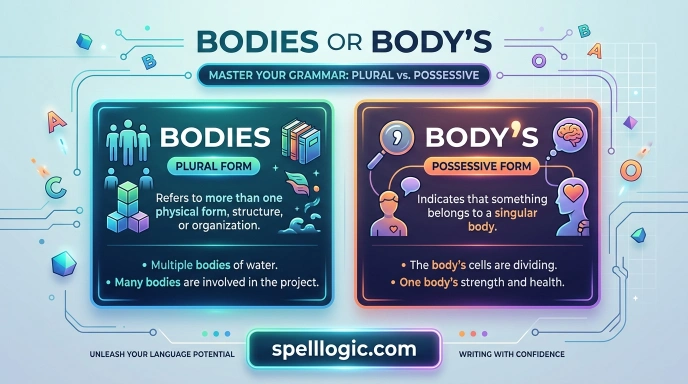
English learners often wonder whether bodies or body’s is the correct spelling because the two forms can sound very similar in everyday speech. However, they have completely different grammatical jobs. Bodies is the plural form of the noun “body,” while body’s is the possessive form of the singular noun “body.”
The apostrophe in body’s is important because it shows ownership, connection, or association. Understanding this small spelling difference can help you avoid common grammar mistakes in emails, essays, reports, and everyday writing. Once you learn what the apostrophe does, choosing between bodies or body’s becomes much easier.
Why “bodies or body’s” Are Confusing
The confusion surrounding bodies or body’s usually comes from their similar pronunciation and nearly identical spelling. Both forms contain the letters “body,” so learners may assume that the apostrophe is optional. It is not.
Similar Pronunciation
In many varieties of English, bodies and body’s can sound the same or extremely similar. This makes the difference difficult to notice when someone speaks.
For example:
- “The bodies were examined.”
- “The body’s temperature changed.”
When spoken, the distinction may not be obvious. Writing, however, requires you to select the correct grammatical form.
Similar Spelling
The words bodies and body’s share the base word “body.” The only visible difference is the apostrophe and the final letter pattern.
This small difference carries a major grammatical meaning.
Context Confusion
Context helps determine whether you are talking about more than one body or something belonging to one body. This is the key to understanding bodies or body’s.
- Bodies = more than one body.
- Body’s = something belonging to or connected with one body.
Common Learner Mistakes
Learners sometimes use an apostrophe to make a noun plural. This is incorrect. Apostrophes normally do not create ordinary plurals.
For example:
- Incorrect: “Many body’s were discovered.”
- Correct: “Many bodies were discovered.”
Another common mistake is leaving out the apostrophe when showing possession:
- Incorrect: “The bodies temperature changed.”
- Correct: “The body’s temperature changed.”
“bodies or body’s” Explained Simply
The easiest way to understand bodies or body’s is to focus on number and possession.
Bodies is the plural form of “body.” It refers to two or more bodies.
Body’s is the possessive form of “body.” It normally refers to something belonging to, associated with, or connected to one body.
One-Line Distinction
Bodies means more than one body, while body’s means belonging to or associated with one body.
Examples
- “The researchers studied several bodies.”
- “The body’s temperature remained stable.”
So, when choosing between bodies or body’s, ask yourself whether you mean multiple bodies or something connected to one body.
Understanding Homophones in English
Words that sound alike can create spelling problems even when their grammatical functions differ. The distinction between bodies or body’s is a useful example of how pronunciation alone cannot always tell you which written form to choose.
What Are Homophones?
Homophones are words that have the same or nearly the same pronunciation but different meanings, spellings, or grammatical functions.
For example, “flower” and “flour” sound alike but have different meanings.
The forms in bodies or body’s can create a similar listening problem because their spoken forms may be difficult to distinguish.
Why Homophones Cause Confusion
When two forms sound alike, writers may choose a spelling based on pronunciation instead of grammar. That strategy can lead to errors.
For instance, hearing “body’s surface” does not tell you visually whether the writer understands possession. You must know that the apostrophe marks the relationship between the singular noun and what follows it.
What Does “Bodies” Mean?
Definition and Core Meaning
Bodies is the plural form of the noun “body.” It means two or more physical bodies, organisms, groups, or organized entities, depending on context.
The word can describe people, animals, physical objects, celestial objects, groups, or organizations.
Examples include:
- “The human bodies were carefully examined.”
- “Several celestial bodies were visible.”
- “Government bodies approved the proposal.”
- “The bodies of water are connected.”
The plural ending changes “body” to “bodies” because nouns ending in consonant + y commonly change y to ies when made plural.
Origin and Historical Use
The word “body” comes from Old English bodig, referring to the physical structure of a person or animal. Over time, its meaning expanded beyond physical anatomy.
Today, “body” can refer to a physical form, a group, a mass, or an organized institution. Its plural form is bodies.
Modern Usage and Synonyms
Depending on the context, possible synonyms for bodies include:
- physical forms
- persons
- corpses
- organisms
- groups
- organizations
- institutions
- entities
However, these alternatives are not interchangeable in every sentence.
For example, “government bodies” means government organizations, not physical human bodies.
More Example Sentences
- “The divers recovered two bodies from the water.”
- “Several government bodies participated in the project.”
- “Scientists observe distant celestial bodies.”
- “The athletes moved their bodies carefully.”
- “These professional bodies publish industry guidelines.”
Understanding the plural meaning is essential when deciding between bodies or body’s.
What Does “Body’s” Mean?
Definition and Core Meaning
Body’s is the possessive form of the singular noun “body.” It usually means “belonging to one body” or “associated with one body.”
The apostrophe followed by s indicates possession or a close relationship.
For example:
- “The body’s temperature increased.”
- “The body’s natural response was important.”
- “The body’s position changed.”
In each example, one body is being discussed, and the following noun is connected to it.
Origin and Historical Context
The possessive apostrophe developed as a written way to indicate relationships between nouns. In modern English, singular nouns commonly form the possessive by adding ’s.
Thus:
- body → body’s
- student → student’s
- teacher → teacher’s
- animal → animal’s
This grammatical pattern makes body’s different from the plural bodies.
Modern Usage and Synonyms
There is no direct synonym for the possessive ending itself. You can sometimes rewrite the sentence using of the body.
For example:
- “The body’s temperature” = “the temperature of the body.”
- “The body’s movement” = “the movement of the body.”
The possessive form is usually shorter and more natural.
More Example Sentences
- “The body’s immune response protects against infection.”
- “The body’s structure varies among species.”
- “The body’s movement was difficult to observe.”
- “The body’s position affected the measurement.”
- “The body’s surface was covered with protective tissue.”
These examples show why bodies or body’s cannot be treated as interchangeable spellings.
“bodies or body’s”: Key Differences at a Glance
| Word | Part of Speech | Meaning | Example Context |
|---|---|---|---|
| Bodies | Plural noun | Two or more bodies | “The bodies were examined.” |
| Body’s | Possessive singular noun | Belonging to or associated with one body | “The body’s temperature changed.” |
The simplest rule for bodies or body’s is to check whether the noun represents more than one or shows possession/association.
If you can replace the word with “more than one body,” use bodies. If you can replace it with “of the body,” use body’s.
How to Remember the Difference Between Bodies and Body’s
Remembering bodies or body’s becomes easier when you connect each form with a simple grammatical clue.
Easy Memory Tricks
Bodies = many
Think of the -ies ending as the plural signal.
- one body
- two bodies
- many bodies
Body’s = belongs to one
The apostrophe in body’s signals possession or association.
- the body’s temperature
- the body’s shape
- the body’s movement
Association Technique
Use this quick test:
Can I say “many”?
If yes, choose bodies.
Many bodies were present.
Can I say “of the body”?
If yes, choose body’s.
The temperature of the body → The body’s temperature.
One Memorable Example
Think of this sentence:
“The bodies were examined, and each body’s condition was recorded.”
The first form refers to several bodies. The second describes something belonging to each individual body.
This single sentence provides a useful way to remember bodies or body’s.
Common Mistakes and Confusions
One of the biggest problems with bodies or body’s is using an apostrophe simply because the writer wants to make the noun plural.
Mistake 1: Using an Apostrophe for a Plural
✘ “Several body’s were found.”
✔ “Several bodies were found.”
Explanation: “Several” requires a plural noun. No apostrophe is needed.
Mistake 2: Omitting the Possessive Apostrophe
✘ “The body temperature changed.”
✔ “The body’s temperature changed.”
Explanation: The first sentence can sometimes be acceptable when “body temperature” is being used as a compound noun. However, when you specifically mean the temperature belonging to one body, body’s clearly expresses possession.
Mistake 3: Confusing Number With Possession
✘ “The bodies temperature was measured.”
✔ “The body’s temperature was measured.”
Explanation: The sentence refers to one body and its temperature, so the possessive singular form is required.
Mistake 4: Treating Both Forms as Interchangeable
✘ “The body’s were moved to another location.”
✔ “The bodies were moved to another location.”
Explanation: The sentence describes multiple bodies, so the plural form is correct.
These examples make the distinction between bodies or body’s clearer in practical writing.
Examples Section: Correct and Incorrect Usage
Example 1
✔ Correct: “The scientists studied several bodies.”
✘ Incorrect: “The scientists studied several body’s.”
Explanation: “Several” indicates more than one, so the plural bodies is necessary.
Example 2
✔ Correct: “The body’s temperature was recorded.”
✘ Incorrect: “The bodies temperature was recorded.”
Explanation: The temperature belongs to one body, so the possessive body’s is correct.
Example 3
✔ Correct: “Several government bodies issued new guidelines.”
✘ Incorrect: “Several government body’s issued new guidelines.”
Explanation: Here, “bodies” means organizations or institutions. The word is plural, not possessive.
Example 4
✔ Correct: “The body’s natural processes continued normally.”
✘ Incorrect: “The bodies natural processes continued normally.”
Explanation: The sentence describes processes associated with one body, so the apostrophe is necessary.
Example 5
✔ Correct: “The researchers compared the bodies of several animals.”
✘ Incorrect: “The researchers compared the body’s of several animals.”
Explanation: “Bodies” is plural, and the phrase “of several animals” already expresses the relationship.
Example 6
✔ Correct: “The body’s shape changed during the experiment.”
✘ Incorrect: “The bodies shape changed during the experiment.”
Explanation: The apostrophe shows that the shape is associated with one body.
Self Assessment: Test Your Knowledge
Choose bodies or body’s to complete each sentence.
- The doctor examined the patient’s ______ carefully.
- Several government ______ attended the meeting.
- The ______ temperature remained normal.
- Scientists discovered several celestial ______ in the region.
Self Assessment Answers
- body’s — The temperature or condition belongs to one body.
- bodies — The sentence refers to several organizations.
- body’s — The temperature is associated with one body.
- bodies — The sentence refers to multiple celestial objects.
A useful strategy is to identify whether the blank needs a plural noun or a possessive singular noun before selecting bodies or body’s.
FAQs
1. What is the difference between bodies and body’s?
Bodies is the plural of “body,” while body’s is the possessive form of the singular noun “body.”
2. Is “body’s” a plural word?
No. Body’s is not normally plural. Its apostrophe shows possession or association with one body.
3. Is “bodies” correct for more than one body?
Yes. Bodies is the standard plural form of “body.”
4. When should I use body’s?
Use body’s when you mean something belongs to, comes from, or is associated with one body.
For example: “The body’s temperature changed.”
5. Why does body become bodies?
When a noun ends in consonant + y, English commonly changes y to ies to form the plural. Therefore, “body” becomes “bodies.”
6. Can bodies and body’s sound the same?
They can sound very similar, and in some accents they may be difficult to distinguish. This is why grammar and context are important.
7. What is an easy way to choose between them?
Use bodies for “more than one body.” Use body’s when you can replace it with “of the body” or “belonging to the body.”
Final Conclusion: Using “Bodies” and “Body’s” Correctly
Choosing between bodies or body’s becomes simple once you understand the difference between a plural noun and a possessive noun. Bodies means more than one body. It is the ordinary plural form of “body,” and it can refer to people, animals, physical forms, celestial objects, organizations, or other entities depending on context. Body’s, on the other hand, is the possessive form of the singular noun “body.” It shows that something belongs to, comes from, or is associated with one body. The apostrophe is therefore meaningful and should not be treated as an optional spelling mark.
When you are unsure, ask yourself two quick questions. Am I talking about several bodies? If the answer is yes, use bodies. Am I describing something belonging to one body? If yes, use body’s. Remember the simple association: -ies means plural, while ’s often means possession. For example, “The bodies were examined” refers to multiple bodies, while “The body’s condition was recorded” refers to one body and its condition. Paying attention to number, possession, and context will help you avoid this common English mistake. With a little practice, choosing the correct form will become automatic, and your writing will become clearer and more accurate.