Possessive forms can be confusing, especially when a name already ends in s. A common question is whether to write Jess’s or Jess’ when showing that something belongs to a person named Jess. Both forms appear in English, which can make the choice even more difficult for English learners.
The answer often depends on the style guide, regional preference, and pronunciation you follow. Understanding how possessive apostrophes work will help you write names correctly in school assignments, emails, articles, and everyday communication. This guide explains the rules in simple language and shows when each form may be appropriate.
Why “Jess’s” and “Jess’” Are Confusing
People often become confused about possessive names ending in s because English style rules do not always follow one universal pattern. A name such as Jess already ends with the letter s, so writers may wonder whether they should add another s after the apostrophe.
Similar Pronunciation
In normal speech, people often pronounce the possessive form with an additional sound, such as:
- Jess’s book
- Jess’s car
- Jess’s idea
This pronunciation makes some writers believe that the spelling must always include ‘s.
However, certain style guides allow only an apostrophe after singular names ending in s, creating another accepted written form.
Similar Spelling
The two forms look almost identical:
- Jess’s
- Jess’
The only visible difference is the additional letter s. Because the difference is small, it is easy to overlook during writing and proofreading.
Context Confusion
Both forms show possession. For example, they can both refer to:
- something owned by Jess
- something created by Jess
- something related to Jess
The meaning does not normally change. The main difference is the spelling style.
Common Learner Mistakes
English learners sometimes make these mistakes:
- Writing Jesss without an apostrophe.
- Using Jess’s and Jess’ randomly in the same document.
- Treating Jess like a plural noun.
- Adding an apostrophe in the wrong position.
The most important thing is to understand that the apostrophe marks possession.
Jess’s vs Jess’ Explained Simply
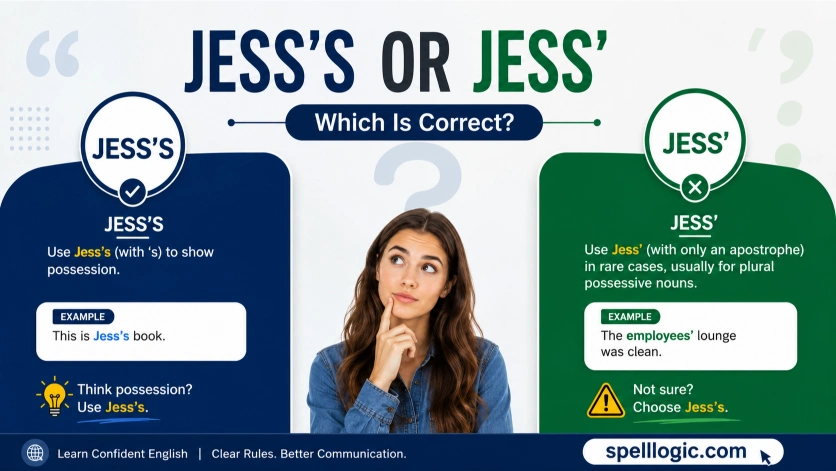
Both forms can show that something belongs to or is connected with a person named Jess. The difference mainly comes from style conventions.
Jess’s usually follows the general rule for singular possessive nouns: add an apostrophe and s.
Jess’ follows a style that allows a singular name ending in s to take only an apostrophe.
One-Line Distinction
Jess’s means the possessive form of Jess using apostrophe + s, while Jess’ means the possessive form of Jess using an apostrophe-only style.
Example Sentences
- Jess’s laptop is on the table.
- Jess’ laptop is on the table.
Both sentences communicate the same basic meaning: the laptop belongs to Jess.
Understanding Homophones in English
Although Jess’s and Jess’ are not a typical pair of different homophones, they can create a similar type of confusion because they may represent the same possessive meaning and can sound identical in everyday speech.
What Are Homophones?
Homophones are words that have the same pronunciation but different meanings or spellings.
For example:
- sea – a large body of salt water
- see – to look at something
These words sound the same but have different meanings.
Why Homophones Cause Confusion
Homophones can confuse writers because listening alone does not always reveal the correct spelling.
For example:
I can see the sea from here.
The pronunciation may sound the same, but the meaning determines the correct word.
Similarly, possessive forms such as Jess’s and Jess’ may create uncertainty because the writer must follow the appropriate grammatical or editorial style rather than relying only on pronunciation.
What Does “Jess’s” Mean?
Definition and Core Meaning
Jess’s is the singular possessive form of the name Jess. It indicates that something belongs to Jess or has a relationship with Jess.
For example:
- Jess’s phone
- Jess’s house
- Jess’s opinion
- Jess’s birthday
The general possessive rule for a singular noun is usually:
singular noun + ‘s
Since Jess is a singular name, many grammar guides and publishers prefer this pattern.
Origin and Historical Use
The possessive apostrophe developed as English spelling and grammar became more standardized. The apostrophe is used to show that letters have been omitted or that a noun has a possessive relationship.
Over time, style conventions developed different approaches to singular names ending in s. One approach recommends adding ‘s consistently to singular nouns, including names such as Jess, Chris, and James.
Modern Usage and Synonyms
Jess’s does not have a direct synonym because it is a grammatical possessive form rather than an independent vocabulary word.
However, its meaning can sometimes be expressed using other structures:
- the book belonging to Jess
- the opinion of Jess
- the house owned by Jess
In modern English, Jess’s is widely used in formal and informal writing.
Key Points
- It shows singular possession.
- It follows the pattern noun + ‘s.
- It is common in modern English.
- It can refer to ownership, relationships, ideas, or characteristics.
Example Sentences
- Jess’s new project starts next week.
- I enjoyed Jess’s presentation.
- We visited Jess’s apartment yesterday.
- Jess’s friends organized a surprise party.
What Does “Jess’” Mean?
Definition and Core Meaning
Jess’ is also a possessive form of the singular name Jess. It shows that something belongs to or is associated with Jess.
For example:
- Jess’ notebook
- Jess’ desk
- Jess’ decision
The meaning is generally the same as the alternative possessive spelling.
Origin and Historical Context
Some editorial traditions prefer using only an apostrophe after certain singular proper names ending in s. This approach is connected to stylistic preferences that developed in publishing and formal writing.
As a result, different organizations, schools, publishers, and style guides may recommend different forms.
Modern Usage and Synonyms
Like the other possessive form, Jess’ does not have a true synonym. It can be replaced in some sentences by phrases such as:
- belonging to Jess
- of Jess
- owned by Jess
However, the possessive form is usually shorter and more natural.
Key Points
- It also indicates singular possession.
- It uses an apostrophe without an additional s.
- Some style guides prefer this form for names ending in s.
- Consistency is important when following a particular writing style.
Example Sentences
- Jess’ answer was different from mine.
- We discussed Jess’ proposal during the meeting.
- Jess’ coat is hanging near the door.
- I borrowed Jess’ notes for the exam.
Jess’s vs Jess’: Key Differences at a Glance
| Word | Part of Speech | Meaning | Example Context |
|---|---|---|---|
| Jess’s | Possessive proper noun | Something belonging to or related to Jess | Jess’s book is missing. |
| Jess’ | Possessive proper noun | Something belonging to or related to Jess | Jess’ book is missing. |
The key point is that both forms usually communicate the same possessive relationship. The choice often depends on the writing style you are required to follow.
How to Remember the Difference Between Jess’s and Jess’
The easiest way to remember the difference is to focus on consistency and style.
Easy Memory Tricks
Think about the general possessive rule:
One person + possession = apostrophe + s.
This makes the first form easy to remember because Jess refers to one person.
Association Technique
Associate the extra s with the possessive sound you often hear when speaking:
Jess’s → Jess + possessive sound
If your school, workplace, publisher, or style guide uses the apostrophe-only convention for names ending in s, then use that convention consistently.
One Memorable Example
Imagine Jess owns a bicycle.
You could write:
Jess’s bicycle needs a repair.
Under another accepted editorial style:
Jess’ bicycle needs a repair.
The bicycle still belongs to the same person. Only the preferred spelling convention changes.
Common Mistakes and Confusions
Mistake 1: Removing the Apostrophe
✘ Jess book is on the desk.
✔ Jess’s book is on the desk.
The apostrophe is necessary because the sentence shows possession.
Mistake 2: Using Too Many Letters
✘ Jesss book is new.
✔ Jess’s book is new.
Do not simply add another s without an apostrophe.
Mistake 3: Confusing Singular and Plural Forms
✘ The Jess’s are coming tonight.
✔ The Jesses are coming tonight.
The first sentence incorrectly uses a possessive form when a plural form is intended.
Mistake 4: Mixing Styles
✘ Jess’s report was excellent, but Jess’ presentation was short.
This may be acceptable if two different style systems are being quoted, but it is usually better to remain consistent within one piece of writing.
Examples Section: Correct and Incorrect Usage
Example 1
✔ Correct: Jess’s phone is charging in the kitchen.
✘ Incorrect: Jesss phone is charging in the kitchen.
Explanation: The possessive form needs an apostrophe.
Example 2
✔ Correct: I liked Jess’s suggestion.
✔ Correct in some style systems: I liked Jess’ suggestion.
Explanation: Both can show possession, depending on the style convention.
Example 3
✔ Correct: Jess’s parents arrived early.
✘ Incorrect: Jess’s’ parents arrived early.
Explanation: Do not add multiple apostrophes.
Example 4
✔ Correct: The teacher praised Jess’ essay.
✘ Incorrect: The teacher praised Jess essay.
Explanation: The apostrophe indicates that the essay belongs to or was written by Jess.
Example 5
✔ Correct: We visited Jess’s new office.
✘ Incorrect: We visited Jesses new office.
Explanation: Jesses is not the normal singular possessive spelling.
Self Assessment: Test Your Knowledge
Fill in the blanks with the correct possessive form according to the sentence and the style being used.
- ________ backpack is under the chair.
- I borrowed ________ notes for the class.
- The manager approved ________ proposal.
- We celebrated ________ birthday last weekend.
Self Assessment Answers
- Jess’s backpack or Jess’ backpack, depending on the chosen style.
- Jess’s notes or Jess’ notes, depending on the chosen style.
- Jess’s proposal or Jess’ proposal, depending on the chosen style.
- Jess’s birthday or Jess’ birthday, depending on the chosen style.
The important lesson is to choose one accepted style and use it consistently.
FAQs
1. Is Jess’s correct?
Yes. Jess’s is a widely accepted singular possessive form and follows the common rule of adding ‘s to a singular noun.
2. Is Jess’ also correct?
Yes, in style systems that allow singular names ending in s to form the possessive with only an apostrophe.
3. Which form should I use in everyday writing?
For general English writing, Jess’s is often the safest choice because it clearly follows the standard singular possessive pattern.
4. Why do some people write only an apostrophe after Jess?
Different style guides have different conventions for singular proper names ending in s. Some prefer an apostrophe-only form.
5. Do Jess’s and Jess’ have different meanings?
No. In most contexts, they express the same possessive meaning. The difference is primarily a matter of writing style.
6. Should I use both forms in the same article?
Usually, no. Choose one style and remain consistent unless you have a specific editorial reason to use both.
7. How do I know which form my teacher or employer prefers?
Check the required style guide, writing instructions, or examples provided by your school, organization, or publisher.
Final Conclusion: Using “Jess’s” and “Jess’” Correctly
Understanding possessive forms becomes much easier when you remember that both spellings are connected to the same basic idea: showing that something belongs to or is associated with a person named Jess. The form Jess’s follows the common singular possessive pattern of adding an apostrophe and s, making it a clear and widely accepted choice in modern English. The form Jess’, on the other hand, appears in writing systems that prefer an apostrophe alone after certain singular names ending in s. Therefore, the difference is usually not about meaning but about grammatical style and editorial preference.
In real-world writing, the most useful habit is consistency. If you choose the apostrophe-plus-s pattern, use it throughout your document. If a school, publisher, workplace, or style guide requires the apostrophe-only form, follow that rule instead. A simple memory trick is to remember that singular possession usually takes ‘s, while names ending in s may sometimes follow a special style convention. With practice, apostrophe rules will become easier to recognize. Do not worry if these small differences seem difficult at first—careful reading and regular writing practice will help you use possessives confidently and accurately.