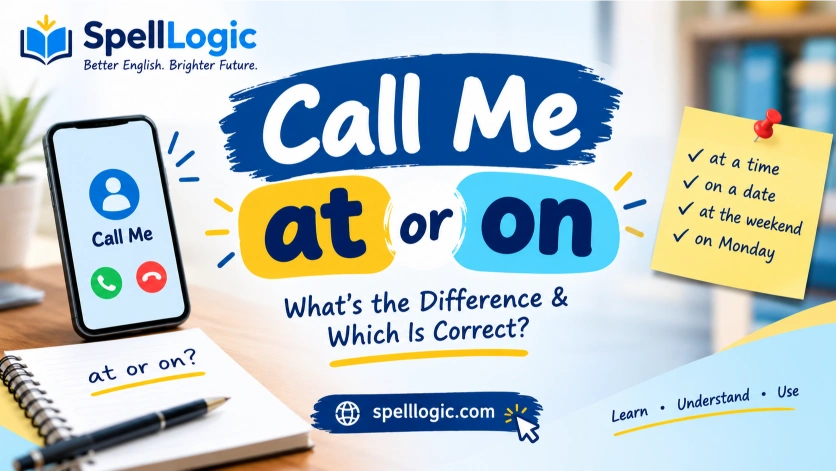
English learners often wonder whether they should say “call me at” or “call me on” when talking about contacting someone. Both prepositions can appear with the verb call, but they are used in different situations. The choice depends mainly on what comes after the preposition—a telephone number, a specific time, or a communication platform.
Understanding this small difference can make your everyday English sound much more natural and accurate. In this guide, we will explain call me at or on in simple English, provide clear examples, show common mistakes, and give you easy memory tricks so you can choose the correct expression confidently.
Why “Call Me At” and “Call Me On” Are Confusing
The expressions call me at or on are confusing because both at and on are common English prepositions, and both can be connected with communication.
Similar Pronunciation
The words at and on sound different, but learners may still confuse them because they frequently occur in similar sentences. When speaking quickly, the preposition may receive little stress, making it harder to notice which one a native speaker uses.
Similar Spelling
At and on are both short, common prepositions. Their short forms can make them easy to overlook when learners focus mainly on the verb call.
Context Confusion
The biggest problem is context. Call me at or on does not have one universal answer. The correct preposition changes according to the information that follows it.
For example, at is commonly used before a telephone number:
- Call me at 555-0182.
However, on can be used when referring to a device, platform, or service:
- Call me on my mobile.
- Call me on WhatsApp.
Common Learner Mistakes
Learners sometimes choose a preposition by translating directly from their first language. This can lead to phrases such as:
- ✘ Call me on 555-0182.
- ✔ Call me at 555-0182.
Another common mistake is using at when referring to a platform:
- ✘ Call me at WhatsApp.
- ✔ Call me on WhatsApp.
Learning the context is more useful than memorizing one fixed rule.
Call Me At or On Explained Simply
The easiest way to understand call me at or on is to look at the noun or information following the preposition.
Call me at is commonly used with a telephone number or specific time.
Call me on is commonly used with a device, communication service, or platform, and it can also refer to a particular day or date.
One-Line Distinction
“Call me at” usually introduces a phone number or time, while “call me on” commonly introduces a device, platform, or day/date.
Examples
- Please call me at 0300-1234567.
- Please call me on WhatsApp tonight.
In simple terms, when discussing a number, call me at or on is usually solved by choosing at. When discussing a platform or device, on is often the natural choice.
Understanding Homophones in English
The issue of call me at or on is not actually a homophone problem. However, understanding homophones can help English learners recognize why some small words create confusion in spoken English.
What Are Homophones?
Homophones are words that have the same pronunciation but different meanings or spellings.
For example:
- right — correct or opposite of left
- write — to produce words using a pen, keyboard, or other method
The two words sound alike but have different meanings.
Why Homophones Cause Confusion
Homophones can be difficult because listening alone may not tell you which word the speaker means. Context provides the answer.
For example:
Please write your name on the right side.
Although write and right sound alike, their meanings are clear from the sentence.
The expressions call me at or on involve preposition choice rather than homophones, but context is equally important.
What Does “Call Me At” Mean?
Definition and Core Meaning
Call me at is generally used when at introduces a telephone number or, in some contexts, a specific time.
When someone says:
Call me at 0300-1234567.
the word at connects the verb call with the number where the person can be reached.
The same preposition can also introduce a time:
Call me at 7 p.m.
Here, at identifies the exact time for the call.
Origin and Historical Use
The preposition at has a long history in English. It developed from an Old English form related to the idea of being at a particular point or place. Over time, its uses expanded to include locations, times, and specific points of reference.
This explains why at works naturally with a telephone number. A phone number can be treated as a specific point of contact.
Modern Usage and Synonyms
In modern English, call me at is especially common in contexts involving contact information.
Common patterns include:
- call me at + phone number
- call us at + phone number
- reach me at + phone number
- contact me at + phone number
- call at + specific time
Examples:
- You can call me at 555-7821.
- Call me at noon.
- Please call our office at the number below.
- You can reach me at my office number.
For learners asking call me at or on, remember that a telephone number normally follows at.
Example Sentences
- Please call me at 0301-5551234.
- You can call me at the office.
- Call me at six o’clock.
- Please call me at the number printed on the card.
- If you need help, call me at home.
Notice that the meaning of at depends on what follows it. It can identify a number, location, or exact time.
What Does “Call Me On” Mean?
Definition and Core Meaning
Call me on is commonly used when on introduces a device, communication platform, service, or day/date.
For example:
Call me on my mobile.
Here, on refers to the device used for communication.
You can also say:
Call me on WhatsApp.
In this sentence, on identifies the communication platform.
Origin and Historical Context
The preposition on originally expressed the idea of being on or upon a surface. English later developed many figurative uses for on. Today, it is commonly used with technology, media, communication systems, and platforms.
For example:
- on the phone
- on the radio
- on television
- on the internet
- on WhatsApp
This broader modern use explains why on frequently appears when people discuss communication technology.
Modern Usage and Synonyms
Common patterns include:
- call me on + device
- call me on + platform
- call me on + day/date
- call us on + service or number in some varieties of English
Examples:
- Call me on my mobile.
- Call me on WhatsApp.
- Call me on Monday.
- She called me on my landline.
- Please call me on the number listed below.
There is an important regional difference here. In British English, on can also be used before a telephone number, especially in expressions such as “call me on this number.” In American English, call me at this number is generally more common.
Therefore, the answer to call me at or on can depend partly on the variety of English you are using.
Example Sentences
- Call me on my mobile when you arrive.
- Please call me on WhatsApp.
- I will call you on Monday.
- She called me on my work phone.
- Can you call me on the office line?
Call Me At or On: Key Differences at a Glance
| Word | Part of Speech | Meaning | Example Context |
|---|---|---|---|
| At | Preposition | Identifies a specific point, number, or time | Call me at 555-1234. |
| On | Preposition | Identifies a device, platform, day, or date | Call me on WhatsApp. |
| At | Preposition | Refers to an exact time | Call me at 8 p.m. |
| On | Preposition | Refers to a particular day | Call me on Tuesday. |
| At | Preposition | Common in American English with a phone number | Call me at this number. |
| On | Preposition | Common in British English with a phone number | Call me on this number. |
The table shows why call me at or on cannot always be answered with one rule. The surrounding context matters.
How to Remember the Difference Between Call Me At and Call Me On
Here are some simple ways to remember call me at or on.
Memory Trick 1: Think “Point” for At
Think of at as pointing to one exact point.
- at 5 p.m.
- at the office
- at this number
So, when you give a specific telephone number, at is a useful choice, especially in American English.
Memory Trick 2: Think “Platform” for On
Think of on as being connected to a device or communication platform.
- on my mobile
- on WhatsApp
- on the phone
- on Tuesday
This makes on easier to remember.
Association Technique
Associate AT = exact point and ON = device/platform/day.
For example:
Number = AT
App = ON
Time = AT
Day = ON
This four-part pattern is easy to remember.
One Memorable Example
Imagine you are talking to a friend:
“Call me at my number, or call me on WhatsApp.”
The number gives you a specific contact point, while WhatsApp is the communication platform.
Common Mistakes and Confusions
Many learners make mistakes because they treat at and on as interchangeable. They are not always interchangeable.
Mistake 1: Using “On” Before a Phone Number
✘ Incorrect: Call me on 0300-1234567.
✔ Correct in standard American usage: Call me at 0300-1234567.
However, British English commonly allows:
✔ Call me on 0300-1234567.
Therefore, the preferred form can depend on regional English.
Mistake 2: Using “At” With WhatsApp
✘ Incorrect: Call me at WhatsApp.
✔ Correct: Call me on WhatsApp.
A platform normally takes on.
Mistake 3: Using “At” With a Day
✘ Incorrect: Call me at Monday.
✔ Correct: Call me on Monday.
Use on with specific days and dates.
Mistake 4: Using “On” With an Exact Time
✘ Incorrect: Call me on 8 p.m.
✔ Correct: Call me at 8 p.m.
Use at for an exact clock time.
Examples Section: Correct and Incorrect Usage
Understanding call me at or on becomes easier when you compare complete sentences.
Example 1: Phone Number
✔ Correct: Call me at 0300-9876543.
✘ Incorrect in standard American usage: Call me on 0300-9876543.
Explanation: American English normally uses at before a telephone number.
Example 2: Communication Platform
✔ Correct: Call me on WhatsApp.
✘ Incorrect: Call me at WhatsApp.
Explanation: WhatsApp is a communication platform, so on is natural.
Example 3: Specific Time
✔ Correct: Call me at 9 p.m.
✘ Incorrect: Call me on 9 p.m.
Explanation: Use at for an exact time.
Example 4: Specific Day
✔ Correct: Call me on Friday.
✘ Incorrect: Call me at Friday.
Explanation: Use on with a particular day.
Example 5: Mobile Device
✔ Correct: Call me on my mobile.
✘ Incorrect: Call me at my mobile.
Explanation: When referring to the device used for communication, on is generally preferred.
Example 6: Regional Telephone Usage
✔ Correct: Call me at this number.
✔ Also correct in British English: Call me on this number.
Explanation: Telephone-number usage differs between major varieties of English, so learners should consider their audience.
Self Assessment: Test Your Knowledge
Fill in each blank with at or on.
- Please call me ___ 8 p.m. tonight.
- You can call me ___ WhatsApp.
- Please call me ___ Monday morning.
- Call me ___ this number if you need assistance.
Self Assessment Answers
- at — We use at for an exact time: “Call me at 8 p.m.”
- on — We use on with a communication platform: “Call me on WhatsApp.”
- on — We use on with a specific day: “Call me on Monday morning.”
- at — In standard American English, at is commonly used with a telephone number: “Call me at this number.” British English may also use on here.
FAQs
1. Is “call me at this number” correct?
Yes. Call me at this number is standard and natural, particularly in American English, when referring to a telephone number.
2. Is “call me on WhatsApp” correct?
Yes. Call me on WhatsApp is the natural expression because WhatsApp is a communication platform.
3. Should I say “call me at Monday” or “call me on Monday”?
Say call me on Monday. The preposition on is used with specific days and dates.
4. Should I say “call me at 7 p.m.” or “call me on 7 p.m.”?
Say call me at 7 p.m. The preposition at is used for an exact time.
5. Is “call me on my mobile” correct?
Yes. Call me on my mobile is natural English because on can refer to the device being used for communication.
6. Is “call me on this number” correct?
Yes, especially in British English. American English more commonly uses call me at this number.
7. Which is correct: “call me at or on”?
Both can be correct. The choice depends on what follows the preposition and, for telephone numbers, sometimes on the variety of English. Use at for an exact time and commonly for a phone number in American English; use on for platforms, devices, and days.
Final Conclusion: Using “Call Me At” and “Call Me On” Correctly
Choosing between call me at or on becomes much easier when you focus on the context instead of trying to memorize one universal rule. Use at when you are pointing to a specific time or, especially in American English, a specific telephone number. For example, “Call me at 7 p.m.” and “Call me at 0300-1234567” are natural constructions. Use on when you are talking about a communication platform or device, such as “Call me on WhatsApp” or “Call me on my mobile.” You should also use on with specific days and dates, as in “Call me on Friday.”
One important point for English learners is regional variation. British English commonly allows on before a telephone number, while American English generally prefers at. Therefore, both forms may be correct in different varieties of English. The easiest memory trick is AT = exact point or time and ON = platform, device, or day. With regular practice, these small preposition choices will become natural. Keep reading, listening, and using English in real conversations, and you will become more confident with prepositions and everyday expressions.