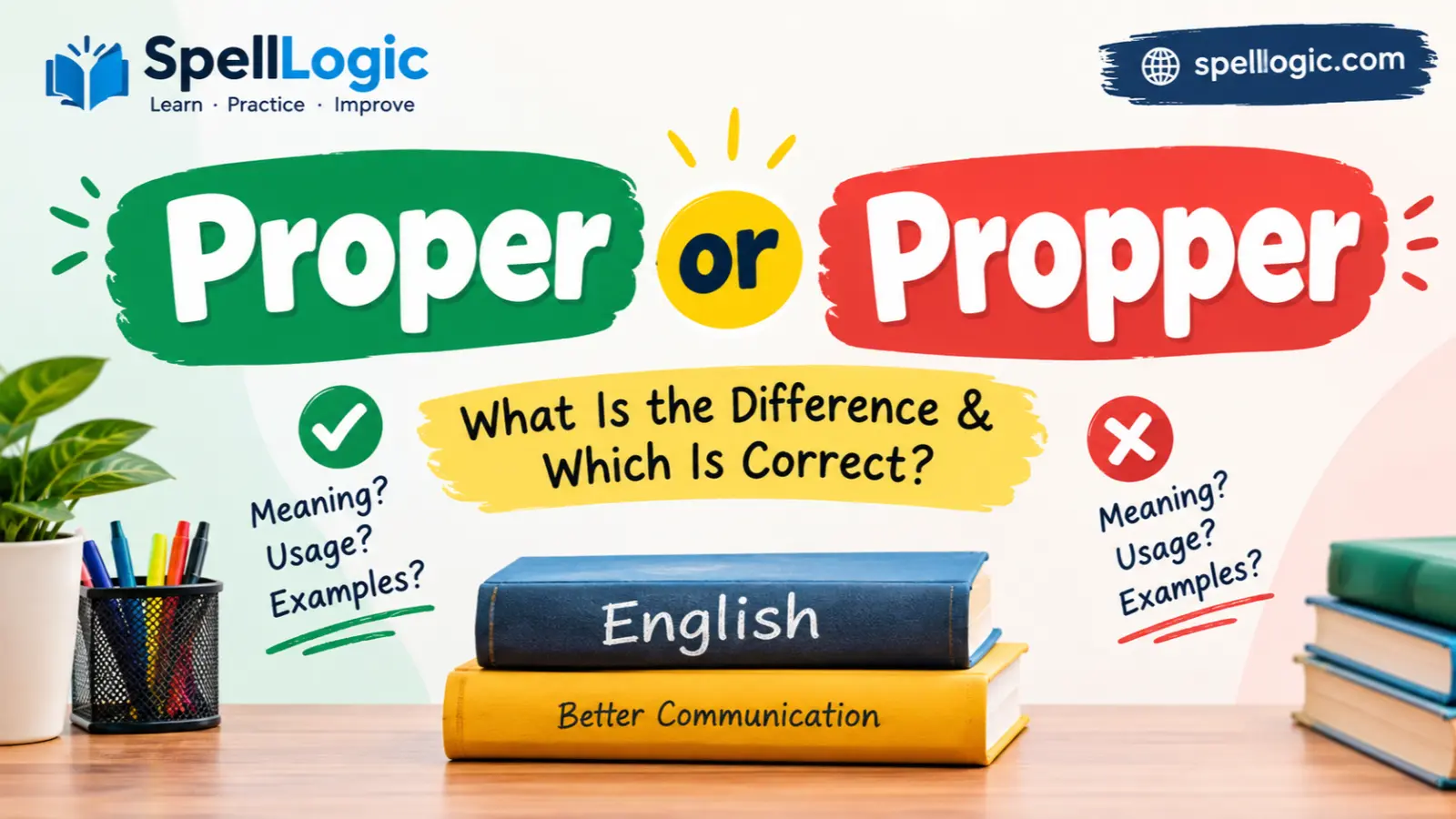
If you have ever wondered whether “propper” or “proper” is the correct spelling, you are not alone. English learners often make this mistake because the two forms look almost identical and are pronounced in a very similar way. However, there is an important difference: proper is the standard English word, while propper is generally a misspelling of it.
Knowing the correct form matters because spelling errors can make otherwise clear writing look careless or confusing. In this guide, we will explain the meaning, spelling, pronunciation, history, and everyday use of proper, while showing why propper should normally be avoided.
Why “Propper” and “Proper” Are Confusing
The confusion between propper and proper usually comes from spelling rather than meaning. Most English learners who write “propper” are trying to spell proper, the correct standard English word.
There are several reasons this mistake happens.
Similar pronunciation
Proper is pronounced roughly like “PROP-er.” Because the first syllable sounds like “prop,” some learners may instinctively add another p before the second part.
However, the correct spelling is:
proper — not propper
The pronunciation does not require a double p in the spelling.
Similar spelling
The two forms differ by only one letter:
- proper ✔
- propper ✘
This small difference makes the error easy to overlook, especially when typing quickly.
Context confusion
The word proper is used in many different situations. It can describe something correct, suitable, appropriate, formal, or belonging to a particular person or place.
For example:
- Please use the proper procedure.
- She wore the proper clothes for the ceremony.
- Lahore proper refers to the central or main city area in certain contexts.
Because the word has several meanings, learners may encounter it frequently and become unsure about its spelling.
Common learner mistakes
A common mistake is assuming that a short vowel sound or a repeated consonant sound must be represented by a double letter.
For example, a learner might write:
“You need the propper tools.”
The correct sentence is:
“You need the proper tools.”
The important point is that propper is not the standard spelling of proper.
Propper vs Proper Explained Simply
The difference is straightforward.
“Proper” is the correct standard English spelling. “Propper” is generally an incorrect spelling and should not be used in normal English writing.
One-line distinction
Proper is a correct English word; propper is normally a misspelling of proper.
Examples
- Please follow the proper instructions.
- She finally found the proper way to solve the problem.
In both sentences, proper means something like “correct,” “appropriate,” or “suitable.”
There is no standard everyday English meaning that requires propper with two p’s.
Understanding Homophones in English
Before going further, it is useful to understand the term homophone, because spelling and pronunciation are often confused by English learners.
What Are Homophones?
Homophones are words that sound the same or nearly the same but have different spellings and meanings.
For example:
- right — correct or opposite of left
- write — to form words using letters
These words have the same pronunciation but completely different meanings.
Why Homophones Cause Confusion
Homophones can be difficult because English spelling does not always closely match pronunciation.
For example:
I want to write the right answer.
The words write and right sound alike, but their meanings and spellings are different.
However, propper and proper are not normally considered homophones. The issue here is mainly misspelling, not two separate words with different meanings.
This distinction is important. If you see propper in ordinary English writing, it is usually intended to be proper.
What Does “Propper” Mean?
Definition and Core Meaning
Propper is generally not a standard English word in ordinary modern English usage. When someone writes “propper,” they usually mean proper.
Therefore, if you are writing an essay, email, school assignment, article, business document, or social media post in standard English, use proper rather than propper.
Origin and Historical Use
Unlike proper, propper does not have an established role as the normal modern spelling of the adjective meaning “correct” or “suitable.”
The form may appear occasionally as:
- A typographical error
- A spelling mistake
- A surname or proper name
- A brand or username
- A specialized name in a particular context
Such uses do not make propper the standard spelling of the English adjective.
Modern Usage and Synonyms
In everyday English, replace propper with proper when you mean:
- correct
- suitable
- appropriate
- acceptable
- suitable for a particular purpose
- correctly done
For example:
- Incorrect: You need to use the propper method.
- Correct: You need to use the proper method.
Example sentences
Because propper is normally a misspelling, it should not be used in standard sentences such as:
✘ We need to find the propper solution.
Instead, write:
✔ We need to find the proper solution.
Another example:
✘ Please wear propper shoes for the hike.
Correct:
✔ Please wear proper shoes for the hike.
What Does “Proper” Mean?
Definition and Core Meaning
Proper is a common English adjective with several related meanings. Most often, it describes something that is correct, suitable, appropriate, or acceptable.
For example:
You should use the proper equipment.
Here, proper means the correct or suitable equipment.
It can also describe something that follows accepted standards or expected behavior:
He did not receive proper training.
In this sentence, proper means adequate or appropriate.
Origin and Historical Context
Proper comes from the Old French propre, which developed from the Latin proprius, meaning “one’s own,” “particular,” or “special.”
Over time, the English word developed several connected meanings. These include ideas such as something belonging specifically to someone, something suitable or appropriate, and something correct or acceptable.
This long history explains why proper has more than one meaning in modern English.
Modern Usage and Synonyms
Today, proper can be used in several ways.
It may mean:
- Correct: “That is the proper answer.”
- Suitable: “Wear proper clothing for the weather.”
- Appropriate: “Please use proper language.”
- Adequate: “The machine needs proper maintenance.”
- Well-behaved or respectable: “The children were taught proper manners.”
- Actual or strict: “The city proper is smaller than the wider metropolitan area.”
Useful synonyms depend on the sentence. They include:
- correct
- suitable
- appropriate
- fitting
- acceptable
- adequate
- right
- suitable
Example sentences
- Please use the proper form when applying.
- She received proper medical attention.
- We need the proper tools for this job.
- He apologized in a proper and respectful way.
- Is this the proper place to park?
- The teacher explained the proper pronunciation.
Notice that the spelling remains proper in every example.
Propper vs Proper: Key Differences at a Glance
| Word | Part of Speech | Meaning | Example Context |
|---|---|---|---|
| proper | Adjective | Correct, suitable, appropriate, or acceptable | “Use the proper method.” |
| propper | Not normally a standard English word | Usually a misspelling of “proper” | “Propper method” ✘ |
The easiest rule is simple: When you mean correct, suitable, or appropriate, spell the word “proper,” with only one “p” before the final “er.”
How to Remember the Difference Between Propper and Proper
A few simple memory tricks can make the correct spelling easier to remember.
Memory trick 1: One “p” in the middle
Think:
pro + per = proper
The word contains one p at the beginning and one p after “pro”? More simply, remember the exact spelling as:
proper
There is no extra p between the first syllable and -er.
Memory trick 2: Think “proper = correct”
Connect the word with its meaning:
PROPER = CORRECT
When you want to say “correct,” think of proper.
For example:
“What is the proper answer?”
“What is the correct answer?”
Both sentences express nearly the same idea.
Memory trick 3: Watch for the extra letter
If you type propper, stop and ask:
“Do I really need two p’s?”
For the standard adjective, the answer is no.
One memorable example
Remember this sentence:
“The proper spelling is proper.”
It is repetitive, but that makes it easy to remember.
Common Mistakes and Confusions
Wrong example 1
✘ Please give me the propper information.
Correct version
✔ Please give me the proper information.
Explanation: The intended word means correct or suitable, so proper is the correct spelling.
Wrong example 2
✘ She did not receive propper training.
Correct version
✔ She did not receive proper training.
Explanation: Training can be described as “proper” when it is adequate, appropriate, or suitable.
Wrong example 3
✘ Use the propper format for your application.
Correct version
✔ Use the proper format for your application.
Explanation: The standard adjective is proper, not propper.
A useful warning
Do not assume that every word containing a doubled consonant follows the same spelling pattern. English has many words with double letters, such as different, successful, necessary, and address. Spelling must often be learned word by word.
Examples Section: Correct and Incorrect Usage
Example 1
✔ Correct: Please use the proper procedure.
✘ Incorrect: Please use the propper procedure.
Why? The adjective meaning “correct” is spelled proper.
Example 2
✔ Correct: He did not have the proper equipment.
✘ Incorrect: He did not have the propper equipment.
Why? The word describes equipment that is suitable or appropriate.
Example 3
✔ Correct: Make sure you use the proper spelling.
✘ Incorrect: Make sure you use the propper spelling.
Why? Ironically, the correct spelling of the word itself is proper.
Example 4
✔ Correct: She received proper instructions before starting the task.
✘ Incorrect: She received propper instructions before starting the task.
Why? Again, proper is the standard English spelling.
Example 5
✔ Correct: Wearing proper shoes can make walking more comfortable.
✘ Incorrect: Wearing propper shoes can make walking more comfortable.
Why? The word means suitable or appropriate.
Self Assessment: Test Your Knowledge
Fill in each blank with proper or propper.
- Please follow the ______ procedure when completing the form.
- He needed ______ training before operating the machine.
- Is this the ______ way to pronounce the word?
- The teacher asked students to use the ______ spelling in their essays.
Try to answer all four before checking the answer section below.
Self Assessment Answers
- proper — Please follow the proper procedure when completing the form.
- proper — He needed proper training before operating the machine.
- proper — Is this the proper way to pronounce the word?
- proper — The teacher asked students to use the proper spelling in their essays.
Answer: proper in all four cases.
FAQs:
Is “propper” a correct English word?
In standard everyday English, propper is generally not the correct spelling. If you mean “correct,” “suitable,” or “appropriate,” use proper.
What is the correct spelling: propper or proper?
The correct standard spelling is proper.
Is proper a noun or an adjective?
Proper is commonly used as an adjective. For example, “She used the proper method.” In some specialized expressions, proper can also function differently, but its common use in this spelling question is as an adjective.
Are proper and propper homophones?
No. They are not normally treated as two standard English words with different meanings. Propper is usually simply a misspelling of proper.
Why do people spell proper as propper?
The mistake often happens because the pronunciation may encourage learners to expect a doubled consonant. Similar-looking words can also reinforce this spelling habit. Fast typing and unfamiliarity with English spelling patterns can make the error more common.
What does proper mean in English?
Proper can mean correct, suitable, appropriate, acceptable, or adequate, depending on context. For example, “proper equipment” means suitable or appropriate equipment.
How can I remember the spelling of proper?
Remember the simple connection:
Proper = correct.
When you mean “correct,” “suitable,” or “appropriate,” choose proper, not propper.
Conclusion:
The difference between propper and proper is much easier to understand once you recognize that they do not represent two standard English words with different meanings. In ordinary English writing, proper is the correct spelling. It is an adjective that can mean correct, suitable, appropriate, acceptable, or adequate, depending on the context. For example, we can talk about proper instructions, proper equipment, proper behavior, or the proper way to do something.
By contrast, propper is normally a spelling mistake. Although you may occasionally see it as part of a name, username, brand, or other special usage, it should not replace proper in standard English sentences.The easiest way to remember the difference is to connect proper with the word correct.
If you mean “correct” or “suitable,” write proper. Also remember that proper and propper are not ordinary homophones; this is mainly a spelling confusion.English spelling can be tricky, but small distinctions become much easier with practice. Every time you correctly use proper, you reinforce the pattern. Keep reading, writing, and checking unfamiliar words, and these common spelling choices will gradually become natural.