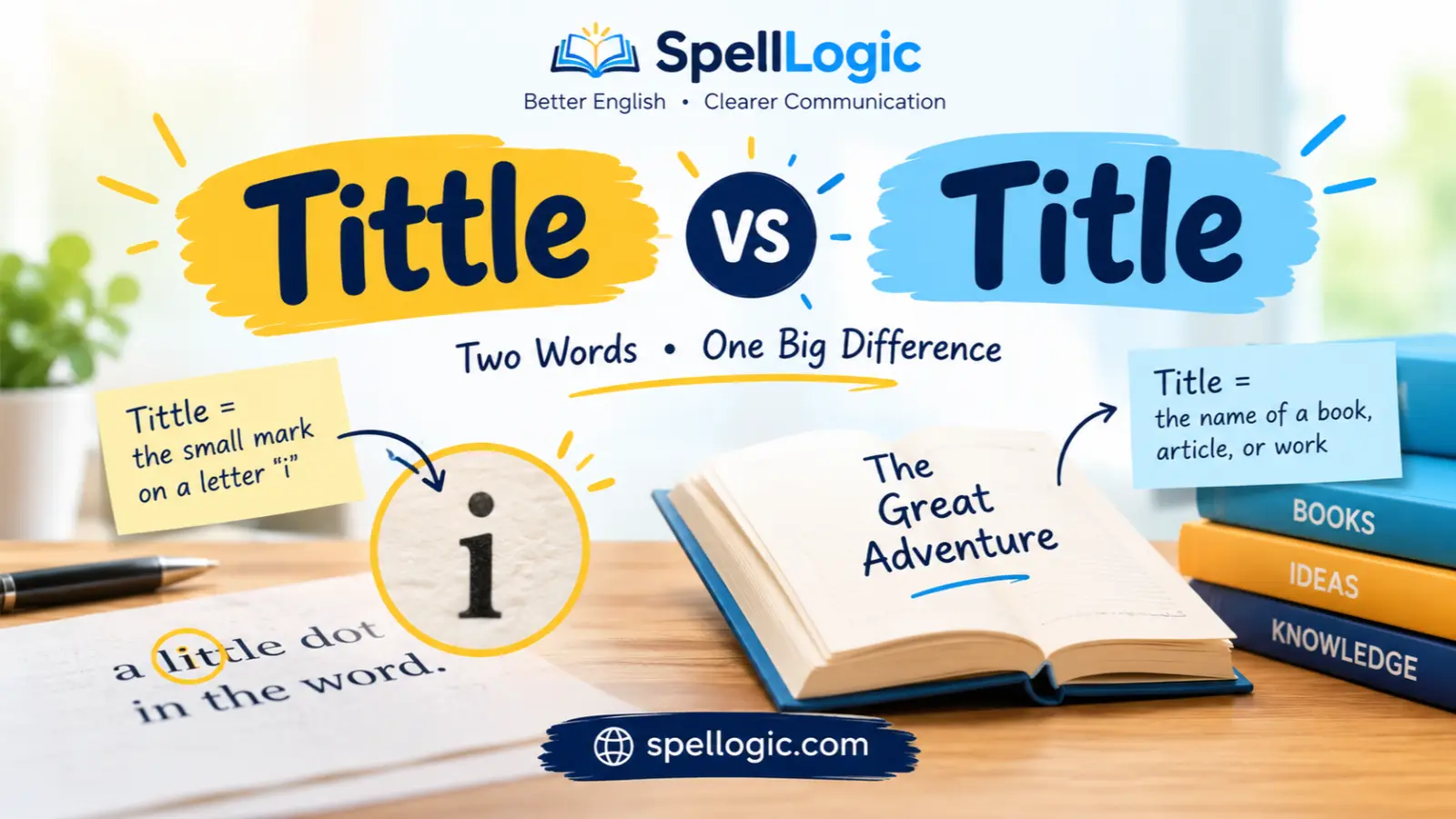
Tittle vs title is a common spelling confusion for English learners because the two words look almost identical. However, they have completely different meanings and are used in very different situations. A title is a name or heading given to a book, article, movie, person, or piece of work.
A tittle, on the other hand, is a small dot or mark, especially the dot above a lowercase i or j. Understanding this difference can help you avoid spelling mistakes in writing and improve your English vocabulary. In this guide, we will explain tittle vs title in simple English, with clear definitions, examples, memory tricks, common mistakes, and a short quiz.
Why “Tittle vs Title” Are Confusing
English learners often confuse tittle and title because their spelling is very similar. Both words begin with tit- and contain the letters t, i, and t, making it easy to type one when you mean the other.
There is also some pronunciation confusion. Title is commonly pronounced like “TY-tuhl”, while tittle is pronounced more like “TIT-uhl.” They are not true homophones because their first vowel sounds are different, but the difference can be easy to miss in fast speech.
Similar spelling
The spelling difference is only one letter:
- tittle → t-i-t-t-l-e
- title → t-i-t-l-e
Notice the extra t in tittle. Because the words look so similar, typing errors are common.
Context confusion
The biggest problem is that learners may know title very well but rarely encounter tittle. For example, you may frequently read phrases such as “book title” or “job title,” while tittle is mainly used when discussing writing, typography, or small marks.
Common learner mistakes
Some common mistakes include:
- Writing tittle when referring to the name of a book.
- Writing title when referring to the dot above an i.
- Assuming the two words are different spellings of the same concept.
- Thinking tittle is simply an uncommon spelling of title.
The key is to remember that these are two separate words with different meanings.
Tittle vs Title Explained Simply
The easiest way to understand the difference is to focus on what each word describes.
Tittle means a small dot or mark, especially the dot above a lowercase “i” or “j,” while title means the name or heading of something, or a name describing a person’s position or achievement.
One-line distinction
Tittle = a small mark or dot; title = a name, heading, position, or distinction.
Examples
- The tittle above the “i” is clearly visible.
- The title of the book is The Great Adventure.
So, if you are talking about a book, article, movie, job, or championship, you almost certainly need title, not tittle.
If you are talking about the tiny dot above an i or j, tittle is the correct word.
Understanding Homophones in English
What Are Homophones?
Homophones are words that have the same pronunciation but different meanings and often different spellings.
For example:
- right = correct or opposite of left
- write = to form words with letters
These words sound the same, but their meanings and spellings are different.
It is important to note that tittle and title are not exact homophones in standard English. Their pronunciation differs in the first vowel sound. However, their similar appearance and relatively close pronunciation can still cause confusion for learners.
Why Homophones Cause Confusion
Homophones can be difficult because listening alone may not tell you which word a speaker means.
For example:
“I need to write a letter.”
A listener must understand the context to know that write means putting words on paper rather than right.
With tittle and title, the main challenge is usually spelling rather than identical pronunciation. A learner may know the correct sound but accidentally choose the wrong spelling when writing.
What Does “Tittle” Mean?
Definition and Core Meaning
A tittle is a small dot, mark, or tiny stroke used as part of a written character. The best-known example is the dot above the lowercase letters i and j.
For example, in the word “little,” the dots above the two i letters can be called tittles.
The word is uncommon in everyday conversation, but it is useful in discussions about typography, handwriting, spelling, and the design of letters.
Origin and Historical Use
The word tittle comes from an older English word related to a small mark or point. Historically, it was also associated with the idea of a very small written sign or detail.
The word became particularly useful when people needed to describe tiny marks in written language. Over time, its meaning became strongly associated with the dot above i and j.
Modern Usage and Synonyms
Today, tittle is most commonly used when talking about written characters.
Related words include:
- dot — the most common everyday word
- mark — a general term for a visible sign
- stroke — a line or movement used to form a character
- diacritic — a broader term for a mark added to a letter to change or clarify its pronunciation or meaning
However, these words are not always exact synonyms. A tittle specifically refers to a small mark, especially the dot associated with i or j.
Example sentences
- The tittle above the letter “i” is missing.
- The font has a very small tittle on each lowercase “j.”
- The designer changed the shape of the tittle to make the letters easier to read.
- Be careful not to confuse the tittle with other marks used in typography.
In ordinary conversation, most people would simply say “the dot above the i.” Therefore, you do not need to use tittle every time you describe this mark.
What Does “Title” Mean?
Definition and Core Meaning
A title is a name or heading given to a book, article, movie, song, speech, or other work.
For example:
- The title of the book is Pride and Prejudice.
- What is the title of that movie?
- Please write the title at the top of the page.
Title has several other meanings as well.
It can describe a person’s official position or role:
- job title
- professional title
- academic title
It can also refer to a championship or an honor:
- world championship title
- league title
- boxing title
Origin and Historical Context
Title comes through Old French and Latin, ultimately relating to a written inscription, label, or name. Historically, titles were used to identify works, documents, people, and positions.
Today, the word is extremely common and has many meanings in everyday English.
Modern Usage and Synonyms
Depending on the context, synonyms or related expressions for title include:
- heading — the name or heading of a section
- name — the identifying name of something
- caption — a short description or label
- designation — an official name or role
- position — a person’s role at work
- honor — a distinction or achievement
Remember that these words are not interchangeable in every sentence.
Common uses of “title”
You will often see title used for:
- A book: book title
- A movie: movie title
- An article: article title
- A song: song title
- A webpage: page title
- A job: job title
- An academic qualification or honor: academic title
- A championship: championship title
- A person’s formal designation: official title
Example sentences
- I forgot the title of that novel.
- The article has an interesting title.
- Her job title is Marketing Manager.
- The team won the league title last season.
- Please give your essay a clear title.
Tittle vs Title: Key Differences at a Glance
| Word | Part of Speech | Meaning | Example Context |
|---|---|---|---|
| Tittle | Noun | A small mark or dot, especially above “i” or “j” | “The tittle above the i is clearly visible.” |
| Title | Noun | The name or heading of a work, person’s position, or an achievement | “The title of the book is fascinating.” |
The simplest distinction is this: a tittle is a tiny written mark, whereas a title is a name, heading, position, or distinction.
How to Remember the Difference Between Tittle vs Title
Learning a confusing word pair becomes easier when you create a simple mental association.
Memory trick 1: Extra T = Tiny
Think:
Tittle has an extra T because it is a Tiny mark.
The extra t in tittle can remind you of the tiny dot above an i.
- tittle → tiny mark
- title → name or heading
Memory trick 2: Title = Name
Connect title with things that have names.
A book has a title.
A movie has a title.
An article has a title.
A person can have a job title.
A champion can hold a title.
Memory trick 3: Look at the spelling
Compare the words carefully:
tittle → has tt
title → has only one t between the i and l
That extra t can serve as your visual reminder that tittle is the word for a tiny mark.
One memorable example
Imagine writing the sentence:
“The title of my article is written above the tittle of the letter i.”
The title is the name of the article, while the tittle is the tiny dot on the i.
Once you connect the two meanings to one sentence, the distinction becomes much easier to remember.
Common Mistakes and Confusions in Tittle vs Title
Mistake 1: Using “tittle” for a book name
Wrong:
The tittle of this book is very interesting.
Correct:
The title of this book is very interesting.
Explanation: A book has a title, not a tittle.
Mistake 2: Using “title” for the dot above an “i”
Wrong:
The title above the letter “i” is missing.
Correct:
The tittle above the letter “i” is missing.
Explanation: The tiny dot associated with i is called a tittle.
Mistake 3: Treating “tittle” as a spelling variant
Wrong idea:
“Tittle” is another way to spell “title.”
Correct idea:
Tittle and title are different words with different meanings.
Mistake 4: Using “tittle” for a job position
Wrong:
Her tittle is Senior Accountant.
Correct:
Her title is Senior Accountant.
Explanation: A person’s official role or position is their title.
Mistake 5: Using “title” for a tiny mark
Wrong:
Make sure the title is above the “j.”
Correct:
Make sure the tittle is above the “j.”
Explanation: In this context, tittle refers to the small dot or mark.
Examples Section: Correct and Incorrect Usage
Example 1
✔ Correct: The title of the novel is A Tale of Two Cities.
✘ Incorrect: The tittle of the novel is A Tale of Two Cities.
Why? A novel has a title, meaning its name.
Example 2
✔ Correct: The tittle above the lowercase “i” is very small.
✘ Incorrect: The title above the lowercase “i” is very small.
Why? The dot above the i can be called a tittle.
Example 3
✔ Correct: What is your job title?
✘ Incorrect: What is your job tittle?
Why? A person’s professional position is their title.
Example 4
✔ Correct: The designer adjusted the tittle to improve the appearance of the letter.
✘ Incorrect: The designer adjusted the title to improve the appearance of the letter.
Why? Here, the sentence is discussing a small part of a written character, so tittle is correct.
Example 5
✔ Correct: The team is hoping to win the championship title.
✘ Incorrect: The team is hoping to win the championship tittle.
Why? A championship title is an honor or distinction.
Example 6
✔ Correct: Please add a clear title to your essay.
✘ Incorrect: Please add a clear tittle to your essay.
Why? An essay has a title, which tells readers its name or subject.
Self Assessment: Test Your Knowledge
Fill in each blank with tittle vs title.
- What is the ______ of your favorite book?
- The ______ above the lowercase “i” is called a small mark.
- Her official job ______ is Project Manager.
- The graphic designer changed the ______ on the letter “j.”
Self Assessment Answers
- title — A book has a title.
- tittle — A tittle can refer to the dot above an “i” or “j.”
- title — A job position is a job title.
- tittle — The small dot or mark on the letter is a tittle.
A quick way to check your answers is to ask: Am I talking about a name, position, or achievement? If yes, use title. If you mean a tiny written mark, especially the dot above i or j, use tittle.
FAQs:
1. What is the difference between tittle and title?
Tittle means a small dot or mark, especially the dot above a lowercase i or j. Title means the name of something, a heading, a person’s position, or an achievement such as a championship.
2. Is “tittle” a correct English word?
Yes. Tittle is a real English word. It is less common than title and is mainly used when discussing letters, writing, typography, or small marks.
3. Is tittle a synonym for title?
No. Tittle and title have different meanings. A tittle is a small mark, while a title can be a name, heading, position, or distinction.
4. Is the dot above an “i” called a tittle?
Yes. The small dot above a lowercase i is commonly called a tittle. The same term can also be used for the dot above a lowercase j.
5. What is the correct word for the name of a book?
The correct word is title. For example: “The title of the book is The Hobbit.”
6. What is the correct spelling: tittle or title of a job?
The correct word is title. For example: “Her job title is Sales Director.”
7. Are tittle and title homophones?
No, they are not exact homophones in standard English. Their pronunciations are different, although their similar spelling and sounds can make them confusing for English learners.
Conclusion:
Understanding tittle vs title is much easier once you separate their meanings. Tittle is a small written mark, most famously the dot above a lowercase i or j. It is a specialized word that you may encounter in discussions about typography, handwriting, fonts, and written characters. Title, in contrast, is a very common English word. It can mean the name of a book, movie, article, song, or other work. It can also refer to a person’s job or official position, or to an honor such as a championship.
When choosing between these words, think about the context. If you are talking about the name of something, use title. If you are talking about a professional position, use title. You are talking about a championship or distinction, use title. But If you mean the tiny dot above an “i” or “j,” use tittle.
The extra t in tittle can help you remember that it describes a tiny mark. Meanwhile, title is connected with names, headings, positions, and honors. Most importantly, do not treat tittle as an alternative spelling of title. They are separate words. Keep practicing them in real sentences, and this small spelling difference will soon become easy to remember. Every confusing word you master is another step toward more accurate and confident English writing.