dads or dad’s can confuse English learners because the two forms look almost identical and often sound the same when spoken. However, the apostrophe changes the grammatical function of the word. Dads is the plural form of dad, while dad’s can show possession or act as a contraction for dad is or dad has.
Understanding this small difference can help you write clearer messages, emails, social media posts, and everyday English. In this guide, we will explain the meaning, grammar, pronunciation, examples, common mistakes, and simple memory tricks so you can confidently choose the correct form in any sentence.
Why “Dads” and “Dad’s” Are Confusing
The difference between dads or dad’s is mainly a matter of grammar, not meaning alone. Both forms are built from the same base word, dad, so learners may naturally assume that the apostrophe is optional. It is not.
Similar Pronunciation
In most varieties of English, dads and dad’s are pronounced the same or very similarly. Both normally sound like /dædz/. Because speech does not show an apostrophe, listeners must use the context to understand the intended meaning.
For example:
- “Several dads attended the meeting.”
- “My dad’s car is outside.”
The written forms are different because their grammatical jobs are different.
Similar Spelling
The two forms contain exactly the same letters: d-a-d-s. The only visible difference is the apostrophe.
That tiny punctuation mark carries important information. It can show possession or indicate that letters have been omitted in a contraction.
Context Confusion
Context is especially important with dads or dad’s. Consider these sentences:
- “The dads are waiting outside.” — More than one father is waiting.
- “My dad’s waiting outside.” — Dad’s means dad is.
The surrounding words tell us which grammatical form is needed.
Common Learner Mistakes
A common mistake is using dad’s simply because the writer means more than one father. Another mistake is leaving out the apostrophe when showing possession.
For example:
- Incorrect: “Three dad’s joined the event.”
- Correct: “Three dads joined the event.”
- Incorrect: “My dads car is new.”
- Correct: “My dad’s car is new.”
Remember that an apostrophe does not normally make a noun plural.
“Dads” vs “Dad’s” Explained Simply
The easiest way to understand dads or dad’s is to look at the grammatical purpose of each form.
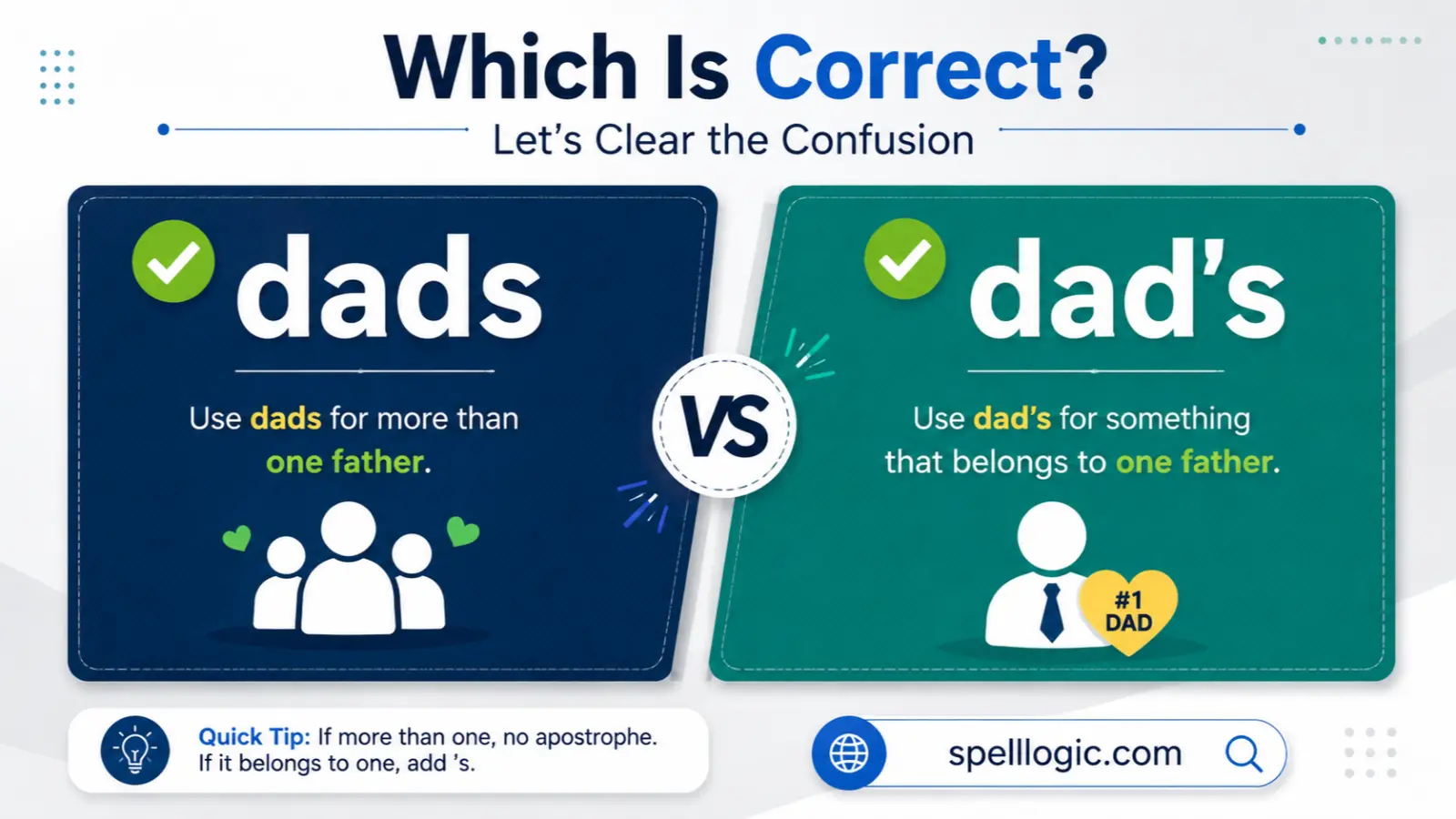
Dads means more than one dad. It is the regular plural noun.
Dad’s usually means belonging to one dad, but it can also be a contraction of dad is or dad has.
One-Line Distinction
Dads means two or more fathers, while dad’s shows possession or means dad is/dad has.
Example Sentences
- “The dads helped their children prepare for the school trip.”
- “My dad’s phone is on the kitchen table.”
A useful test is to ask whether you mean more than one father or something connected with one father.
Understanding Homophones in English
English contains many words that sound alike but have different spellings or meanings. These words can be difficult for learners because spoken English does not always reveal the spelling.
What Are Homophones?
Homophones are words that have the same pronunciation but different meanings, spellings, or grammatical functions.
For example:
- to — used before a verb or to show direction
- two — the number 2
- too — meaning also or excessively
The pronunciation may be the same, but the written forms are different.
Why Homophones Cause Confusion
Pronunciation alone cannot always tell us which spelling to use. The same issue appears with dads or dad’s because the final sound is generally the same.
For example, when someone says “my dad’s home,” you hear the sound, but the apostrophe is invisible. In writing, however, choosing the correct form is essential because the apostrophe communicates grammatical information.
What Does “Dads” Mean?
Definition and Core Meaning
Dads is the plural form of dad. It refers to two or more fathers or men who are called dads.
The word dad is an informal and familiar term for a father. When more than one person is being discussed, we normally add -s to make the plural: dad → dads.
This is the most important point when learning dads or dad’s: plural nouns do not normally need an apostrophe.
Origin and Historical Use
The word dad is an informal term for father. It has been used in English for centuries and is generally associated with familiar or child-centered speech. Similar forms appear in several languages and may have developed partly from simple sounds used by young children.
Over time, dad became a common everyday word for a father, while dads developed naturally as its regular plural.
Modern Usage and Synonyms
Today, dads is common in casual, family, advertising, educational, and social contexts.
Related words include:
- fathers
- parents
- dads
- fathers and dads
- male parents
However, dad is usually warmer and more informal than father.
Example Sentences
- “The dads organized a football match for the children.”
- “Many dads attended the school meeting.”
- “The two dads shared parenting advice.”
- “Several dads volunteered at the community event.”
- “The dads helped decorate the classroom.”
In each example, the word refers to more than one father.
What Does “Dad’s” Mean?
Definition and Core Meaning
Dad’s has two main grammatical uses. First, it can be the possessive form of dad, meaning something belongs to or is associated with one dad.
For example:
- “That is my dad’s jacket.”
- “I borrowed my dad’s car.”
Second, dad’s can be a contraction of dad is or dad has.
For example:
- “Dad’s cooking dinner.” = “Dad is cooking dinner.”
- “Dad’s finished his work.” = “Dad has finished his work.”
Understanding these three possibilities makes dads or dad’s much easier to distinguish.
Origin and Historical Context
The possessive form follows the general English rule for singular nouns: add ‘s to show possession.
The contraction developed from ordinary spoken English, where speakers naturally shorten combinations such as dad is and dad has. The apostrophe marks the missing letters.
Therefore, dad’s does not have only one meaning. Its meaning depends on the sentence.
Modern Usage and Synonyms
In modern English, the possessive form is extremely common:
- dad’s house
- dad’s phone
- dad’s advice
- dad’s car
The contraction is also common in informal and conversational English:
- Dad’s here.
- Dad’s working.
- Dad’s already left.
Example Sentences
- “My dad’s office is near the station.”
- “Dad’s waiting for you.”
- “My dad’s keys are on the table.”
- “Dad’s already eaten.”
- “That is my dad’s favorite chair.”
The first and third examples show possession. The second and fourth use contractions.
“Dads” vs “Dad’s”: Key Differences at a Glance
| Word | Part of Speech | Meaning | Example Context |
|---|---|---|---|
| Dads | Plural noun | Two or more fathers | “The dads are talking.” |
| Dad’s | Possessive noun | Something belongs to one dad | “That is dad’s coat.” |
| Dad’s | Contraction | Dad is or dad has | “Dad’s coming home.” |
This table provides a quick answer to the question of dads or dad’s. If you mean several fathers, use dads. If you mean possession or a shortened form of dad is/dad has, use dad’s.
How to Remember the Difference Between Dads and Dad’s
The easiest way to remember dads or dad’s is to focus on the apostrophe.
Easy Memory Tricks
No apostrophe = plural
Think:
dads = many dads
If you can replace the word with fathers, you probably need dads.
Example:
“Many dads attended the event.”
You could say:
“Many fathers attended the event.”
Apostrophe + s = possession or contraction
If something belongs to one dad, use dad’s.
Example:
“My dad’s wallet is missing.”
You can ask:
“Whose wallet is missing?”
The answer is “my dad’s.”
Association Techniques
Try these simple associations:
- dads = more than one
- dad’s = belongs to one
- dad’s = dad is
- dad’s = dad has
Apostrophes often signal ownership or missing letters. They are not simply plural marks.
One Memorable Example
Remember this sentence:
“The dads parked outside, but one dad’s car is blocking the gate.”
Here, dads means several fathers, while dad’s shows that the car belongs to one father.
That single sentence demonstrates the main difference between dads or dad’s.
Common Mistakes and Confusions
Many learners make errors because they think an apostrophe is needed whenever a word ends in s. English does not work that way.
Wrong Example 1
✘ “Three dad’s attended the meeting.”
Correct Version
✔ “Three dads attended the meeting.”
Explanation
The sentence refers to three fathers, so the noun must be plural. The plural form does not require an apostrophe.
Wrong Example 2
✘ “My dads car is outside.”
Correct Version
✔ “My dad’s car is outside.”
Explanation
The car belongs to one dad. Therefore, the possessive form requires ‘s.
Wrong Example 3
✘ “Dad is coming. Dad’s late.”
This sentence is not necessarily grammatically wrong, but it may be unclear depending on the intended meaning. If the writer means Dad is late, then Dad’s late is correct because dad’s is a contraction of dad is.
Wrong Example 4
✘ “My dad’s are friendly.”
Correct Version
✔ “My dads are friendly.”
Explanation
If the writer genuinely means more than one father, dads is required. The possessive form dad’s cannot normally be used as a plural noun.
Examples Section: Correct and Incorrect Usage
Example 1
✔ Correct: “Several dads joined the parents’ meeting.”
✘ Incorrect: “Several dad’s joined the parents’ meeting.”
Why? The sentence refers to several fathers, so use the plural dads.
Example 2
✔ Correct: “My dad’s bicycle is in the garage.”
✘ Incorrect: “My dads bicycle is in the garage.”
Why? The bicycle belongs to one dad, so the possessive form needs an apostrophe.
Example 3
✔ Correct: “Dad’s coming home soon.”
✘ Incorrect: “Dads coming home soon.”
Why? Here, dad’s means dad is.
Example 4
✔ Correct: “The dads are waiting near the school.”
✘ Incorrect: “The dad’s are waiting near the school.”
Why? The sentence refers to multiple fathers. The apostrophe is unnecessary.
Example 5
✔ Correct: “Dad’s already finished the work.”
✘ Incorrect: “Dads already finished the work.”
Why? Here, dad’s means dad has.
Example 6
✔ Correct: “The dads shared their experiences.”
✘ Incorrect: “The dad’s shared their experiences.”
Why? The sentence discusses multiple fathers, so dads is the correct plural form.
Self Assessment: Test Your Knowledge
Fill in each blank with dads or dad’s.
- The ______ at the school event helped organize the games.
- My ______ old watch is still working.
- ______ coming to pick us up after dinner.
- Several ______ volunteered to coach the children’s team.
Self Assessment Answers
- dads — The sentence refers to several fathers.
- dad’s — The watch belongs to one dad.
- Dad’s — It means “Dad is coming.”
- dads — The sentence refers to several fathers.
A quick substitution test can help. If you can replace the word with fathers, choose dads. If you can replace it with dad is or dad has, choose dad’s. If something belongs to one dad, choose the possessive dad’s.
FAQs
1. What is the difference between dads or dad’s?
Dads is the plural of dad, while dad’s is possessive or a contraction of dad is or dad has.
2. Is “dads” the plural of “dad”?
Yes. Dads is the standard plural form of dad. For example, “Many dads attended the event.”
3. When should I use “dad’s”?
Use dad’s to show that something belongs to one dad, or when it means dad is or dad has.
4. Is “dad’s” always possessive?
No. Dad’s can be possessive, as in “dad’s car,” or a contraction, as in “Dad’s here,” meaning “Dad is here.”
5. Do plural nouns need an apostrophe?
Usually, no. A normal plural noun such as dads does not need an apostrophe. Apostrophes are generally used for possession or contractions.
6. Is “dads” or “dad’s” correct?
Both can be correct, but they are used differently. Dads is correct for multiple fathers, while dad’s is correct for possession or certain contractions.
7. How can I quickly choose between the two forms?
Ask what you mean. If you mean more than one father, use dads. If you mean belonging to one dad, dad is, or dad has, use dad’s.
Final Conclusion: Using “Dads” and “Dad’s” Correctly
The difference between dads or dad’s becomes simple once you understand what the apostrophe does. Dads is the regular plural form of dad, so use it when you are talking about two or more fathers. For example, “The dads attended the school event” is correct because the sentence refers to several fathers. Dad’s, on the other hand, has two important uses. It can show possession, as in “My dad’s car is new,” or it can be a contraction of dad is or dad has, as in “Dad’s coming home” or “Dad’s finished his work.”
The best memory trick is simple: no apostrophe means plural; apostrophe plus s means possession or a contraction. When you are unsure, replace the word mentally. If fathers makes sense, choose dads. If dad is, dad has, or “belonging to dad” makes sense, choose dad’s. With a little practice, this small punctuation difference will become automatic. Keep checking the context, pay attention to apostrophes, and remember that careful grammar is built from small choices. Learning these details will make your everyday English clearer, more accurate, and more confident.