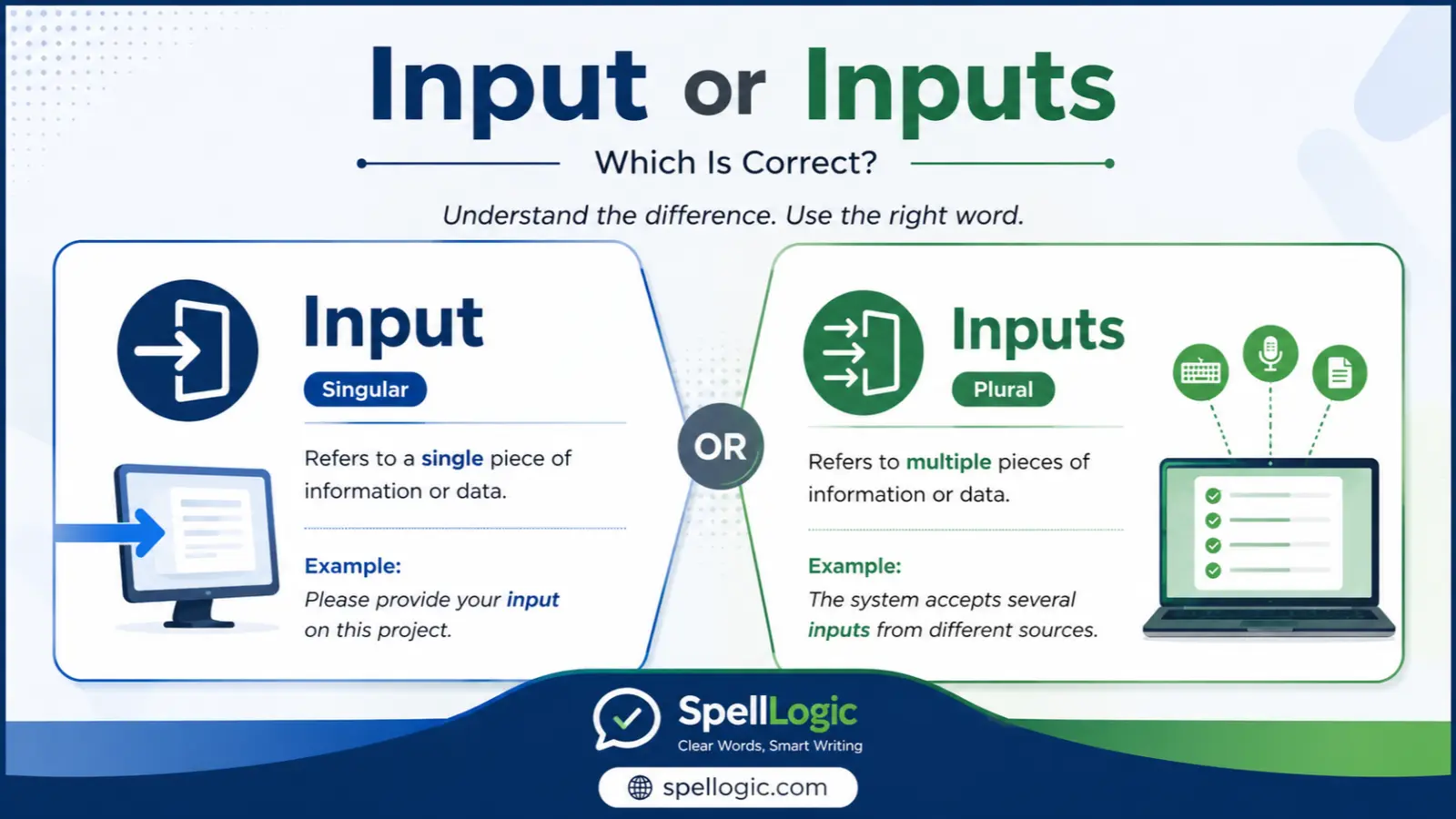
English learners often wonder whether input or inputs is the correct form because both words are used when talking about information, data, advice, or something entered into a system. The confusion becomes greater because the word can work as both a noun and a verb, and its plural form does not always behave like ordinary countable nouns.
Understanding when to use the singular and plural forms will help you write more naturally and avoid unnecessary grammar mistakes. In this guide, we will explain the difference in simple English, show common examples, and give you practical ways to remember which form fits different situations.
Why “Input” and “Inputs” Are Confusing
Many English learners mix up input or inputs because the two forms have almost the same spelling and pronunciation. The only visible difference is the final -s, but that small change can affect the meaning and grammar of a sentence.
Similar Pronunciation
The words sound almost identical when spoken naturally. The plural form simply adds an /s/ sound at the end. Because this difference can be very small in fast speech, learners may not notice it.
Similar Spelling
The singular form is input, while the plural form is inputs. The spelling is therefore very similar, which can make it difficult to decide which form is appropriate.
Context Confusion
The biggest problem is context. Sometimes input refers to information in general and does not need a plural form. In other situations, inputs refers to several separate pieces of information, resources, or entries.
For example:
- “We need your input.”
- “The computer receives several inputs.”
The first sentence treats the idea as general feedback. The second refers to separate items.
Common Learner Mistakes
A common mistake is adding -s simply because several pieces of information are involved. However, input can be an uncountable noun when it means advice, feedback, or information generally.
Another mistake is using the singular form when several distinct entries or sources are clearly being discussed.
Input vs Inputs Explained Simply
The basic difference between input or inputs is grammatical and contextual.
Input can mean information, advice, feedback, data, or something entered into a system. It can be singular and can also function as an uncountable noun.
Inputs is the plural form when you are talking about two or more distinct inputs, entries, resources, or contributions.
One-Line Distinction
Input usually refers to information or contribution in general, while inputs refers to multiple separate items or sources.
Example Sentences
- “Your input is valuable to the project.”
- “The system combines inputs from several sensors.”
In the first example, feedback is treated as a general idea. In the second, there are several distinct sources.
Understanding Homophones in English
The difference between input or inputs is not a homophone issue. These words are related forms of the same word rather than two unrelated words that happen to sound alike.
What Are Homophones?
Homophones are words that have the same pronunciation but different meanings, spellings, or both.
For example:
- Sea means a large body of salt water.
- See means to look at or notice something.
They sound the same, but their meanings and spellings differ.
Why Homophones Cause Confusion
Homophones can confuse learners because listening alone may not reveal which word a speaker means. Context usually provides the answer.
For example, “I can see the sea” contains two words with different meanings but almost identical pronunciation. By contrast, input or inputs are simply singular and plural forms, so grammar and context determine the correct choice.
What Does “Input” Mean?
Definition and Core Meaning
Input has several related meanings. As a noun, it can mean information, advice, feedback, data, or something provided to a process. It can also mean something entered into a computer or machine.
As a verb, it means to enter information into a computer, system, form, or device.
Examples include:
- “We need more input from the marketing team.”
- “Please input your password.”
- “The software uses customer data as input.”
- “Her input helped us improve the plan.”
When input means feedback or advice, it is often used as an uncountable noun. In this sense, we normally say:
- “I need your input.”
- “The manager asked for input from the staff.”
We do not usually say “inputs” simply because several people gave advice.
Origin and Historical Use
The word input developed from the combination of in and put. Its original sense was closely connected with putting something into a place or process.
Over time, its meaning expanded. With the growth of computing and information technology, input became an important technical term for information entered into a machine or computer system.
Today, the word is common in everyday English as well as business, education, science, economics, and technology.
Modern Usage and Synonyms
Depending on the context, useful synonyms include:
- feedback
- advice
- contribution
- information
- data
- entry
- contribution to a process
- resource
However, these synonyms are not always interchangeable. For example, feedback usually means comments or opinions, while input can describe a broader contribution.
More Example Sentences
- “The teacher welcomed student input.”
- “Please input the correct identification number.”
- “We need expert input before making a decision.”
- “The program requires user input.”
- “His input made the discussion more productive.”
What Does “Inputs” Mean?
Definition and Core Meaning
Inputs is the plural form of the noun input and the third-person singular present form of the verb input.
As a noun, it can refer to several separate pieces of information, data entries, contributions, resources, or signals.
For example:
- “The machine receives inputs from three sensors.”
- “The report considers inputs from several departments.”
- “The model uses different inputs to produce a result.”
As a verb, inputs is used with he, she, it, or another singular subject.
For example:
- “She inputs the data every morning.”
- “The program automatically inputs the values.”
Origin and Historical Context
The plural form developed naturally from the noun input as English began using the word for separate items or contributions. Its technical use became especially common with computers, machines, databases, and mathematical models.
In modern English, inputs is especially useful when several clearly identifiable sources or entries are being discussed.
Modern Usage and Synonyms
Depending on context, possible alternatives include:
- entries
- data points
- contributions
- resources
- sources
- signals
- pieces of information
The correct synonym depends on the situation. For example, entries may work for information entered into a form, while signals may be better for information received by a sensor.
More Example Sentences
- “The system processes multiple inputs.”
- “The manager collected inputs from five departments.”
- “These inputs affect the final result.”
- “The application accepts several inputs.”
- “She inputs the figures into the spreadsheet.”
Input vs Inputs: Key Differences at a Glance
| Word | Part of Speech | Meaning | Example Context |
|---|---|---|---|
| Input | Noun | Information, feedback, data, contribution, or something entered into a process | “We need your input.” |
| Input | Verb | To enter information into a system | “Please input the code.” |
| Inputs | Plural noun | Two or more separate pieces, sources, entries, or contributions | “The system receives several inputs.” |
| Inputs | Verb | Enters information; used with a singular third-person subject | “She inputs the data.” |
The table shows why input or inputs cannot be selected simply by looking at the number of people involved. The intended meaning and grammatical role matter.
For instance, “We received input from ten employees” can be correct because input means general feedback. However, “We received inputs from ten separate systems” can also be correct when each system provides a distinct contribution.
How to Remember the Difference Between Input and Inputs
Learning input or inputs becomes easier when you focus on whether you mean a general contribution or separate items.
Easy Memory Tricks
Think of input as one general stream of information:
Input = information or contribution in general.
Think of inputs as several identifiable things:
Inputs = multiple separate entries or sources.
Association Techniques
You can connect the singular form with words such as:
- feedback
- advice
- information
- contribution
You can connect the plural form with:
- entries
- signals
- sources
- separate contributions
Another useful trick is to ask:
“Can I clearly count the separate things?”
If yes, the plural form may be appropriate. If you mean advice or feedback generally, the singular form is usually more natural.
One Memorable Example
Remember this pair:
- “The manager asked for employee input.”
- “The computer received inputs from four sensors.”
The manager wants feedback as a general contribution. The computer receives several distinct signals.
Common Mistakes and Confusions
Mistake 1: Treating General Feedback as Countable
✘ “The manager asked for many inputs from the employees.”
✔ “The manager asked for input from the employees.”
Explanation: When you mean feedback or opinions generally, the singular uncountable noun is normally preferred.
Mistake 2: Using the Singular Form for Clearly Separate Items
✘ “The machine combines three input from different sensors.”
✔ “The machine combines three inputs from different sensors.”
Explanation: Three distinct signals or data sources are being counted, so the plural noun is required.
Mistake 3: Confusing the Noun and Verb
✘ “She input the information every morning.”
✔ “She inputs the information every morning.”
Explanation: In standard present-tense usage, inputs is the third-person singular form of the verb.
However, the past tense is commonly input:
- “She input the information yesterday.”
Mistake 4: Assuming Every Plural Idea Needs “-s”
✘ “We received several inputs from the team.”
✔ “We received input from several team members.”
Explanation: The first sentence can be correct if the writer means several distinct contributions. The second is more natural when referring generally to feedback from people.
Examples Section: Correct and Incorrect Usage
Example 1
✔ Correct: “Your input will help us make a better decision.”
✘ Incorrect: “Your inputs will help us make a better decision.”
Why? Here, the word refers to general advice or feedback.
Example 2
✔ Correct: “The device receives inputs from multiple sensors.”
✘ Incorrect: “The device receives input from multiple sensors.”
Why? The sentence emphasizes several separate signals or sources, so the plural form is suitable.
Example 3
✔ Correct: “Please input your email address.”
✘ Incorrect: “Please inputs your email address.”
Why? After please, the base form of the verb is required.
Example 4
✔ Correct: “She inputs the figures into the system every day.”
✘ Incorrect: “She input the figures into the system every day.”
Why? The sentence describes a regular present-tense action with a singular subject, so inputs is the correct verb form.
Example 5
✔ Correct: “We need input from our customers.”
✘ Incorrect: “We need inputs from our customers.”
Why? The intended meaning is general feedback. The singular uncountable noun sounds more natural.
Example 6
✔ Correct: “The software uses several inputs to calculate the result.”
✘ Incorrect: “The software uses several input to calculate the result.”
Why? The adjective several requires a countable plural noun.
Self Assessment: Test Your Knowledge
Fill in each blank with input or inputs.
- We need your ______ before we finalize the proposal.
- The machine receives data from five different ______.
- Please ______ your username into the form.
- She ______ the information into the database every afternoon.
Self Assessment Answers
- input — It refers to general feedback or advice.
- inputs — Five separate data sources are being counted.
- input — It follows please, so the base verb is needed.
- inputs — The subject she requires the third-person singular present verb.
FAQs About
Is “input” singular or plural?
Input is normally the singular noun. It can also be an uncountable noun when it means general feedback, advice, or information.
Is “inputs” the plural of “input”?
Yes. Inputs is the regular plural noun when you are talking about multiple separate inputs, entries, sources, or contributions.
Is “input” a noun or a verb?
It can be both. As a noun, it can mean information or feedback. As a verb, it means to enter information into a system or device.
Can I say “inputs” when talking about feedback?
Sometimes, but context matters. If you mean general feedback or advice, input is usually more natural. If you mean several distinct contributions, inputs can be appropriate.
Which form is correct after “several”?
Use inputs because several is followed by a plural countable noun.
For example: “The system requires several inputs.”
Is “she inputs” grammatically correct?
Yes. When input is used as a present-tense verb with he, she, or it, the correct form is inputs.
What is the past tense of “input”?
The past tense is commonly input. For example: “She input the data yesterday.” In some contexts, inputted is also encountered, but input is widely used and preferred in standard usage.
Final Conclusion: Using “Input” and “Inputs” Correctly
Choosing between input or inputs becomes much easier once you understand whether you are talking about a general contribution, a single entry, several separate items, or a verb used with a particular subject. Input commonly refers to information, advice, feedback, data, or a contribution in general. It can also be the base form of the verb meaning “to enter information.” Inputs is used as a plural noun for multiple distinct entries, sources, signals, or contributions. It is also the present-tense verb form used with a singular third-person subject, such as “she inputs the data.”
A useful memory rule is simple: think of input as a general contribution and inputs as separate, countable items. Also remember that “please input” uses the base verb, while “she inputs” uses the third-person singular form. With regular practice, you will quickly recognize which form fits the context. Pay attention to whether you are counting separate things or describing information generally. Most importantly, do not worry if the distinction feels difficult at first. Reading examples, writing your own sentences, and checking the surrounding grammar will help you use both forms naturally and confidently.