English learners often wonder whether they should say “fairer” or “more fair” when comparing two people, situations, or decisions. Both forms are used in English, so the choice can feel confusing at first. The good news is that neither form is automatically wrong. The main difference is one of style, rhythm, and preference rather than meaning. In everyday English, fairer is usually the more natural and concise comparative form.
However, more fair also appears, especially when a speaker wants to emphasize the comparison or prefers a less compressed structure. Understanding this small grammar point can make your writing and speaking sound more natural and confident. The choice between fairer or more fair often depends on style rather than meaning.
Why “Fairer or More Fair” Are Confusing
English has more than one way to form some comparative adjectives, and fair is one of the adjectives that can be compared with either -er or more. That flexibility makes learners hesitate when choosing one form. When learners search for fairer or more fair, they are usually asking which comparative form sounds most natural.
Similar pronunciation
The words do not sound identical, but the difference can disappear in fast speech. A learner may hear “fairer” as something close to “fair” followed by a weak ending. This can make the longer form seem less obvious. Knowing the difference between fairer or more fair helps you choose confidently in everyday English.
Similar spelling
Both forms contain the same adjective, fair. The only structural difference is that one adds -er, while the other adds more before the adjective. In grammar discussions, fairer or more fair is a useful example of flexible comparative formation.
Context confusion
Both forms can describe something that is more just, reasonable, equal, or acceptable than something else. For example, a person may describe a new rule as fairer or more fair. The meaning stays almost the same. For most learners, fairer or more fair becomes easy once the basic rule is clear.
Common learner mistakes
A frequent mistake is assuming that only one form can ever be correct. Another is using both comparative markers together, as in “more fairer.” That construction is incorrect because more and -er should not normally be combined for the same comparative adjective. The question of fairer or more fair usually matters most when you are comparing two choices.
Fairer vs More Fair Explained Simply
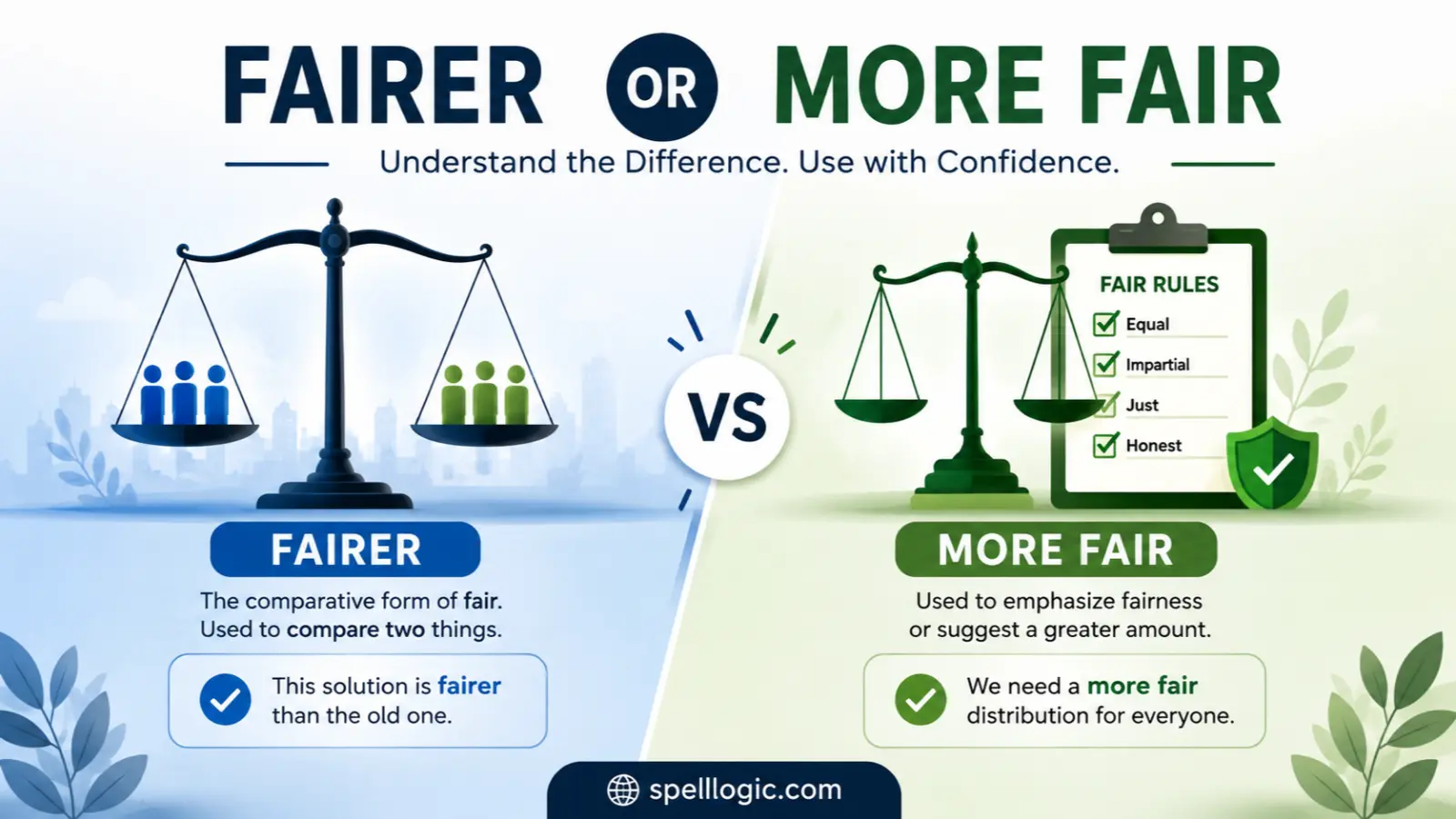
The simplest answer is that both forms are grammatically possible, but fairer is generally the more traditional and compact comparative form. In ordinary conversation, fairer or more fair can both be understood without difficulty.
One-line distinction: fairer is the usual comparative form of fair, while more fair is an accepted alternative that can sound more deliberate or emphatic.
Here are two examples:
- The new system is fairer to small businesses than the old one.
- The judge tried to create a more fair process for everyone involved.
So, fairer or more fair can communicate the same basic comparison, but the first form is often preferred in concise standard English.
Understanding Homophones in English
This comparison is not really a homophone issue. Still, understanding homophones helps explain why English learners sometimes confuse words that sound similar. The grammar behind fairer or more fair is simpler than it first appears.
What Are Homophones?
Homophones are words that have the same pronunciation but different meanings, spellings, or both. For example, right and write sound the same but have different meanings.
Why Homophones Cause Confusion
Learners cannot always identify a word from sound alone. For instance, hearing “right” does not tell you whether the speaker means the opposite of left or the act of writing. With fairer and more fair, however, the problem is different: these are two grammatical ways of making a comparison, not homophones. A quick search for fairer or more fair may show both forms because English usage allows variation.
What Does “Fairer” Mean?
Definition and Core Meaning
Fairer is the comparative form of the adjective fair. It means “more fair” and is used when comparing two things, people, decisions, systems, or situations. The phrase fairer or more fair can describe rules, prices, decisions, opportunities, and treatment.
The adjective fair has several related meanings. It can describe something that treats people equally, follows reasonable standards, or is morally just. It can also mean acceptable or reasonable in expressions such as “a fair price.” When discussing fairer or more fair, focus first on the meaning of the adjective fair.
Origin and Historical Use
The word fair has a long history in English and developed from Germanic roots associated with beauty, pleasantness, and suitability. Over time, its meanings expanded. The modern sense connected with justice and equal treatment became firmly established in English usage.
The comparative ending -er is one of the oldest and most familiar ways English forms comparisons. This is why fairer fits naturally into a large group of comparative adjectives. The comparison fairer or more fair does not change the basic meaning of fairness.
Modern Usage and Synonyms
Today, fairer is common in conversation, journalism, education, business writing, and formal discussion. It is especially useful when the sentence is concise and the comparison is straightforward. Learners can master fairer or more fair by noticing which form appears naturally in edited English.
Depending on context, useful synonyms or related expressions include:
- more just
- more equitable
- more reasonable
- more impartial
- more balanced
- more even-handed
Example Sentences
- We need a fairer way to distribute the available resources.
- The revised policy gives employees a fairer chance to apply.
- Her proposal offers a fairer solution for both sides.
- The second price seems fairer than the first.
- The teacher created a fairer grading system.
In each example, the adjective compares one situation with another. The ending -er clearly signals the comparative meaning. If you are unsure about fairer or more fair, choose the shorter comparative form in most cases.
What Does “More Fair” Mean?
Definition and Core Meaning
More fair has essentially the same meaning as fairer. It describes something that is more just, reasonable, balanced, or acceptable than another thing. Both fairer or more fair can express a stronger degree of fairness.
Although more fair is less compact, it is used in real English. It can be useful when a writer or speaker wants the comparison to feel especially clear or when the phrase fits the rhythm of the sentence better.
Origin and Historical Context
English developed several ways to create comparisons. The use of more with adjectives became increasingly important as the language changed, especially for longer or more complex adjectives. In modern English, speakers sometimes extend this pattern to shorter adjectives when it feels natural.
As a result, more fair can appear in edited writing as well as everyday speech. Usage varies by region, speaker, and style. The spelling pattern in fairer or more fair provides a useful lesson about English comparatives.
Modern Usage and Synonyms
The phrase is understandable and can be appropriate in many contexts. Still, when you want the most concise and conventional comparative form, fairer is often the safer choice. Examples of fairer or more fair are especially helpful when learning how comparisons work.
Related expressions include:
- more equitable
- more reasonable
- more just
- more balanced
- more impartial
- more acceptable
Example Sentences
- The revised procedure is more fair to applicants with limited experience.
- We need a more fair distribution of responsibilities.
- This arrangement seems more fair to everyone involved.
- The new rules are more fair than the previous rules.
- They argued for a more fair approach to funding.
These sentences show that the alternative construction can communicate the intended comparison clearly. Context can make fairer or more fair feel more natural in one sentence than another.
Fairer vs More Fair: Key Differences at a Glance
| Word | Part of Speech | Meaning | Example Context |
|---|---|---|---|
| Fairer | Comparative adjective | More fair; more just or reasonable | “This policy is fairer to workers.” |
| More fair | Comparative adjective phrase | More just, reasonable, or balanced | “This policy is more fair to workers.” |
The two forms normally express the same comparison. The main difference is style and preference. Fairer is shorter and usually sounds more natural, while more fair can place extra emphasis on the word more. The distinction between fairer or more fair is mainly about form, preference, and style.
How to Remember the Difference Between Fairer and More Fair
A useful memory trick is to think of fairer as the standard short comparative form. Remembering fairer or more fair is easier when you connect fair with familiar short comparatives.
Easy memory tricks
- Fair + er = fairer
- Use more + fair when you prefer the expanded comparative structure.
- Never use more fairer in standard English.
Association techniques
Connect fairer with other familiar short comparatives such as:
- fast → faster
- kind → kinder
- clear → clearer
- fair → fairer
This pattern helps you remember that fairer is a natural comparative form. For fairer or more fair, the key is to remember that both can express comparison, but the shorter form is usually preferred.
One memorable example
Imagine two ways of dividing a cake. If one division gives everyone a more equal share, you can say:
“The second way is fairer.”
You could also say:
“The second way is more fair.”
Remember: fairer is the shorter choice; more fair is the expanded choice.
Common Mistakes and Confusions
Wrong example
✘ The new policy is more fairer than the old policy.
Correct version
✔ The new policy is fairer than the old policy.
Explanation
The mistake happens because the learner uses two comparative markers at once. More already signals comparison, and -er also signals comparison. In standard usage, you normally choose one structure. In practical English, fairer or more fair can both communicate a stronger sense of equality.
Another common mistake
✘ This decision is fair than the previous one.
✔ This decision is fairer than the previous one.
The word fair alone is the positive form. When you compare two things, use a comparative form such as fairer or more fair, usually followed by than. Remember fairer or more fair when making comparisons between two situations.
A style-related mistake
Some learners believe that more fair is always wrong. That is too strict. It is used in English, although fairer is generally more concise and often more idiomatic. The rule for fairer or more fair is useful in school writing, workplace communication, and conversation.
Examples Section: Correct and Incorrect Usage
For fairer or more fair, context matters.
Both fairer or more fair sound natural.
Example 1
✔ Correct: The new schedule is fairer for everyone.
✘ Incorrect: The new schedule is more fairer for everyone.
Why? The second sentence uses two comparative markers together.
Example 2
✔ Correct: We need a more fair system for selecting candidates.
✘ Incorrect: We need a more fairer system for selecting candidates.
Why? The expanded comparative is possible, but adding -er to it creates an incorrect double comparative.
Example 3
✔ Correct: This price seems fairer than the original price.
✘ Incorrect: This price seems fair than the original price.
Why? The comparison requires a comparative form.
Example 4
✔ Correct: The revised process is more fair to new employees.
✘ Incorrect: The revised process is more fairer to new employees.
Why? More fair already expresses the comparison, so another comparative ending is unnecessary.
Example 5
✔ Correct: The teacher introduced a fairer grading policy.
✘ Incorrect: The teacher introduced a more fairer grading policy.
Why? Use either the -er form or the more construction, not both together.
Practice fairer or more fair aloud.
Compare fairer or more fair in context.
Self Assessment: Test Your Knowledge
Choose the best option for each sentence.
- The new rule is ______ to all students.
a) fairer
b) more fairer - We need a ______ way to divide the money.
a) more fair
b) more fairer - This arrangement is ______ than the previous one.
a) fairer
b) fair - The revised system seems ______ to small businesses.
a) fairer
b) more fairer
Self Assessment Answers
- fairer — It is the standard comparative form.
- more fair — This alternative comparative form is possible.
- fairer — A comparison needs the comparative form.
- fairer — More fairer incorrectly uses two comparative markers.
Review fairer or more fair regularly.
Notice fairer or more fair in reading.
FAQs
Is fairer or more fair more correct?
Fairer is generally the preferred and more concise comparative form. More fair is also used and can be acceptable depending on context and style. The choice between fairer or more fair is usually a matter of usage and preference.
Is fairer grammatically correct?
Yes. Fairer is the regular comparative form of fair and is widely used in standard English.
Can I use more fair in formal writing?
Yes. More fair can occur in formal writing, although fairer is often smoother and more economical.
Is more fairer correct?
No. More fairer is generally considered an incorrect double comparative. Choose fairer or more fair. Use fairer or more fair correctly by selecting only one comparative marker.
Should I always use fairer?
Not necessarily. Fairer is usually the best default, but more fair may work when it sounds clearer or fits the sentence better. The practical rule for fairer or more fair is to prefer fairer unless there is a reason to choose the longer form.
Does fairer mean more just?
Yes. When fair means just or equitable, fairer means more just or equitable.
What is the comparative form of fair?
The usual comparative form is fairer. More fair is also used as an alternative. Use fairer or more fair according to context and preferred style.
Use fairer or more fair with confidence.
Final Conclusion: Using Fairer and More Fair Correctly
Understanding fairer and more fair is easier once you recognize that both forms can express the same basic comparative idea. Fairer is the regular, comparative form of fair, and it is usually the best choice when you want natural, concise English. More fair can also be used, particularly when the expanded structure fits the sentence or the speaker wants to make the comparison more explicit. The important rule is to avoid more fairer, because it combines two comparative markers unnecessarily.
When fair means just, reasonable, balanced, or equitable, its comparative meaning is “more fair.” In everyday writing and conversation, fairer will often sound smoother: “The new rule is fairer to everyone.” However, saying “The new rule is more fair to everyone” can still communicate the intended meaning clearly. As you practice, pay attention to how comparisons are formed with other short adjectives, and remember the simple pattern fair + -er = fairer. Most importantly, do not worry about this distinction too much. Both accepted forms are understandable, and choosing fairer as your default will help your English sound natural and confident. Keep practicing, read widely, and your sense of comparative forms will become stronger over time.