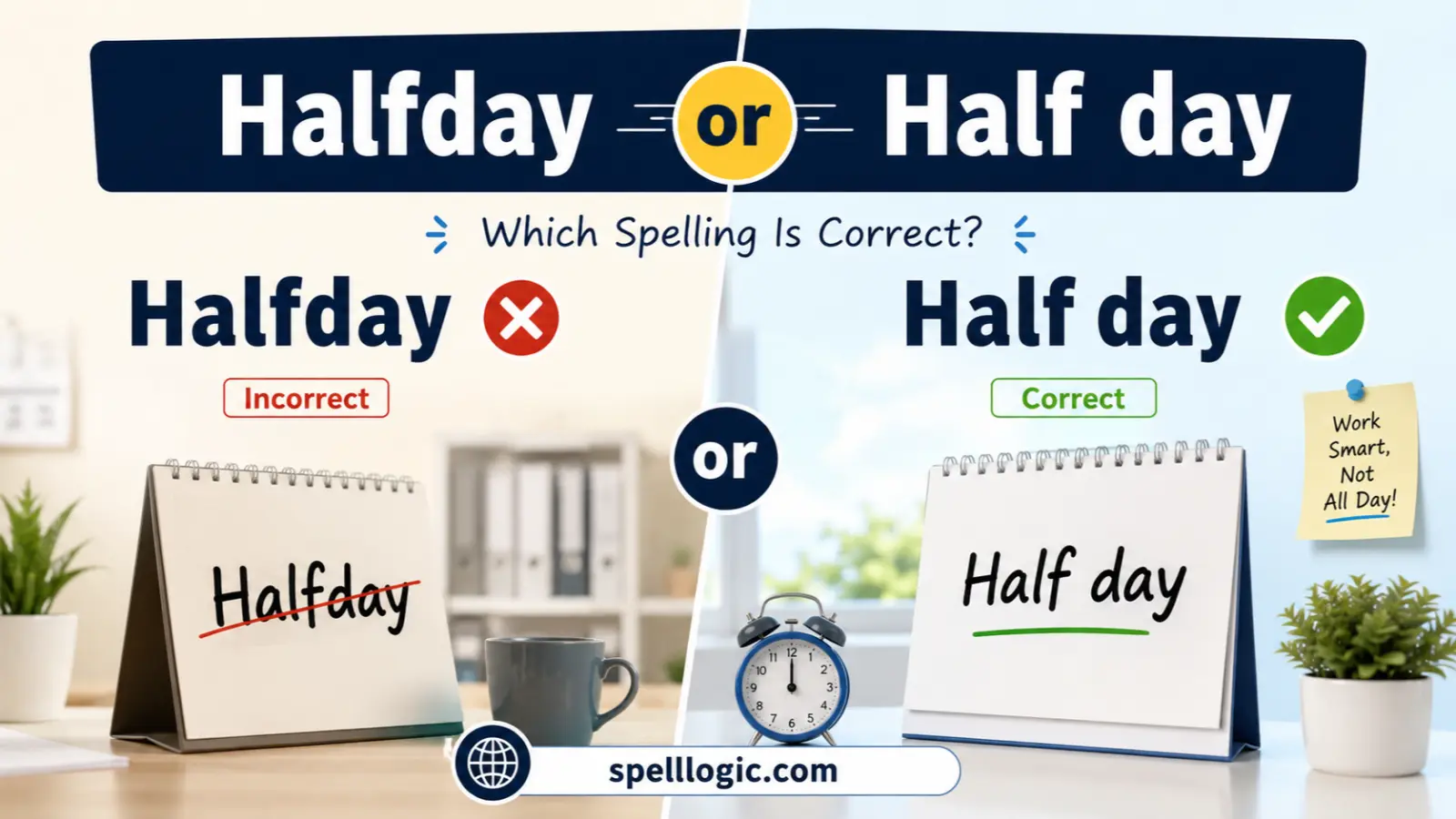
English learners often wonder whether halfday or half day is the correct form because the two versions look almost identical and sound the same in normal speech. The confusion becomes greater when learners see phrases such as “a half-day course,” “half a day,” and “half day leave” in different types of writing.
In standard English, half day is generally written as two words when it functions as a noun phrase, while half-day is commonly used as a compound adjective before a noun. The closed form halfday is generally not the standard spelling. Understanding this small difference can make your writing clearer, more natural, and more professional.
Why “halfday” and “half day” Are Confusing
The confusion mainly comes from the fact that English frequently combines words into compounds. Learners may therefore assume that two familiar words should always be joined together when they describe one idea.
Similar pronunciation
There is normally no meaningful pronunciation difference between the closed spelling and the two-word expression. When people speak quickly, half day sounds like a single unit. This can make learners unsure about how to represent it in writing.
For example:
- “I worked half a day.”
- “It was a half-day workshop.”
The spoken forms can sound very similar, but their grammatical roles are different.
Similar spelling
The words half and day naturally appear together in many contexts. Because English has compounds such as weekday, daytime, and daybreak, learners may incorrectly assume that halfday follows the same pattern.
However, standard English normally does not use halfday as a closed compound.
Context confusion
The expression changes slightly depending on how it is used. When the phrase acts as a noun expression, it is usually written as half day. When it describes another noun, the compound adjective half-day is often appropriate.
Compare:
- “I took a half day off.”
- “I attended a half-day training session.”
The hyphen helps readers understand that half-day works together to modify training session.
Common learner mistakes
Common errors include:
- Writing halfday as one word.
- Using half day without understanding its grammatical function.
- Leaving out the hyphen when the expression comes directly before a noun as a compound modifier.
- Confusing half day with half a day.
- Treating every use as though it needs the same punctuation.
The safest approach is to consider the role of the phrase in the sentence rather than simply how it sounds.
halfday vs half day Explained Simply
The simplest answer is that halfday is generally not the standard form in modern English. Half day is normally written as two words when referring to a period that lasts half of a day. A hyphen is commonly used in half-day when the expression functions as an adjective before a noun.
One-line distinction
Halfday is generally nonstandard, while half day is the normal two-word expression; half-day is commonly used as a compound adjective.
Examples
- “I only worked for a half day because the office closed early.”
- “She joined a half-day workshop on communication skills.”
In the first sentence, half day identifies a period of time. In the second, half-day describes the type or duration of the workshop.
So, when deciding halfday or half day, remember that the standard choice is normally two words, with a hyphen used when the phrase acts as a compound adjective.
Understanding Homophones in English
This issue is related to pronunciation, but it is not actually a homophone problem. Homophones are different words that have the same pronunciation but different meanings or spellings.
What Are Homophones?
Homophones are words that sound alike but have different meanings, and sometimes different spellings.
For example:
- right and write
- sea and see
- flower and flour
The listener must use context to understand which word the speaker means.
Why Homophones Cause Confusion
Pronunciation does not always tell us how a word or phrase should be written. For example, right and write sound the same, but they cannot be used interchangeably.
The same general lesson applies here: hearing an expression does not automatically tell you whether English writers use one word, two words, or a hyphenated compound. In this case, however, halfday and half day are not true homophones because halfday is generally not accepted as a standard word.
What Does “halfday” Mean?
Definition and Core Meaning
Halfday is generally not considered the standard spelling in contemporary standard English. Most dictionaries and conventional usage prefer either half day, half a day, or half-day, depending on the grammatical context.
The intended meaning is usually easy to understand: a period lasting approximately half of a normal day. Nevertheless, being understandable does not automatically make a spelling standard.
Origin and Historical Use
English has a long history of turning combinations of words into compounds. Some compounds become established as single words over time, while others remain open or become hyphenated.
The combination of half and day has generally remained flexible rather than becoming a universally accepted closed compound. Modern style therefore favors forms based on grammatical function.
Modern Usage and Synonyms
Instead of the nonstandard closed form, writers can use:
- half day — a period covering half of a day.
- half a day — a natural expression for a duration.
- half-day — a compound adjective before a noun.
- four-hour session — useful when a specific duration is known.
- morning session or afternoon session — useful when referring to part of a working or school day.
Example sentences
- “The employee requested a half day off.”
- “We spent half a day exploring the museum.”
- “The company arranged a half-day seminar.”
- “The school has a half-day schedule on Friday.”
These examples show why replacing the standard expressions with halfday can make writing look unusual or incorrect.
What Does “half day” Mean?
Definition and Core Meaning
Half day is a two-word noun phrase referring to a period that covers approximately one-half of a day. It can describe work, school, leave, activities, appointments, or other periods of time.
For example, “I need a half day off” means that the speaker needs approximately half of the normal working day away from work.
The phrase half a day is also extremely common. It emphasizes duration and often sounds more natural in general statements.
Origin and Historical Context
The phrase developed naturally from the ordinary meanings of half and day. Half indicates one of two equal parts, while day refers to the relevant period of daytime or a full daily period, depending on context.
Unlike established compounds such as weekday, the expression has generally retained its separate-word structure in ordinary usage.
Modern Usage and Synonyms
Today, the phrase is common in everyday and professional English.
Useful alternatives include:
- half a day
- part of a day
- half-day
- morning
- afternoon
- partial day
- four hours, when the exact duration is known
The best choice depends on the context. For example, “half a day” works well when talking about duration, while “half-day course” is useful when describing a course.
Example sentences
- “I will be away from work for half a day.”
- “The appointment took half a day.”
- “She requested a half day of leave.”
- “They offer a half-day training program.”
- “We need only half a day to complete the task.”
Notice that the two-word form can occur in several grammatical patterns, while the hyphenated form is especially useful before a noun.
halfday vs half day: Key Differences at a Glance
| Word | Part of Speech | Meaning | Example Context |
|---|---|---|---|
| halfday | Generally nonstandard closed form | Intended to mean half of a day | Avoid in standard formal writing |
| half day | Noun phrase | A period covering half of a day | “I took a half day off.” |
| half-day | Compound adjective | Describes something lasting half a day | “A half-day course was offered.” |
| half a day | Noun phrase | A duration equal to half a day | “It took half a day.” |
This table makes the central point clear: the spelling should match the grammatical function.
How to Remember the Difference Between halfday and half day
A few simple memory tricks can help you remember the standard forms.
Easy memory tricks
Think: “Half + day = two words.”
When you are talking about the amount of time itself, keep half and day separate.
For example:
“I worked for a half day.”
When the expression describes a noun immediately afterward, think:
“Description = hyphen.”
For example:
“It was a half-day course.”
Association techniques
Associate the three useful forms with three functions:
- half day → a period of time
- half-day → describes a noun
- half a day → emphasizes duration
- halfday → avoid in standard English
This simple pattern is easier to remember than memorizing isolated rules.
One memorable example
Remember this pair:
“I took a half day off.”
“I attended a half-day class.”
The first refers to time taken away from work or another activity. The second describes the class.
Common Mistakes and Confusions
One frequent mistake is joining the two words simply because they refer to one idea.
Wrong example
✘ “I need a halfday off.”
Correct version
✔ “I need a half day off.”
The phrase is functioning as a noun expression, so the two words remain separate.
Another common mistake
✘ “We attended a half day workshop.”
Better version
✔ “We attended a half-day workshop.”
Here, the expression modifies workshop. The hyphen makes the compound relationship clear.
Confusion with “half a day”
Learners may also wonder whether “half day” and “half a day” have exactly the same use.
Compare:
- “The task took half a day.”
- “I took a half day off.”
Both are grammatical, but they are structured differently. The article a is part of the expression half a day, while a half day uses half day as a noun phrase.
Another issue is regional or institutional style. Some organizations may write “half-day leave” or “half day leave” according to their house style. When formal consistency matters, follow the style guide used by the organization.
Examples Section: Correct and Incorrect Usage
Example 1
✔ Correct: “I worked only a half day yesterday.”
✘ Incorrect: “I worked only a halfday yesterday.”
Explanation: The standard noun phrase is written as two words.
Example 2
✔ Correct: “She attended a half-day seminar.”
✘ Incorrect: “She attended a half day seminar.”
Explanation: When the expression functions as a compound adjective directly before seminar, the hyphen is commonly used.
Example 3
✔ Correct: “We spent half a day at the library.”
✘ Incorrect: “We spent halfday at the library.”
Explanation: Half a day is a natural duration expression, whereas the closed spelling is not standard.
Example 4
✔ Correct: “The company offers half-day training sessions.”
✘ Incorrect: “The company offers halfday training sessions.”
Explanation: The adjective half-day describes the training sessions, so the hyphenated form is appropriate.
Example 5
✔ Correct: “He requested a half day of leave.”
✘ Incorrect: “He requested a halfday of leave.”
Explanation: The standard noun phrase is open, not closed.
Example 6
✔ Correct: “The students have a half-day schedule.”
✘ Incorrect: “The students have a half day schedule.”
Explanation: The compound adjective comes directly before schedule, so the hyphen improves clarity.
Self Assessment: Test Your Knowledge
Fill in each blank with half day, half-day, or half a day.
- I need to take a ______ off from work tomorrow.
- The manager organized a ______ training session.
- We spent ______ completing the project.
- The school follows a ______ schedule on Friday.
Self Assessment Answers
- half day — “I need to take a half day off from work tomorrow.”
- half-day — “The manager organized a half-day training session.”
- half a day — “We spent half a day completing the project.”
- half-day — “The school follows a half-day schedule on Friday.”
The answers demonstrate the main pattern: use the open form for the noun phrase, the hyphenated form for a compound adjective, and half a day for a duration expression.
FAQs
Is halfday one word?
No. Halfday is generally not the standard spelling in contemporary English. Use half day, half a day, or half-day according to the sentence.
Is half day correct English?
Yes. Half day is correct when it functions as a noun phrase, as in “I took a half day off.”
Should I write half-day with a hyphen?
Usually, yes, when it functions as a compound adjective before a noun, such as “a half-day course” or “a half-day workshop.”
Is “half a day” grammatically correct?
Yes. Half a day is a very common expression for describing a duration. For example, “The journey took half a day.”
Which is correct for formal writing?
Avoid the closed form halfday. In formal writing, choose half day, half a day, or half-day according to grammatical function and the style guide you are following.
Is half day or half-day used for leave?
Both may appear depending on grammatical structure and organizational style. For example, “I requested a half day of leave” uses the noun phrase, while “half-day leave” uses a compound modifier.
Is halfday or half day the correct spelling?
Half day is the standard two-word form. When it modifies a following noun, half-day is commonly used. The closed form halfday should generally be avoided.
Final Conclusion: Using “halfday” and “half day” Correctly
Knowing whether to write halfday or half day becomes much easier once you focus on grammar instead of pronunciation. The closed form halfday is generally not standard English, so it is best avoided in formal and everyday writing. When you are referring to a period of time, use half day or the very common expression half a day. For example, you can say, “I took a half day off” or “The work took half a day.” However, when the phrase describes another noun, the hyphenated half-day is commonly preferred: “a half-day course,” “a half-day workshop,” or “a half-day schedule.”
The easiest memory rule is simple: two words for the time period, a hyphen when the phrase acts as a compound adjective, and never normally one closed word. This distinction is useful in workplace emails, school notices, schedules, applications, reports, and everyday conversations. Once you recognize the grammatical role of the phrase, choosing the correct form becomes almost automatic. Keep practicing these small differences, and your English writing will become more accurate, natural, and confident.