English learners often hesitate when choosing between “in” and “on” before the word “playground.” The confusion is understandable because both prepositions can describe a person’s location near a place where children play. However, English uses prepositions to show different relationships between people, places, and surfaces.
Understanding that difference can make your everyday English sound much more natural. This guide explains the phrase in the playground or on the playground in simple terms, with clear rules, examples, common mistakes, and a short test. By the end, you will know when to use each form confidently in conversation and writing.
Why “in the playground or on the playground” Are Confusing
The expression in the playground or on the playground can be confusing because both choices may sound reasonable when you are describing where children are playing. The main problem is that learners sometimes translate prepositions directly from their first language instead of following the usual English pattern.
The question in the playground or on the playground often appears in learner searches.
Similar pronunciation
Learners may ask about in the playground or on the playground when speaking quickly.
Similar spelling
There is no spelling similarity between “in” and “on,” but both are very short prepositions. Their simple form can make their grammatical function seem interchangeable when it is not.
Context confusion
Context usually gives the answer to in the playground or on the playground.
A playground is both a defined area and a physical place containing equipment and surfaces. English speakers can therefore use different prepositions depending on what they want to emphasize. If the focus is being inside the playground area, in the playground or on the playground becomes a useful comparison.
Common learner mistakes
A frequent mistake is assuming that “on” must always refer to a physical surface. In everyday English, “on the playground” commonly means being at or using the playground area. Another mistake is thinking that “in” is always wrong because a playground is outdoors. Outdoor spaces can still be treated as enclosed or defined areas.
“in the playground” vs “on the playground” Explained Simply
The choice in in the playground or on the playground depends on the speaker’s viewpoint.
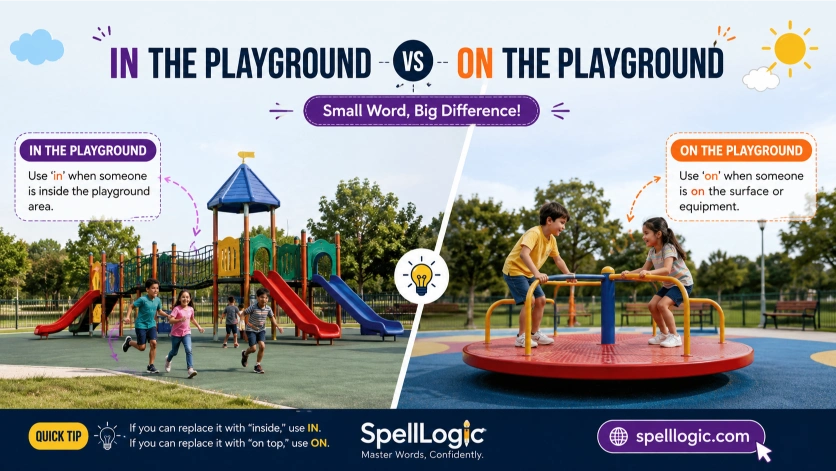
Simple explanation: “In the playground” usually emphasizes being within the playground area. “On the playground” commonly emphasizes being at the playground, often taking part in play or using its equipment.
One-line distinction: In focuses on being inside the area; on often focuses on being at or actively using the play area.
This makes in the playground or on the playground easier to understand.
For learners comparing in the playground or on the playground, remember that both forms can be correct. The intended meaning and regional usage matter.
Example 1: The children are in the playground, waiting for their teacher.
Example 2: The children are on the playground, climbing and playing together.
In many contexts, either form can describe the same general location. The difference is usually one of perspective rather than a strict rule that makes one form universally correct.
Understanding Homophones in English
The phrase in the playground or on the playground does not contain homophones. The words “in” and “on” have different sounds and meanings. However, learning about homophones is useful because English learners often encounter similar-sounding words elsewhere.
What Are Homophones?
Homophones are words that sound the same, or almost the same in some varieties of English, but have different meanings and often different spellings. For example, “two,” “to,” and “too” are pronounced alike in standard English but have different functions.
Why Homophones Cause Confusion
Homophones can cause problems because listening alone may not tell you which word a speaker means. Context helps you choose the correct spelling and meaning. For example, “I have two books” and “I want to go too” sound similar around the target word but use different words.
It is important not to label in the playground or on the playground as a homophone problem. It is actually a preposition choice problem.
What Does “in the playground” Mean?
The first part of in the playground or on the playground describes an area.
Definition and Core Meaning
“In the playground” means within the area designated for children to play. The speaker views the playground as a place or area and places the person or thing inside that area.
For example, if a school has a fenced play area, a child standing anywhere within that area can naturally be described as being in the playground.
Modern Usage and Synonyms
In everyday English, in the playground or on the playground can describe similar situations.
Modern English uses “in” for many locations viewed as areas, spaces, or containers. Similar expressions include “in the park,” “in the garden,” and “in the school.”
Useful related expressions include:
- in the park
- in the garden
- in the schoolyard
- inside the play area
- within the playground
Example Sentences
- The students are in the playground during their break.
- I saw my son in the playground after school.
- Several parents were waiting in the playground.
- The teacher called the children back in the playground area.
When learners compare in the playground or on the playground, “in” is especially natural when the playground is treated as a defined area.
What Does “on the playground” Mean?
The second part of in the playground or on the playground often highlights activity.
Definition and Core Meaning
“On the playground” commonly means at the playground or using the playground as a place for play. It can also suggest activity on the playground’s ground or surfaces, depending on context.
In everyday speech, “on” is extremely common with activity areas. For example, people say “The children are on the playground” to describe children who are playing there.
Modern Usage and Synonyms
This pattern helps explain in the playground or on the playground in related expressions.
Modern English frequently uses “on” for surfaces and certain activity locations. Similar patterns include “on the field,” “on the court,” and “on the track.”
Common related expressions include:
- on the field
- on the court
- on the track
- at the playground
- using the play equipment
Example Sentences
- The children are on the playground after lunch.
- We watched the students on the playground.
- She met her friends on the playground.
- The coach asked everyone to gather on the playground.
In everyday English, “on the playground” is often the most natural choice when the sentence emphasizes playing, movement, or participation in playground activities.
That is why in the playground or on the playground can have more than one acceptable answer depending on the context.
“in the playground” vs “on the playground”: Key Differences at a Glance
| Word | Part of Speech | Meaning | Example Context |
|---|---|---|---|
| in | Preposition | Within a place or defined area | The children are in the playground. |
| on | Preposition | At, on, or associated with an activity area or surface | The children are on the playground. |
The table shows why in the playground or on the playground is not simply a case of one word being correct and the other being incorrect.
How to Remember the Difference Between “in the playground” and “on the playground”
A simple way to remember in the playground or on the playground is to imagine two different camera views.
Easy memory trick
Use the area-versus-activity idea for in the playground or on the playground.
Think IN = area. If you imagine a boundary around the playground and focus on the people inside it, “in” feels natural.
Think ON = activity. If you imagine children running, climbing, sliding, or playing, “on” often sounds natural.
Association technique
Connect “in” with places that feel like areas:
- in the park
- in the garden
- in the yard
Connect “on” with activity locations:
- on the field
- on the court
- on the track
- on the playground
One memorable example
Imagine a teacher looking at the whole schoolyard: “The children are in the playground.” Then imagine the teacher describing their activity: “The children are on the playground, playing football.”
This mental picture makes in the playground or on the playground easier to remember without memorizing a complicated grammar rule.
Common Mistakes and Confusions
Many learners search in the playground or on the playground after hearing both forms.
Learners often make mistakes because they expect one preposition to work in every situation.
Mistake 1
✘ The children are in the playground, playing on the slide.
This sentence is not necessarily wrong. In fact, it can be perfectly natural, especially when “in” describes the overall area. However, if the speaker wants to emphasize the activity location, “on the playground” may sound more natural in some varieties of English.
Mistake 2
✘ “On” is always wrong because nobody can stand on the word playground.
The preposition does not need to refer literally to the word itself. English uses “on” in many activity-location expressions.
Better way to think
When discussing in the playground or on the playground, context is more useful than a rigid rule.
Examples Section: Correct and Incorrect Usage
These examples make in the playground or on the playground easier to apply.
Example 1
✔ Correct: The children are in the playground during the morning break.
This treats the playground as a defined area.
✘ Incorrect: The children are in the playground because “in” can never be used for outdoor places.
That explanation is incorrect. “In” can describe outdoor areas.
Example 2
✔ Correct: The children are on the playground, playing and running.
This emphasizes the activity taking place there.
✘ Incorrect: “On” is always wrong because nobody can stand on the word playground.
The preposition does not need to refer literally to the word itself. English uses “on” in many activity-location expressions.
Overall, in the playground or on the playground should be selected according to meaning, context, and natural English usage.
Self Assessment: Test Your Knowledge
Fill in each blank with in or on.
- The children are ___ the playground during recess.
- We saw several students ___ the playground playing together.
- My daughter is waiting ___ the playground for her teacher.
- The boys spent the afternoon ___ the playground.
Self Assessment Answers
- in — The sentence emphasizes the children’s location within the playground area.
- on — The sentence emphasizes the activity taking place at the playground.
- in — “In” naturally presents the playground as the area where the daughter is waiting.
- on — “On the playground” is natural when the sentence focuses on spending time playing or being active there.
Remember that some real-life sentences may allow either form, especially when the intended meaning does not strongly distinguish area from activity.
FAQs
These FAQs answer common questions about in the playground or on the playground.
1. Is “in the playground” correct?
Yes. It is correct when the speaker views the playground as an area or place and means that someone is within it.
2. Is “on the playground” correct?
Yes. It is very common when referring to children being at the playground and taking part in activities there.
3. Which is more common: “in the playground” or “on the playground”?
Both are used. The preferred form can depend on context, regional English, and whether the speaker emphasizes location or activity.
4. Is “in the playground” grammatically wrong?
No. It is a standard and useful English expression. Outdoor locations can still be described with “in” when they are viewed as areas.
5. Is “on the playground” grammatically wrong?
No. “On” is widely used with playgrounds, especially when talking about children playing or being active there.
6. Are “in” and “on” homophones?
No. They have different pronunciations and meanings. The confusion here comes from preposition choice, not homophones.
7. Should I use “at the playground” instead?
“At the playground” is also correct and can be useful when you simply want to identify the general location. For example, “We are at the playground” focuses on being at that place without emphasizing being inside an area or participating in an activity.
Final Conclusion: Using “in the playground” and “on the playground” Correctly
Choosing in the playground or on the playground becomes easier when you stop looking for a single rule that works in every sentence. “In the playground” generally presents the playground as a defined area and emphasizes that someone or something is within that space. “On the playground” is also standard and often emphasizes being at the playground, playing, moving, or using the area and its equipment. Neither expression is automatically wrong. Instead, the best choice depends on context, meaning, regional preference, and what the speaker wants to emphasize.
A useful memory trick is in = area and on = activity. If you picture a boundary around the playground, “in” may feel natural. If you picture children running, climbing, or playing, “on” may feel more natural. Also remember that English prepositions do not always translate directly from one language to another. Listening to native speakers, reading simple English, and practicing real examples will help you develop a natural sense of preposition use. Keep practicing, and these small choices will become much easier over time.