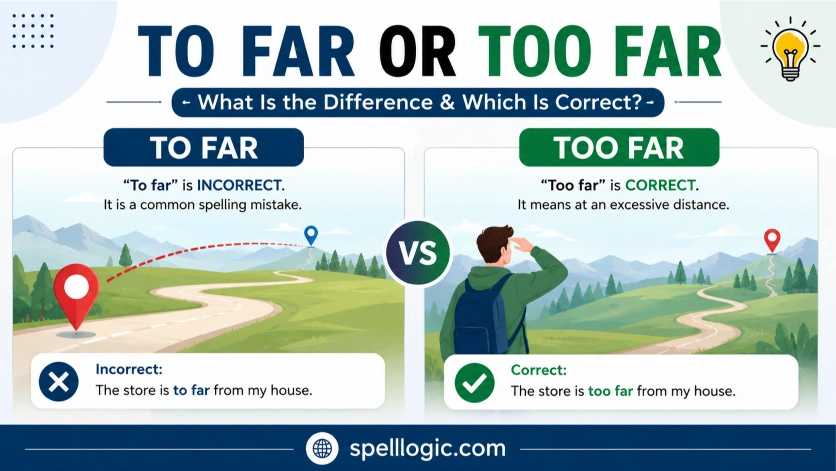
Many English learners feel confused when deciding whether to write to far or too far. The confusion happens because to and too look and sound very similar, yet they have different grammatical functions and meanings. In most sentences, too far is the correct expression when you mean an excessive distance or an unacceptable degree.
On the other hand, to far is usually grammatically incorrect when used before far. Learning the difference can improve your writing, speaking, and understanding of common English expressions. This guide explains the rule in simple language, with examples, memory tips, common mistakes, and practice questions.
Why “To Far” and “Too Far” Are Confusing
The confusion between to far or too far mainly comes from the similarity between to and too. Although they are pronounced almost the same way, they serve different purposes in English.
Similar pronunciation
In ordinary speech, to and too often sound identical. This makes it difficult for learners to know which spelling should appear in writing.
Similar spelling
The words differ by only one letter:
- to
- too
That small difference creates a major difference in meaning.
Context confusion
The word far can describe distance, degree, or limits. Learners may therefore focus on the word far and forget to check whether the word before it should mean direction or excessiveness.
Common learner mistakes
A frequent mistake is writing:
The shop is to far from my house.
This is incorrect because the sentence means the shop is excessively far away. Therefore, too is needed.
The correct sentence is:
The shop is too far from my house.
To Far vs Too Far Explained Simply
The simplest way to understand the difference is to remember that too can mean more than necessary, desirable, or acceptable.
To is usually a preposition or part of an infinitive verb, while too is an adverb.
One-line distinction
To usually expresses direction or forms an infinitive, while too means excessively or more than is acceptable.
Therefore:
To far is usually incorrect, while too far means excessively far.
Examples
- The station is too far to walk.
- You have taken the joke too far.
The second example shows that too far does not always refer to physical distance. It can also mean going beyond an acceptable limit.
Understanding Homophones in English
Although to and too are not always classified in exactly the same way in every grammatical discussion, they are commonly treated as homophones because they usually share the same pronunciation.
What Are Homophones?
Homophones are words that sound the same but have different meanings and spellings.
For example:
- to = toward or in the direction of
- two = the number 2
Example:
I want to buy two books.
Both words sound alike but have completely different meanings.
Why Homophones Cause Confusion
Homophones can cause problems because English spelling does not always match pronunciation.
For example:
I went to the park.
Here, to shows direction.
However:
The music is too loud.
Here, too means excessively.
Because the pronunciation is similar, writers must use context to choose the correct word.
What Does “To Far” Mean?
Definition and Core Meaning
The expression to far is generally not correct as a complete phrase when you mean an excessive distance or degree.
The word to has several legitimate uses in English. It can function as:
- A preposition
- Part of an infinitive verb
- A word showing direction
- A word showing a relationship or connection
For example:
- We walked to school.
- I want to learn English.
- Give the book to Sarah.
However, to normally cannot replace too when you mean excessively.
Important note
The words to and far can occasionally appear near each other in a sentence for separate grammatical reasons. However, this does not make to far a standard expression meaning excessively far.
For example:
We need to travel far.
Here, to belongs to the infinitive verb to travel, while far describes how far someone travels.
Origin and Historical Use
The word to is one of the oldest and most common words in English. Its historical development comes from earlier Germanic languages, where similar forms expressed direction and movement.
Over time, to developed several grammatical functions, including showing direction:
She went to London.
It also became part of the English infinitive structure:
They want to leave.
Because to has such common uses, learners sometimes mistakenly choose it when they actually need the adverb too.
Modern Usage and Synonyms
Depending on context, to may be associated with ideas such as:
- toward
- in the direction of
- until
- for
- in order to
However, none of these meanings normally create the expression to far when the intended meaning is excessively distant.
Example sentences
- We decided to travel far across the country.
- She hopes to go far in her career.
- I need to walk farther before reaching the village.
In each sentence, to belongs to the verb structure. It does not mean excessively.
What Does “Too Far” Mean?
Definition and Core Meaning
Too far means more distant, extreme, or excessive than is acceptable, necessary, or possible.
It can describe:
- Physical distance
- Emotional limits
- Behaviour
- Opinions
- Actions
- Jokes
- Rules
- Arguments
Examples of physical distance
- The airport is too far from the city centre.
- That restaurant is too far to visit tonight.
Examples of limits or behaviour
- His comments went too far.
- You are taking the argument too far.
In these examples, there is no physical distance. Instead, something has crossed an acceptable limit.
Origin and Historical Context
The word too developed from earlier English forms connected with the idea of addition or excess. Modern English uses too in several important ways.
It can mean also:
I like coffee too.
It can also mean excessively:
The coffee is too hot.
When combined with far, the second meaning applies:
The destination is too far.
The expression therefore communicates the idea that the distance or limit has become excessive.
Modern Usage and Synonyms
Depending on the context, too far may have similar meanings to:
- excessively far
- overly distant
- beyond the limit
- beyond what is acceptable
- excessively extreme
Example sentences
- The hotel is too far from the airport.
- I think that joke went too far.
- The deadline is too far away to worry about now.
- They pushed the discussion too far.
To Far vs Too Far: Key Differences at a Glance
| Word | Part of Speech | Meaning | Example Context |
|---|---|---|---|
| To | Preposition / infinitive marker | Shows direction, relationship, or forms an infinitive | We want to travel far. |
| Too | Adverb | More than necessary or acceptable | The village is too far away. |
| To far | Usually incorrect phrase | Does not normally mean excessively distant | The shop is to far. ✘ |
| Too far | Adverbial phrase | Excessively distant or beyond a limit | The shop is too far. ✔ |
The most important point is simple: when you mean excessively far, use too far.
How to Remember the Difference Between To Far and Too Far
Learning a small memory trick can prevent repeated spelling mistakes.
Easy memory trick
Remember that too has an extra O.
Think of the extra letter as representing extra amount.
- too = extra
- too much
- too many
- too far
If something is more than necessary or acceptable, you need too.
Association technique
Connect too with the phrase:
Too = more than enough.
For example:
- too hot = more heat than is comfortable
- too expensive = more expensive than acceptable
- too late = later than desired
- too far = farther than acceptable or practical
One memorable example
Imagine walking toward a destination and becoming tired. You might say:
“I cannot walk anymore because the destination is too far.”
The word too tells us that the distance is excessive.
Common Mistakes and Confusions
Here are some common errors learners make when writing this expression.
Mistake 1
✘ The school is to far from my home.
✔ The school is too far from my home.
Explanation: The distance is excessive, so too is required.
Mistake 2
✘ You took the joke to far.
✔ You took the joke too far.
Explanation: The joke crossed an acceptable limit.
Mistake 3
✘ This goal is to far away.
✔ This goal is too far away.
Explanation: Too means excessively distant.
Mistake 4
✘ It is to far to walk.
✔ It is too far to walk.
Explanation: The distance is greater than what is practical for walking.
A useful comparison
Compare these sentences:
I want to travel far.
I do not want to travel too far.
In the first sentence, to belongs to the verb travel. In the second sentence, too describes the degree of distance.
Understanding the sentence structure helps you choose the correct spelling.
Examples Section: Correct and Incorrect Usage
Example 1
✔ Correct: The supermarket is too far to walk to.
✘ Incorrect: The supermarket is to far to walk to.
Example 2
✔ Correct: I think you have taken this argument too far.
✘ Incorrect: I think you have taken this argument to far.
Example 3
✔ Correct: Their house is too far from the nearest hospital.
✘ Incorrect: Their house is to far from the nearest hospital.
Example 4
✔ Correct: The children stayed outside too long and walked too far from home.
✘ Incorrect: The children stayed outside too long and walked to far from home.
Example 5
✔ Correct: She wants to travel far and explore different countries.
✘ Incorrect: She wants too travel far and explore different countries.
Explanation: This example shows another important distinction. Before the base form of a verb, use to, not too.
Self Assessment: Test Your Knowledge
Choose the correct word to complete each sentence.
1. The mountains are ______ far away to see clearly.
a) to
b) too
2. We want ______ travel far during our holiday.
a) to
b) too
3. His criticism went ______ far.
a) to
b) too
4. The village is ______ far from the main road.
a) to
b) too
Self Assessment Answers
- too — The mountains are too far away to see clearly.
- to — We want to travel far during our holiday.
- too — His criticism went too far.
- too — The village is too far from the main road.
If you answered all four correctly, you now understand the basic difference between to and too in these contexts.
FAQs
1. Is “to far” correct English?
Usually, no. If you mean excessively far, too far is the correct expression.
2. Why is “too far” correct?
Too is an adverb that means more than necessary, desirable, or acceptable. Therefore, it correctly describes excessive distance or an excessive limit.
3. Can “too far” describe something other than distance?
Yes. It can describe behaviour, opinions, jokes, arguments, or actions that go beyond an acceptable limit.
For example:
That comment went too far.
4. What is the difference between “to go far” and “to go too far”?
To go far means to travel or progress a great distance. To go too far means to go beyond an acceptable, practical, or reasonable limit.
5. Does “too far” always mean a physical distance?
No. It can be literal or figurative.
Literal:
The station is too far away.
Figurative:
The joke went too far.
6. How can I remember whether to use “to” or “too”?
Remember that too means extra or more than necessary. The extra O can help you remember the idea of “extra.”
7. Is “far too” also correct?
Yes. Far too is used to make too stronger.
For example:
This bag is far too heavy.
It means the bag is much more heavy than acceptable.
Final Conclusion: Using “To Far” and “Too Far” Correctly
Understanding the difference between to far or too far is easier once you know the job each word performs in a sentence. To is commonly used to show direction or to form an infinitive, as in to travel or to go. Too, however, means more than necessary, acceptable, or reasonable. Therefore, when you want to describe an excessive distance or say that someone has crossed a limit, too far is the correct expression. The phrase can describe physical distance, such as a place that is difficult to reach, but it can also describe behaviour, jokes, arguments, and actions that become excessive.
A simple memory tip can help you avoid mistakes: too has an extra “O,” and too often means something extra. If something is more than enough—too hot, too expensive, too late, or too far—choose too. On the other hand, when the word introduces a verb, as in to travel far, use to.
English spelling can sometimes be challenging because words that sound alike may have different meanings and grammatical roles. However, regular practice makes these differences easier to remember. Read sentences carefully, think about the meaning, and ask yourself whether you mean direction or excess. With practice, choosing the correct form will become natural and confident.