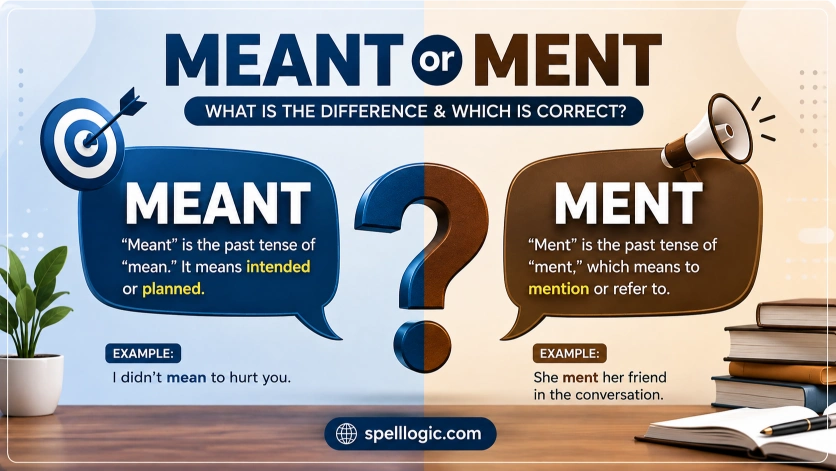
English learners often wonder whether they should write meant or ment, especially because both forms may sound similar when spoken quickly. However, these two words do not have the same status in standard English. Meant is a common and correct English word, while ment usually does not function as an independent standard word in modern everyday English.
Understanding this difference can improve your spelling, grammar, and writing accuracy. This article explains when to use each form, why learners confuse them, and how to remember the correct spelling with simple examples and practical tips.
Why “Meant” and “Ment” Are Confusing
Many English learners confuse meant or ment because the words can appear very similar when heard in conversation. English spelling is not always based on pronunciation, so learners sometimes write a word exactly as they think it sounds.
Similar pronunciation
In normal speech, meant may sound like a short word ending in a simple -ent sound. Because of this, some learners incorrectly spell it as ment.
For example:
- Correct: I meant to call you yesterday.
- Incorrect: I ment to call you yesterday.
Similar spelling
The difference between the two forms is small. Meant contains the letters ea, while ment does not. Missing two letters can completely change whether the spelling is correct.
Context confusion
The word meant can be used in several situations. It may refer to:
- intention
- meaning
- purpose
- something that was supposed to happen
Because the word has several uses, learners sometimes focus on its pronunciation instead of learning its correct spelling.
Common learner mistakes
A frequent mistake is writing ment as the past tense of mean.
For example:
✘ What ment you by that?
✔ What did you mean by that?
Another common error is:
✘ I ment no harm.
✔ I meant no harm.
The key point is simple: when you need the past tense or past participle of mean, the correct spelling is meant.
Meant vs Ment Explained Simply
The difference between meant or ment is straightforward in standard modern English.
Meant is the correct past tense and past participle of the verb mean.
Ment is generally not a standard independent word used as the past tense of mean. However, the letters -ment commonly appear as a suffix in English words such as development, agreement, and improvement.
One-line distinction
Meant means “intended” or “expressed,” while ment is not the standard spelling of the past tense of mean.
Example sentences
- I meant to send you a message this morning.
- She meant every word she said.
In both sentences, meant refers to intention or meaning.
Understanding Homophones in English
The confusion between meant or ment also shows how pronunciation can influence spelling mistakes. Although these forms are not a perfect example of traditional homophones, they may sound similar enough in quick speech to create confusion.
What Are Homophones?
Homophones are words that have the same or nearly the same pronunciation but different meanings and spellings.
For example:
- Sea – a large area of salt water
- See – to use your eyes
Both words sound the same, but their meanings and spellings are different.
Why Homophones Cause Confusion
English learners often hear a word before learning how to spell it. As a result, they may choose a spelling that looks logical but is incorrect.
For example:
- I can see the sea.
The two words sound the same, but choosing the wrong spelling changes the meaning.
Similarly, someone who hears meant may incorrectly write ment because the shortened spelling appears to match the sound. Learning words through both reading and listening can help prevent this mistake.
What Does “Meant” Mean?
Definition and Core Meaning
Meant is the past tense and past participle of the verb mean.
It commonly describes:
- something a person intended
- what someone wanted to say
- the meaning of words or actions
- something that was planned or expected
Common meanings of “meant”
- Intended: I meant to finish the report today.
- Expressed: What did she mean by that comment?
- Signified: The red light meant that we had to stop.
- Was intended for: This gift was meant for you.
- Was supposed to happen: The meeting was meant to begin at ten.
Origin and Historical Use
The word comes from the verb mean, which has existed in English for many centuries. Like many common English verbs, its past form does not simply add -ed.
Compare:
- walk → walked
- play → played
- mean → meant
This makes mean an irregular verb. The spelling changes when the word moves into the past tense.
Modern Usage and Synonyms
Depending on the context, synonyms for meant may include:
- intended
- expressed
- referred to
- signified
- indicated
- implied
- planned
However, the best synonym depends on the sentence.
For example:
I meant to help you.
Here, intended is a close synonym:
I intended to help you.
Another example:
Her smile meant that she was happy.
Here, indicated may be a suitable synonym:
Her smile indicated that she was happy.
Example sentences
- I meant to answer your question earlier.
- He meant no disrespect.
- The teacher meant that students should study regularly.
- This opportunity was meant for hardworking people.
- Her message meant a lot to me.
What Does “Ment” Mean?
Definition and Core Meaning
In standard modern English, ment is generally not used as an independent word with the meaning of the past tense of mean.
Therefore, if you want to say that someone intended, expressed, or signified something in the past, ment is incorrect.
For example:
✘ I ment what I said.
✔ I meant what I said.
Origin and Historical Context
Although ment is not normally used alone in modern English, the letter group -ment is extremely common as a suffix.
A suffix is a group of letters added to the end of a word.
Examples include:
- develop → development
- agree → agreement
- improve → improvement
- achieve → achievement
- excite → excitement
In these examples, -ment helps form a noun. However, this does not mean that ment can replace meant.
Modern Usage and Synonyms
When -ment appears as part of another word, it often helps create a noun connected with an action, process, condition, or result.
For example:
- agreement – the result of agreeing
- improvement – the process or result of improving
- movement – the act of moving
- government – the system or process of governing
As a standalone replacement for meant, however, ment has no appropriate synonyms because it is simply the wrong spelling in that context.
Example sentences
Correct use of words containing -ment:
- The company announced an important development.
- We finally reached an agreement.
- Her English has shown great improvement.
Incorrect use:
✘ I ment to arrive early.
Correct version:
✔ I meant to arrive early.
Meant vs Ment: Key Differences at a Glance
| Word | Part of Speech | Meaning | Example Context |
|---|---|---|---|
| Meant | Verb (past tense/past participle) | Intended, expressed, signified, or referred to | I meant to call you. |
| Ment | Not normally an independent standard word in this context | Incorrect spelling when used as the past tense of mean | ✘ I ment to call you. |
The easiest rule to remember is that the past tense of mean is always meant.
How to Remember the Difference Between Meant and Ment
Learning spelling becomes easier when you create a simple association.
Easy memory trick
Remember this pattern:
Mean → Meant
The letters ea remain important in both forms.
You can think:
Mean contains “ea,” and meant keeps “ea.”
This visual connection can help you remember the correct spelling.
Association technique
Associate meant with another familiar word:
- mean
- meant
Both begin with m and contain the vowel combination ea.
When you write the past form of mean, look for ea before nt.
One memorable example
I mean it today; I meant it yesterday.
This sentence clearly shows the present and past forms:
- mean = present
- meant = past
If you remember this pair, you are less likely to make the spelling mistake.
Common Mistakes and Confusions
Understanding common errors can help you avoid them.
Mistake 1
✘ I ment to tell you the truth.
✔ I meant to tell you the truth.
Explanation: The speaker is talking about a past intention. The correct past tense of mean is meant.
Mistake 2
✘ She ment that the project was finished.
✔ She meant that the project was finished.
Explanation: The speaker is explaining what another person intended to say.
Mistake 3
✘ What ment you when you said that?
✔ What did you mean when you said that?
Explanation: After did, use the base form of the verb, which is mean, not meant.
Mistake 4
✘ This word ment something different.
✔ This word meant something different.
Explanation: The sentence describes what the word signified in the past.
Examples Section: Correct and Incorrect Usage
Example 1
✔ Correct: I meant to visit my friend last weekend.
✘ Incorrect: I ment to visit my friend last weekend.
Example 2
✔ Correct: He meant no harm.
✘ Incorrect: He ment no harm.
Example 3
✔ Correct: What did you mean by that question?
✘ Incorrect: What did you meant by that question?
Explanation: After did, use mean, not meant.
Example 4
✔ Correct: The warning sign meant that the road was dangerous.
✘ Incorrect: The warning sign ment that the road was dangerous.
Example 5
✔ Correct: She said what she meant.
✘ Incorrect: She said what she ment.
Example 6
✔ Correct: The teacher meant that practice improves performance.
✘ Incorrect: The teacher ment that practice improves performance.
These examples show that correct grammar and correct spelling work together. Knowing the meaning of a word is important, but remembering its correct form is equally necessary.
Self Assessment: Test Your Knowledge
Choose the correct word to complete each sentence.
1. I ______ to reply to your email yesterday.
a) ment
b) meant
2. What did she ______ by her comment?
a) mean
b) meant
3. He ______ no disrespect when he asked the question.
a) meant
b) ment
4. The message ______ a lot to the family.
a) ment
b) meant
Self Assessment Answers
- meant
I meant to reply to your email yesterday. - mean
What did she mean by her comment? - meant
He meant no disrespect when he asked the question. - meant
The message meant a lot to the family.
If you answered all four questions correctly, you have a strong understanding of the difference.
FAQs
1. Is “ment” a correct spelling?
Ment is not the correct spelling when you want the past tense of mean. The correct form is meant.
2. What is the difference between meant and ment?
Meant is the correct past tense and past participle of mean. Ment is generally incorrect when used as a replacement for that verb form.
3. Is “I ment to” correct English?
No. The correct sentence is “I meant to.”
4. Why is the past tense of mean spelled meant?
Mean is an irregular verb, so it does not form its past tense by simply adding -ed. Its correct past form is meant.
5. Can “ment” appear in English words?
Yes. The letters -ment commonly appear as a suffix in words such as agreement, development, and improvement. However, this is different from using ment as the past tense of mean.
6. What is the present tense of meant?
The base and present form is mean. For example: I mean what I say.
7. What is the easiest way to remember the correct spelling?
Remember the pattern mean → meant. Both forms contain ea, which can help you remember the correct spelling.
Final Conclusion: Using “Meant” and “Ment” Correctly
Understanding the difference between meant or ment is important because correct spelling makes your writing clearer and more professional. The main rule is simple: meant is the correct past tense and past participle of mean. Use it when talking about something that someone intended, expressed, implied, signified, or was supposed to do. For example, you can say, “I meant to call you,” or “She meant what she said.” In contrast, ment should not be used as an independent replacement for the past form of mean. Although the letters -ment appear in many English nouns, such as agreement and development, that does not make ment a correct alternative to meant.
The easiest way to remember the spelling is to connect the two forms: mean → meant. Both words contain ea, so this simple pattern can help you avoid one of the most common spelling mistakes. Also remember the grammar rule that after did, you should use the base form mean, not meant. With regular reading, writing, and practice, these forms will become easier to recognize. Every spelling mistake you understand is another step toward stronger and more confident English.