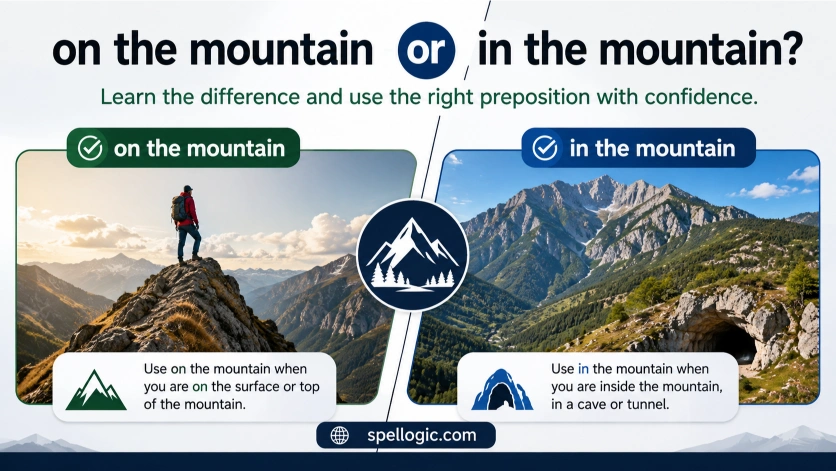
English learners often wonder whether they should say on the mountain or in the mountain. The two expressions look very similar, but they describe different locations and situations. The main confusion comes from the prepositions on and in, which can completely change the meaning of a sentence.
Generally, we use on the mountain when someone or something is located on its surface, slope, or summit. We use in the mountain when referring to something inside the mountain, such as a cave, tunnel, or mine. Understanding this difference helps you describe locations more naturally and accurately.
Why “On the Mountain” and “In the Mountain” Are Confusing
The confusion between these expressions usually comes from the difficulty of choosing the correct English preposition.
Similar pronunciation
Both expressions contain the same noun, mountain, and sound very similar when spoken quickly. The only major difference is the small preposition at the beginning: on or in.
However, these small words create an important difference in meaning.
Similar spelling
The phrases are almost identical in spelling. Only one word changes:
- on = on the surface or exterior
- in = inside something
Because the rest of the phrase remains the same, learners may assume that the two expressions can always be used interchangeably. They cannot.
Context confusion
A mountain can be understood in two ways. It can be viewed as:
- A physical surface that people can climb, walk on, or stand on.
- A large physical structure with an interior containing caves, tunnels, mines, or other spaces.
This is why the context determines whether on or in is appropriate.
Common learner mistakes
A common mistake is using in simply because a person is surrounded by mountains. For example, if someone is hiking on the side of a mountain, they are normally on the mountain, not inside it.
Another mistake is using on when describing something physically enclosed within the rock.
On the Mountain vs In the Mountain Explained Simply
The simplest way to understand the difference is to think about surface versus interior.
On the mountain means located on its surface, slope, or summit, while in the mountain means located inside the mountain itself.
One-line distinction
Use “on” for the outside surface; use “in” for the inside.
Examples
- The hikers built a camp on the mountain.
- The workers discovered a tunnel in the mountain.
In the first sentence, the camp is outside and resting on the mountain’s surface.
In the second sentence, the tunnel is physically located inside the mountain.
Understanding Homophones in English
Although on the mountain and in the mountain are not homophones, learning about homophones can help English learners understand why similar-sounding expressions sometimes cause confusion.
What Are Homophones?
Homophones are words that have the same or very similar pronunciation but different meanings and often different spellings.
For example:
- sea = a large area of salt water
- see = to use your eyes to look at something
The words sea and see sound alike but have different meanings.
Why Homophones Cause Confusion
Homophones can confuse learners because pronunciation alone does not always reveal meaning.
For example:
I can see the sea.
The meaning becomes clear only when we understand the context and spelling.
Similarly, prepositions such as on and in may be short and easy to pronounce, but choosing the wrong one can change the meaning of a sentence. English learners should therefore pay attention not only to the main noun but also to the relationship between objects and places.
What Does “On the Mountain” Mean?
Definition and Core Meaning
On the mountain refers to something located on the outer surface, side, slope, or top of a mountain.
It can describe:
- People standing or walking on a mountain
- Buildings constructed on a mountain
- Animals living on the mountain’s surface
- Snow covering the mountain
- Activities such as hiking, skiing, or camping
The expression focuses on the mountain as a surface or location.
Origin and Historical Use
The preposition on has been used in English for centuries to describe contact with a surface. This basic meaning appears in many everyday expressions:
- on the table
- on the floor
- on the roof
- on the hill
- on the mountain
As English developed, on continued to describe a position where something touches or occupies the surface of another object or place.
Modern Usage and Synonyms
In modern English, the phrase may appear in descriptions of travel, nature, sports, and geography.
Depending on the sentence, similar expressions include:
- upon the mountain
- at the top of the mountain
- on the mountainside
- on the slope
- high up the mountain
However, these expressions are not always exact replacements. Their meanings depend on the precise location.
Example sentences
- We spent the night on the mountain.
- There is a small village on the mountain.
- The climbers were trapped on the mountain during the storm.
- Snow remained on the mountain throughout the summer.
- They built a cabin on the mountain overlooking the valley.
In each example, the person, object, or activity is outside and associated with the mountain’s surface.
What Does “In the Mountain” Mean?
Definition and Core Meaning
In the mountain means physically inside the mountain.
This expression is used when something exists within the rock or internal structure of the mountain.
For example, something may be inside:
- A cave
- A tunnel
- A mine
- A secret room
- A research facility
- A natural underground space
The phrase therefore emphasizes enclosure or physical location within the mountain.
Origin and Historical Context
The preposition in has long been used in English to describe a position inside an enclosed space or area.
For example:
- in the house
- in the box
- in the cave
- in the room
The same principle applies when a mountain contains an interior space. A tunnel may run through or be located in the mountain.
Historically, people have built mines, tunnels, shelters, and storage areas inside mountains. As a result, the phrase is commonly used in descriptions involving engineering, mining, geology, and adventure stories.
Modern Usage and Synonyms
Modern English may use similar expressions such as:
- inside the mountain
- within the mountain
- beneath the mountain
- under the mountain
These expressions have slightly different meanings. For example, beneath the mountain may mean under it rather than physically inside its rock.
Example sentences
- The miners worked in the mountain.
- Engineers built a railway tunnel in the mountain.
- Scientists discovered an unusual cave in the mountain.
- The soldiers created a shelter in the mountain.
- A large network of tunnels lies in the mountain.
In these examples, the location is enclosed by the physical structure of the mountain.
On the Mountain vs In the Mountain: Key Differences at a Glance
| Word | Part of Speech | Meaning | Example Context |
|---|---|---|---|
| On the mountain | Prepositional phrase | Located on the surface, side, or summit | Hiking, camping, skiing, buildings |
| In the mountain | Prepositional phrase | Located inside the physical structure | Caves, tunnels, mines, underground spaces |
The key difference is simple:
- On = surface
- In = interior
How to Remember the Difference Between On the Mountain and In the Mountain
A simple memory trick can make the distinction easier.
Easy memory trick
Think about what you can physically see.
If something is exposed to the sky and resting on the outside:
Use ON.
If something is surrounded by rock and located inside:
Use IN.
Association technique
You can associate the prepositions with these ideas:
- ON → outside surface
- IN → inside space
For example, imagine a hiker standing under the open sky. The hiker is on the mountain.
Now imagine a miner working in a dark tunnel surrounded by rock. The miner is in the mountain.
One memorable example
A hiker is on the mountain, but a miner may be in the mountain.
This sentence clearly shows the difference between an exterior location and an interior location.
Common Mistakes and Confusions
Mistake 1
✘ We went in the mountain to enjoy the view.
✔ We went on the mountain to enjoy the view.
Explanation: The people are visiting or climbing the mountain’s surface, not entering its interior.
Mistake 2
✘ The workers built a tunnel on the mountain.
✔ The workers built a tunnel in the mountain.
Explanation: A tunnel is generally enclosed by the mountain, so in is more appropriate.
Mistake 3
✘ There was a cabin in the mountain.
✔ There was a cabin on the mountain.
Explanation: A normal cabin is built on the outside surface. If the cabin were carved into the rock, in could be correct.
Mistake 4
✘ The hikers got lost in the mountain.
✔ The hikers got lost on the mountain.
Explanation: Hikers usually travel across the surface.
However, context matters. If people become lost inside a huge cave system, you could say they were lost in the mountain.
Examples Section: Correct and Incorrect Usage
Example 1
✔ Correct: We watched the sunrise on the mountain.
✘ Incorrect: We watched the sunrise in the mountain.
Why? The people are outside, viewing the sunrise from the mountain’s surface.
Example 2
✔ Correct: The engineers discovered water in the mountain.
✘ Incorrect: The engineers discovered water on the mountain.
Why? In this context, the water is located inside the rock.
Example 3
✔ Correct: There was heavy snow on the mountain.
✘ Incorrect: There was heavy snow in the mountain.
Why? Snow normally falls and rests on the surface.
Example 4
✔ Correct: The railway passes through a tunnel in the mountain.
✘ Incorrect: The railway passes through a tunnel on the mountain.
Why? The tunnel is inside the mountain.
Example 5
✔ Correct: We saw several goats on the mountain.
✘ Incorrect: We saw several goats in the mountain.
Why? The goats are walking on the surface.
Example 6
✔ Correct: The miners found valuable minerals in the mountain.
✘ Incorrect: The miners found valuable minerals on the mountain.
Why? The minerals are being described as part of the mountain’s interior.
Self Assessment: Test Your Knowledge
Choose on the mountain or in the mountain to complete each sentence.
- The hikers built their camp __________.
- The miners found a large cave __________.
- Snow remained __________ during the winter.
- Engineers constructed a secret tunnel __________.
Self Assessment Answers
- The hikers built their camp on the mountain.
- The miners found a large cave in the mountain.
- Snow remained on the mountain during the winter.
- Engineers constructed a secret tunnel in the mountain.
FAQs
Is it correct to say “on the mountain”?
Yes. Use on the mountain when someone or something is located on the mountain’s surface, slope, or summit.
Is “in the mountain” grammatically correct?
Yes. In the mountain is grammatically correct when something is physically located inside the mountain, such as a cave or tunnel.
Which phrase should I use for hiking?
Use on the mountain because hikers normally travel on the surface.
Can a house be “in the mountain”?
Yes, but only if the house or structure is physically built inside or carved into the mountain.
Should I say “snow on the mountain” or “snow in the mountain”?
Usually, say snow on the mountain because snow covers the outside surface.
Can both expressions be correct in the same situation?
Sometimes, depending on what you are describing. For example, people can hike on the mountain while miners work in the mountain.
Is “in the mountains” different from “in the mountain”?
Yes. In the mountains often means within a mountainous region or among several mountains. In the mountain usually refers to the physical interior of one particular mountain.
Final Conclusion: Using “On the Mountain” and “In the Mountain” Correctly
Understanding the difference between on the mountain or in the mountain becomes easy when you focus on one simple idea: surface versus interior. Use on the mountain when describing something outside, such as hikers walking, snow falling, animals moving, or a cabin standing on the slope. Use in the mountain when something is physically enclosed within the mountain, such as a cave, tunnel, mine, or underground facility. This distinction may seem small because the only word that changes is the preposition, but choosing the correct preposition makes your English more accurate and natural.
A useful memory trick is to picture the location. If you can imagine the object under the open sky and on the mountain’s outer surface, choose on. If the object is surrounded by rock and hidden within the mountain, choose in. Context is always important, especially when describing unusual buildings or underground spaces.
Keep practicing with real examples from travel, geography, nature, and everyday conversation. The more you notice how native speakers use prepositions to describe location, the easier these choices will become. Small differences like this are an important part of becoming a confident English speaker, so keep learning and practicing one sentence at a time.