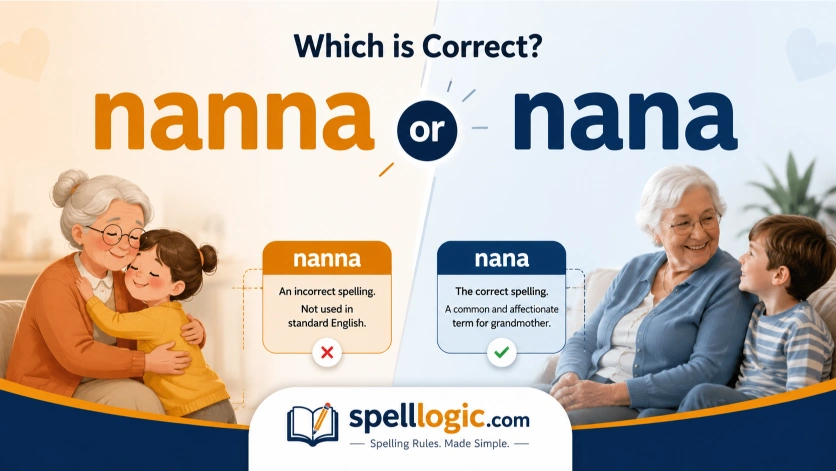
Nanna or nana can confuse English learners because both words look and sound almost the same. In many situations, they refer to a grandmother, but their spelling and usage can vary depending on region, family tradition, and personal preference. One spelling may be more common in British English, while another may be widely used in American English or other varieties.
In addition, nana can sometimes have meanings beyond “grandmother,” which creates further confusion. Understanding the difference helps you choose the spelling that sounds natural for your audience and communicate clearly when talking about family.
Why “Nanna” and “Nana” Are Confusing
People often mix up nanna and nana because they are closely related family terms. In everyday speech, the difference may be difficult to notice, especially when people pronounce them in similar ways.
Similar pronunciation
Depending on the speaker’s accent, both words may sound very similar. This makes it easy for learners to hear the word correctly but remain unsure about its spelling.
Similar spelling
The two words differ by only one letter. Nanna has a double n in the middle, while nana has a single n. Such small spelling differences are common sources of confusion in English.
Context confusion
Both words can refer affectionately to a grandmother. However, the preferred spelling often depends on regional English and family customs.
Common learner mistakes
English learners may:
- Assume that only one spelling is correct.
- Use the spelling preferred in one country when writing for readers in another.
- Confuse nana with another meaning of the word.
- Capitalize the word incorrectly when using it as a name.
The important point is that context matters. When talking about a family member, the spelling often depends on how that particular family uses the word.
Nanna vs Nana Explained Simply
Both terms are commonly used as affectionate names for a grandmother.
Nanna means an informal or affectionate name for a grandmother, while nana can also mean a grandmother and is used in different regions and families.
The difference is mainly one of spelling, regional preference, and personal family usage rather than a major difference in meaning.
Example sentences
- My nanna makes the best homemade cakes.
- We are visiting our nana during the holidays.
In both examples, the word refers to a grandmother.
Understanding Homophones in English
Nanna and nana may sound alike or nearly alike in many accents, but they are not a perfect example of traditional homophones in every pronunciation. Still, they provide a useful opportunity to understand why similar-sounding words can confuse English learners.
What Are Homophones?
Homophones are words that have the same or very similar pronunciation but different meanings or spellings.
For example:
- sea — a large body of salt water
- see — to use your eyes to look at something
These words sound the same but have different meanings and spellings.
Why Homophones Cause Confusion
Homophones can confuse learners because listening does not always provide enough information about spelling.
For example, if someone says, “I can see the sea,” both important words sound the same, but their meanings are completely different.
With family terms, the challenge can be slightly different. You may hear a word clearly but still need to know the speaker’s regional spelling preference before writing it.
What Does “Nanna” Mean?
Definition and Core Meaning
Nanna is an informal and affectionate word for a grandmother. Children often use it when speaking directly to their grandmother or when talking about her.
It is a family term rather than a formal word.
For example:
- My nanna lives near the beach.
- I called my nanna yesterday.
- The children are spending the weekend with their nanna.
The word usually expresses warmth, affection, and familiarity.
Origin and Historical Use
Family names for grandparents often develop naturally through everyday speech. Young children may find certain sounds easier to pronounce, and these forms can become permanent family names.
Words such as Nanna, Nan, Nanny, and Gran have been used in different English-speaking communities as familiar names for grandmothers.
Modern Usage and Synonyms
Today, nanna remains a common family word in some varieties of English, especially in informal speech.
Related words include:
- Grandma
- Grandmother
- Gran
- Granny
- Nan
- Nanny
The best choice depends on regional usage and personal family preference.
Example sentences
- Nanna always tells us interesting stories about her childhood.
- We bought a birthday present for Nanna.
- My friends call their grandmother “Gran,” but I call mine Nanna.
When used as a personal family name in place of a person’s name, it is often capitalized:
We are going to visit Nanna tomorrow.
When used more generally, lowercase may be appropriate:
My nanna lives nearby.
What Does “Nana” Mean?
Definition and Core Meaning
Nana is also an affectionate or informal word for a grandmother. It is widely used by families in several English-speaking regions.
For example:
- My nana lives in another city.
- We are having lunch with Nana on Sunday.
- The children love spending time with their nana.
Origin and Historical Context
Like many family names, nana developed through informal speech and family traditions. Short, repeated sounds are especially common in words used by young children, which helps explain why similar forms appear in many languages and cultures.
The exact meaning and preferred pronunciation may depend on the cultural or linguistic background of the speaker.
Modern Usage and Synonyms
In modern English, nana can be used affectionately for a grandmother. Depending on context and region, related terms include:
- Grandma
- Grandmother
- Gran
- Granny
- Nana
- Nan
However, nana can also have different meanings in some varieties of English or in other languages. Therefore, the surrounding sentence usually makes the intended meaning clear.
Example sentences
- My nana taught me how to cook.
- Nana is coming to watch the children.
- I received a lovely letter from my nana.
As with Nanna, capitalization depends on whether the word is functioning like a name.
I visited Nana yesterday.
But:
I visited my nana yesterday.
Nanna vs Nana: Key Differences at a Glance
| Word | Part of Speech | Meaning | Example Context |
|---|---|---|---|
| Nanna | Noun | An affectionate name for a grandmother | “My Nanna is visiting us.” |
| Nana | Noun | An affectionate name for a grandmother; meaning may vary by region or context | “We spent the weekend with Nana.” |
The main difference is usually spelling and regional or family preference. Neither term is universally the only correct choice.
How to Remember the Difference Between Nanna and Nana
Remembering the spelling can be easier when you connect each word with the people and language around you.
Easy memory tricks
Nanna has two Ns together. You can remember the double letter by thinking of the word as having an extra letter for emphasis or affection.
Nana has a simpler spelling. It contains only one n in the middle.
Association techniques
Ask yourself:
- How does my family spell the word?
- Which spelling is common in the English variety I am writing?
- Am I using the word as a personal name?
Looking at authentic examples from your preferred English variety can also help.
One memorable example
Think:
Nanna has an extra N. Nana does not.
This simple visual comparison can help you remember the spelling difference quickly.
Common Mistakes and Confusions
Mistake 1: Believing one spelling is always wrong
✘ Only “nanna” is correct for grandmother.
✔ Both spellings can be correct depending on region and family usage.
Explanation: English family vocabulary often varies between countries and households.
Mistake 2: Ignoring family preference
✘ I changed the spelling of my grandmother’s family name because another spelling seemed more common.
✔ I use the spelling my family prefers for our grandmother.
Explanation: Family titles often function like personal names, so personal usage matters.
Mistake 3: Incorrect capitalization
✘ I visited nanna yesterday.
✔ I visited Nanna yesterday.
This is correct when Nanna replaces a person’s name.
However:
✔ I visited my nanna yesterday.
Here, the word follows my and functions as a general family noun.
Mistake 4: Assuming pronunciation is identical everywhere
✘ Everyone pronounces these words in exactly the same way.
✔ Pronunciation may vary according to accent, family tradition, and regional English.
English pronunciation is not always identical across countries and communities.
Examples Section: Correct and Incorrect Usage
Example 1
✔ Correct: My nana is coming to visit us this weekend.
✘ Incorrect: My nana are coming to visit us this weekend.
Explanation: Nana is singular, so it takes is.
Example 2
✔ Correct: We bought Nanna a beautiful birthday gift.
✘ Incorrect: We bought Nanna an beautiful birthday gift.
Explanation: Use a before a consonant sound, as in a beautiful gift.
Example 3
✔ Correct: I love listening to stories from my nanna.
✘ Incorrect: I love listen to stories from my nanna.
Explanation: After love, the gerund form listening works naturally in this sentence.
Example 4
✔ Correct: Nana took the children to the park.
✘ Incorrect: nana took the children to the park.
Explanation: Capitalization is appropriate when the family title is used like a personal name.
Example 5
✔ Correct: Her grandmother prefers to be called Nanna.
✘ Incorrect: Her grandmother prefer to be called Nanna.
Explanation: The singular subject grandmother requires prefers.
Self Assessment: Test Your Knowledge
Choose the correct word or form to complete each sentence.
- My ________ always makes pancakes for breakfast.
a) nana
b) quickly - We are visiting ________ this weekend because it is being used as her personal family name.
- My ________ lives near our school, so we visit her often.
- Both ________ and ________ can be used as affectionate names for a grandmother, depending on family or regional preference.
Self Assessment Answers
- nana or nanna, depending on the intended family spelling.
- Nana or Nanna, depending on the person’s preferred family title.
- nana or nanna, depending on the intended spelling.
- nanna; nana
The key lesson is that context and personal or regional usage help determine the most suitable spelling.
FAQs
1. Is Nanna or Nana correct?
Both can be correct when referring affectionately to a grandmother. The preferred spelling often depends on region, family tradition, and personal preference.
2. What is the difference between Nanna and Nana?
The main difference is spelling. Both commonly refer to a grandmother, although nana may have additional meanings in different contexts or languages.
3. Is Nanna British or American?
Usage varies, but Nanna is commonly associated with certain varieties of British and other English usage. However, family vocabulary does not always follow strict national rules.
4. Is Nana American English?
Nana is commonly used in American English, but it is not limited to the United States. Many English-speaking families around the world use it.
5. Should I capitalize Nana or Nanna?
Capitalize the word when it is used like a person’s name:
Nana is coming for dinner.
Use lowercase when it follows a possessive or functions as a general noun:
My nana is coming for dinner.
6. Which spelling should I use for my grandmother?
The best choice is usually the spelling your grandmother or family prefers. Family titles are personal and often follow long-established traditions.
7. Are Nanna and Nana homophones?
They may sound the same or nearly the same in many accents, but pronunciation can vary. Their similarity is one reason learners may confuse the spellings.
Final Conclusion: Using “Nanna” and “Nana” Correctly
Understanding nanna or nana is easier once you recognize that the difference is usually not about one word being completely right and the other being completely wrong. Both terms can be affectionate names for a grandmother, and the most suitable spelling often depends on regional English, family tradition, and personal preference. Nanna contains a double n, while nana has a single n, making spelling the most obvious difference between them.
In real-life English, family members often choose their own special names for grandparents. One family may always say Nanna, while another may use Nana, Gran, or Granny. Therefore, context is especially important. If you are writing about your own family, use the spelling your family prefers. If you are writing about another person, follow that person’s preferred family title.
A simple memory tip is to remember that Nanna has an extra N, while Nana has a simpler spelling. Also remember the capitalization rule: capitalize the word when it replaces a person’s name, but use lowercase when it follows words such as my, your, or her.
English family vocabulary can vary, and that is perfectly normal. Keep reading, listening, and practicing, and you will become more confident about choosing the right word for the right situation.