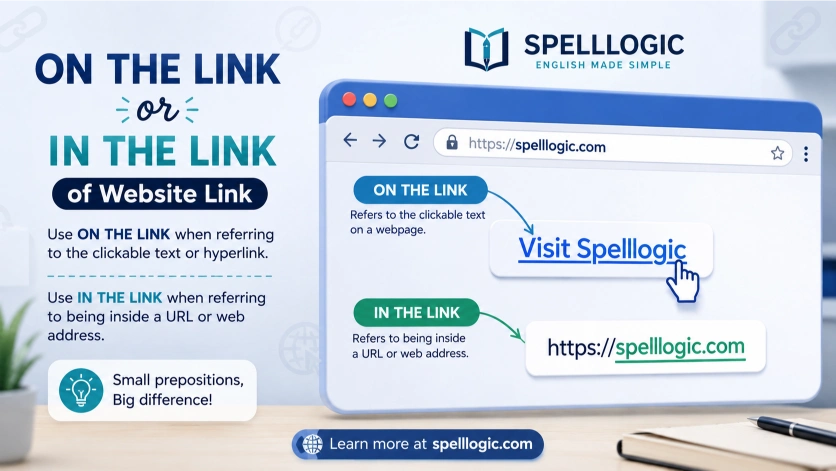
English learners often wonder whether on the link or in the link is the correct expression. The confusion happens because English uses different prepositions depending on how we think about a website link, webpage, document, or piece of online information. In everyday speech, people may also use these expressions loosely, even when a more natural phrase is available.
Understanding on the link or in the link helps you choose the right preposition and communicate more naturally in emails, websites, instructions, and online conversations. In most situations, native speakers usually say “on the link” when referring to information or an action associated with a link, while “in the link” is less common and often means something different.
Why “On the Link or In the Link” Are Confusing
The expressions on the link or in the link are confusing because both on and in are common English prepositions. Learners often know that “on” can describe something displayed on a webpage, while “in” can describe something contained inside a document. The difficulty comes when the word “link” connects the speaker to an online resource.
Similar pronunciation
There is no major pronunciation similarity between on and in, but both are short, frequently used prepositions. Because they appear in many expressions, learners can easily transfer patterns from other sentences.
For example:
- The information is on the website.
- The information is in the document.
When the word “link” replaces “website” or “document,” the correct preposition becomes less obvious.
Similar spelling
The words are not similarly spelled. However, their short forms and frequent use make them easy to interchange when learners are writing quickly.
Context confusion
Context is the biggest reason for confusion about on the link or in the link. A link is normally a clickable path to another webpage, file, image, or resource. Therefore, English speakers often use “on” for actions associated with a link, but they may use “in” when talking about information contained in the destination reached through that link.
Common learner mistakes
Some learners write:
- “Click in the link.”
- “The details are in the link.”
- “Open in the link.”
These sentences may be understandable, but they are not always natural English. More natural alternatives include:
- “Click on the link.”
- “The details are on the linked page.”
- “Open the link.”
“On the Link or In the Link” Explained Simply
The simplest way to understand on the link or in the link is to separate the link itself from the information behind it.
On the link or in the link is not a choice between two equally common fixed expressions. “On” is normally used when describing an action performed on a link, especially click on a link. “In” may be appropriate when referring to content contained within the destination, although “in the link” itself is usually less natural.
One-line distinction: Use “on” for an action involving a clickable link; use “in” when something is actually contained inside a destination or resource, not usually inside the link itself.
Examples:
- Please click on the link to open the registration form.
- The information in the document is available through the link.
A useful replacement for on the link or in the link is often “on the linked page” or “in the linked document.”
Understanding Homophones in English
The question on the link or in the link is sometimes treated like other confusing English expressions, but these two phrases are not homophones.
What Are Homophones?
Homophones are words that sound the same but have different meanings, spellings, or both.
For example:
- right — correct
- write — to form words with a pen or keyboard
They sound alike but have different meanings and spellings.
Why Homophones Cause Confusion
Homophones can cause problems because listening alone does not tell you which spelling is correct. For example, when someone says “write,” you need the context to know whether they mean write or right.
The confusion surrounding on the link or in the link is different. Here, the issue is mainly preposition choice, not pronunciation.
What Does “On the Link” Mean?
Definition and Core Meaning
“On the link” is most commonly encountered in the expression “click on the link.” Here, on identifies the link as the object you interact with.
When discussing online navigation, “on” is especially natural with verbs such as:
- click on
- tap on
- press on
- select
- open
For example:
- Click on the link below.
- Tap on the link to continue.
- Please click on the link to download the file.
- She clicked on the link in the email.
The important point is that the person is performing an action involving the clickable link.
Origin and Historical Use
The preposition on has been used in English for centuries to describe contact, position, attachment, or association with a surface or object. Modern digital English extended these meanings to computer interfaces.
As graphical interfaces became common, expressions such as “click on the button” and “click on the link” became standard. In this sense, on does not necessarily mean physical contact. It describes interaction with an item displayed on a screen.
Modern Usage and Synonyms
In modern digital communication, “on” is particularly common when giving instructions.
Useful related expressions include:
- click on the link
- tap on the link
- follow the link
- use the link
- select the link
- access the page through the link
Notice that “follow the link” does not need a preposition before “the link.”
Example Sentences
- Click on the link to see the full article.
- Please tap on the link from your mobile device.
- I clicked on the link, but the page did not load.
- You can follow the link to complete the application.
- The teacher asked students to click on the link.
Therefore, when learners ask about on the link or in the link, “on” is normally the better choice for a clickable-link action.
What Does “In the Link” Mean?
Definition and Core Meaning
“In the link” is much less common than “on the link.” A hyperlink is generally not viewed as a container that holds information. Instead, it points to another resource.
For this reason, saying “the information is in the link” can sound unnatural. The speaker may actually mean:
- The information is on the linked page.
- The information is in the linked document.
- The information is at the link in some contexts.
- The link contains the relevant information, depending on the situation.
Origin and Historical Context
The preposition in traditionally describes something located inside a space, container, area, or written work. For example:
- The answer is in the book.
- Her name is in the document.
- The information is in the report.
Digital English continues this pattern. However, a hyperlink itself is not normally considered a container. That is why in the link is often replaced by a more precise expression.
Modern Usage and Synonyms
You may hear “in the link” in informal speech, particularly when a speaker means that information can be found by using the link. Nevertheless, formal and natural English often makes the destination explicit.
Better alternatives include:
- on the linked webpage
- in the linked document
- on the website
- in the file
- through the link
- at the URL
Example Sentences
- The full explanation is in the linked document.
- You can find the details on the linked webpage.
- The instructions are in the PDF available through the link.
- The answer is on the website.
- Please use the link to access the information.
This distinction makes on the link or in the link easier to understand: “in” is useful for actual contents, but “in the link” is usually not the clearest way to express that idea.
“On the Link or In the Link”: Key Differences at a Glance
| Word | Part of Speech | Meaning | Example Context |
|---|---|---|---|
| On | Preposition | Shows interaction with a clickable item | Click on the link. |
| In | Preposition | Shows something contained within a space, document, or resource | The information is in the document. |
| Link | Noun | A clickable connection to another resource | Follow the link. |
| Linked page | Noun phrase | The webpage reached through a link | The details are on the linked page. |
When choosing between on the link or in the link, remember that the word “link” normally refers to the clickable connection, while the linked page or file is the destination.
How to Remember the Difference Between On the Link and In the Link
Here are some simple memory tricks for on the link or in the link.
Memory Trick 1: Click = On
Think:
Click → on
You normally say:
Click on the link.
The same pattern works with “tap”:
Tap on the link.
Memory Trick 2: Content = In the Destination
If you are talking about information contained inside something, identify the container:
- information in the document
- words in the PDF
- details in the report
Do not automatically call that container “the link.”
Association Technique
Imagine a link as a door. You click on the door to open it, but the room behind the door contains the information.
So:
Action → on the link
Content → in the document/page/file
One Memorable Example
Click on the link to read the information on the webpage.
This single sentence shows the difference clearly.
Common Mistakes and Confusions
A frequent mistake is to use “in” after “click.”
✘ Click in the link to open the page.
✔ Click on the link to open the page.
The verb “click” normally takes on when identifying the clickable object.
Another common mistake is:
✘ The information is in the link.
A clearer version is:
✔ The information is on the linked page.
Or:
✔ The information is in the linked document.
Similarly:
✘ Please find the details in the link below.
✔ Please find the details on the linked page below.
Another natural alternative is:
✔ Please use the link below to find the details.
This last version avoids the preposition problem completely.
When deciding between on the link or in the link, ask yourself what you are describing: the clickable object or the destination containing the information.
Examples Section: Correct and Incorrect Usage
Example 1
✔ Correct: Click on the link to register.
✘ Incorrect: Click in the link to register.
Explanation: “Click on” is the standard expression for interacting with a clickable link.
Example 2
✔ Correct: The instructions are in the linked document.
✘ Incorrect: The instructions are in the link.
Explanation: The instructions are inside a document, while the link simply provides access to that document.
Example 3
✔ Correct: Please follow the link below.
✘ Incorrect: Please follow on the link below.
Explanation: “Follow the link” is a complete expression and does not require “on.”
Example 4
✔ Correct: The details are on the linked webpage.
✘ Incorrect: The details are on the link.
Explanation: The details appear on the webpage, not literally on the hyperlink itself.
Example 5
✔ Correct: Tap on the link to continue.
✘ Incorrect: Tap in the link to continue.
Explanation: “Tap on” is natural when referring to a clickable item on a screen.
Example 6
✔ Correct: You can access the report through the link.
✘ Incorrect: You can access the report in the link.
Explanation: “Through the link” clearly explains that the link provides access to the report.
Self Assessment: Test Your Knowledge
Fill in each blank with on, in, through, or leave the preposition out where appropriate.
- Please click ___ the link to open the registration page.
- The full information is ___ the linked document.
- You can access the report ___ the link below.
- Please follow ___ the link to continue.
Self Assessment Answers
- on — Please click on the link to open the registration page.
- in — The full information is in the linked document.
- through — You can access the report through the link below.
- No preposition — Please follow the link to continue.
These answers show why understanding on the link or in the link requires attention to the verb and the destination, rather than memorizing one preposition for every situation.
FAQs
1. Is “on the link or in the link” correct English?
The phrase “on the link” is natural mainly when describing an action such as clicking or tapping. “In the link” is less common and often sounds unnatural when referring to a hyperlink itself.
2. Should I say “click on the link” or “click in the link”?
Say “click on the link.” This is the standard and natural expression for interacting with a hyperlink.
3. Is “the information is in the link” correct?
It may be understood, but it is usually clearer to say “the information is on the linked page” or “the information is in the linked document.”
4. Can I say “follow the link”?
Yes. “Follow the link” is completely natural. You do not need “on” after “follow.”
5. What is the difference between “on the link” and “through the link”?
“On” commonly describes interacting with a clickable link, while “through” emphasizes that the link provides access to another resource.
6. Is “in the link” ever acceptable?
It can occur in informal communication when the speaker means information accessible from a link. However, more precise English usually identifies the destination, such as a webpage, file, or document.
7. What is the easiest way to remember the rule?
Remember: click on the link, but find information on the webpage or in the document. This simple pattern works in most everyday situations.
Final Conclusion: Using “On the Link” and “In the Link” Correctly
Understanding on the link or in the link becomes much easier when you focus on what the sentence is actually describing. “On the link” is most natural when you are talking about an action performed on a clickable hyperlink, especially in expressions such as “click on the link” or “tap on the link.” By contrast, “in the link” is much less common because a hyperlink is not normally treated as a container. If you mean that information exists in the resource reached through a hyperlink, it is usually better to say “on the linked webpage,” “in the linked document,” or “through the link.”
The most useful memory rule is simple: click on the link, but look for the information in the destination. Also remember that “follow the link” does not need “on.” These patterns will help you write clearer emails, website instructions, online messages, and professional documents. Do not worry if you have used these prepositions incorrectly before. Preposition choice can be difficult even for advanced English learners. With regular reading, writing, and attention to context, you will quickly become more confident in choosing the most natural expression.