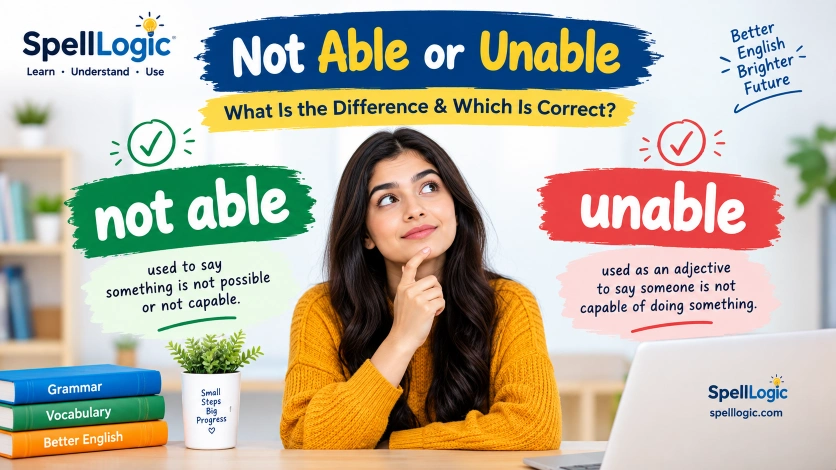
English learners often hesitate when choosing between “not able” and “unable” because both expressions describe a lack of ability. At first glance, they may seem interchangeable, and in many sentences they are. However, they can differ in tone, emphasis, and sentence structure.
Knowing when to use each form can make your English sound clearer and more natural. Learning not able or unable also helps you choose a suitable tone. This guide explains the difference in simple English, gives practical examples, and shows common mistakes so you can choose the right expression with confidence.
Why “Not Able” and “Unable” Are Confusing
The main reason not able or unable causes confusion is that both forms communicate the same basic idea: someone cannot do something. For example, “I am not able to attend” and “I am unable to attend” can both mean that the speaker cannot attend.
Similar pronunciation
The expressions are not homophones, and they do not sound the same. This is an important point when studying not able or unable. Still, learners may hear them in similar contexts and associate both with the same meaning. This can make the choice feel difficult.
Similar spelling
The words are not especially similar in spelling. “Not able” contains two separate words, while “unable” is one word formed with the prefix un- and the adjective able.
Context confusion
Context is often the biggest source of uncertainty when choosing not able or unable. Both may be grammatically correct, but “unable” often sounds more formal, concise, or definite. “Not able” can sound more conversational and can place extra emphasis on the negative idea.
Common learner mistakes
Learners sometimes write “I am unable for come” or “I am not able attending.” Both are incorrect. After these expressions, English normally uses to + base verb, as in “I am unable to come” and “I am not able to attend.”
Not Able vs Unable Explained Simply
In simple terms, not able or unable can usually be used to express the same basic inability. The main difference is style and emphasis rather than meaning.
One-line distinction: “Not able” is a negative form of able, while “unable” is a single adjective that often sounds more formal or direct.
For example:
- I am not able to join the meeting today.
- I am unable to join the meeting today.
Both sentences tell the reader that the speaker cannot join. The second sentence may sound more formal, especially in a business email or official notice.
A useful pattern is: “Not able” means not having the ability or opportunity to do something, while “unable” means not having the ability or being unable to do it.
The two expressions can overlap, but they are not always equally natural in every situation. This is the practical lesson behind not able or unable. In friendly conversation, “I’m not able to come” is perfectly normal. In a formal message, “I’m unable to attend” may be more formal.
Understanding Homophones in English
Homophones are a common source of confusion for English learners, but this particular pair is not a homophone pair. Learning that distinction is useful because it prevents you from treating every confusing word or phrase as a pronunciation problem, including not able or unable.
What Are Homophones?
Homophones are words that have the same pronunciation but different meanings or spellings. For example, right and write sound alike but have different meanings.
Why Homophones Cause Confusion
When two words sound the same, learners cannot always identify the correct spelling from speech alone. For example, hearing “write” does not tell you whether the speaker means the verb write or the direction right. In contrast, not able or unable is mainly a grammar, style, and usage question because the expressions have different sounds and forms.
What Does “Not Able” Mean?
Definition and Core Meaning
“Not able” means that someone does not have the ability, capacity, permission, opportunity, or practical possibility to do something. It is usually followed by to + verb.
For example, “She is not able to drive” means that she cannot drive. The reason could be physical ability, lack of skill, circumstances, or another limitation.
When considering not able or unable, remember that “not able” is a phrase rather than a single word. This structure is central to understanding not able or unable.
Origin and Historical Use
The phrase is built from the adjective able and the negative word not. Able comes from Old French and ultimately traces back to Latin habilis, meaning suitable or capable. English has used forms related to able for centuries.
The negative construction “not able” follows the ordinary English pattern of putting not before an adjective. Because it is a normal grammatical construction, it remains common in everyday speech and writing.
Modern Usage and Synonyms
Today, “not able” is common when speakers want to sound natural and conversational. It can also emphasize the negative condition.
Common alternatives include:
- cannot
- can’t
- not capable of
- not in a position to
- not in a position to do something
Examples:
- I am not able to finish the report today.
- We are not able to offer refunds after thirty days.
- He was not able to answer the question.
- They were not able to reach the station before noon.
In everyday conversation, “can’t” is often shorter: “I can’t attend.” However, “not able to” can be useful when you want to emphasize the situation or avoid ambiguity.
What Does “Unable” Mean?
Definition and Core Meaning
“Unable” is an adjective meaning not able to do something. It normally appears before to + base verb.
For example, “The team was unable to complete the project” means that the team could not complete it.
In discussions of not able or unable, “unable” is often chosen when the writer wants a compact or formal expression of inability.
Origin and Historical Context
“Unable” combines un-, a negative prefix, with able. The prefix un- has Old English and Germanic roots and has long been used to create negative adjectives. Therefore, the basic structure of unable is literally the idea of being “not able.”
Modern Usage and Synonyms
“Unable” is widely used in formal, professional, academic, and everyday English. It often appears in notices, reports, customer-service messages, and business correspondence.
Common alternatives include:
- incapable of
- cannot
- not in a position to
- powerless to
- unsuccessful in being able to
Examples:
- We were unable to contact the customer.
- She was unable to attend the interview.
- The machine is unable to process the request.
- I was unable to find the document.
When choosing not able or unable, consider your audience. “Unable” is often more concise, while “not able” can sound more conversational. This audience awareness makes not able or unable easier to use naturally.
Not Able vs Unable: Key Differences at a Glance
| Word | Part of Speech | Meaning | Example Context |
|---|---|---|---|
| Not able | Negative adjective phrase | Not having the ability or opportunity to do something | I am not able to attend today. |
| Unable | Adjective | Not having the ability to do something | I am unable to attend today. |
The table shows why not able or unable is usually a matter of wording and register. In other words, not able or unable often depends on style.
“Not able” can be useful when the speaker wants to make the negative idea especially clear. “Unable” packages the same idea into one adjective and is often preferred in formal writing.
How to Remember the Difference Between Not Able and Unable
Here are some easy memory tricks for not able or unable. These tips make not able or unable easier to remember.
Memory Trick 1: “Un-” Means “Not”
Think of unable as un + able. The prefix un- commonly gives a word a negative meaning.
- able = capable
- unable = not able
Memory Trick 2: Use “To” After Both
A simple grammar pattern is:
not able + to + verb
unable + to + verb
Examples:
- She is not able to swim.
- She is unable to swim.
Memory Trick 3: Think “Conversation vs Formal”
When speaking casually, “not able to” can sound natural. In formal writing, “unable to” is often a neat and concise choice.
Memorable Example
Imagine receiving an email that says, “I am unable to attend the meeting.” You can mentally expand unable to not able. This helps connect the short adjective with the longer phrase.
Common Mistakes and Confusions
A frequent mistake is forgetting to after either expression.
Wrong: I am unable attend the meeting.
Correct: I am unable to attend the meeting.
Another mistake is using the wrong verb form when writing not able or unable.
Wrong: She is not able going to the office.
Correct: She is not able to go to the office.
Learners also sometimes think that “unable” is always more correct when comparing not able or unable. That is not true. Both can be correct when the sentence structure and context are appropriate.
Another point is that “unable” does not always describe a permanent lack of ability. It can describe a temporary situation.
For example:
- I am unable to open the file because the system is offline.
- I am not able to join the call because my internet connection is down.
Both sentences describe a temporary problem, which is another useful point about not able or unable.
Examples Section: Correct and Incorrect Usage
Example 1
✔ Correct: I am not able to attend the meeting today.
✘ Incorrect: I am not able attend the meeting today.
Explanation: Use to + base verb after “not able.”
Example 2
✔ Correct: She is unable to answer the question.
✘ Incorrect: She is unable answering the question.
Explanation: “Unable” is followed by to + base verb, not an -ing form.
Example 3
✔ Correct: We were unable to contact him.
✘ Incorrect: We were unable for contact him.
Explanation: The correct pattern is unable to + verb.
Example 4
✔ Correct: He was not able to finish the work on time.
✘ Incorrect: He was not able finishing the work on time.
Explanation: Again, use to + base verb after the phrase.
Example 5
✔ Correct: The customer was unable to log in.
✘ Incorrect: The customer was unable for log in.
Explanation: “Unable to log in” is the standard grammatical structure.
Self Assessment: Test Your Knowledge
Fill in each blank with not able or unable.
- I was ______ to attend the appointment yesterday.
- She is ______ to open the locked door.
- We are ______ to provide the service today.
- He was ______ to complete the task before the deadline.
Self Assessment Answers
- unable — “I was unable to attend the appointment yesterday.”
- not able — “She is not able to open the locked door.”
- unable — “We are unable to provide the service today.”
- not able — “He was not able to complete the task before the deadline.”
In these answers, both forms can often work, showing the flexibility of not able or unable. The choices above demonstrate natural variations in style rather than a strict rule that only one form can ever be correct.
FAQs
1. Is “not able” grammatically correct?
Yes. “Not able” is grammatically correct when followed by the appropriate structure, usually to + base verb.
2. Is “unable” more formal than “not able”?
Often, yes. “Unable” frequently appears in formal or professional writing, while “not able to” can sound more conversational.
3. Can I use “not able” and “unable” interchangeably?
In many sentences, yes. Both can express inability, although the tone and emphasis may change when using not able or unable.
4. Is “unable to” correct?
Yes. Unable to + base verb is a standard English structure.
5. Is “not able to” correct?
Yes. Not able to + base verb is also standard and common.
6. Which sounds more natural in everyday English?
Both are natural. In casual conversation, speakers often choose “can’t,” while “not able to” can add emphasis or clarity.
7. Does “unable” mean permanently incapable?
No. It can describe either a temporary or lasting inability. Context tells you which meaning applies.
Final Conclusion: Using “Not Able” and “Unable” Correctly
Understanding not able or unable is easier once you focus on their shared meaning and their difference in style. Both forms in not able or unable describe a person, group, or thing that cannot do something. “Not able” is a negative phrase built from not and able, while “unable” is a single adjective formed with the negative prefix un-. In most situations, both can be followed by to + base verb, as in “I am not able to attend” and “I am unable to attend.”
For everyday conversation, “not able to” can sound natural and direct. In formal emails, reports, notices, and professional communication, “unable to” is often a concise choice. However, neither expression is automatically more correct than the other. The best choice in not able or unable depends on the context, tone, and emphasis you want.
A simple memory rule is: un + able = not able. Also remember the important grammar pattern: not able to + verb and unable to + verb. Once these patterns become familiar, the difference in not able or unable becomes easier to use confidently. Keep practicing not able or unable with real sentences, and choosing the right form will become increasingly natural as your English develops.