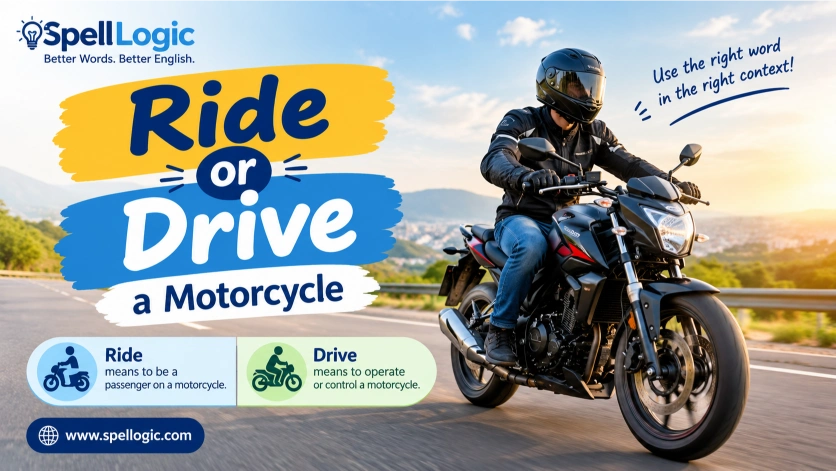
English learners often wonder whether to say “ride a motorcycle” or “drive a motorcycle.” Both expressions may seem logical because a motorcycle is a vehicle, and we commonly use drive with cars, buses, and trucks. However, English has a useful distinction between the verbs ride and drive.
Understanding this difference can help you sound more natural when talking about motorcycles, transportation, and everyday travel. In standard English, ride is normally the preferred verb for motorcycles because the rider sits on the vehicle rather than inside it. This article explains when to use each expression, gives practical examples, and shows common mistakes.
Why “Ride” and “Drive” Are Confusing
The expressions ride or drive a motorcycle confuse learners because both verbs can describe controlling or traveling in a vehicle. The main difference is not simply whether the vehicle has an engine. Instead, English speakers traditionally choose the verb according to how a person is positioned on or in the vehicle.
Similar Pronunciation
The words ride and drive do not sound the same, so this pair is not a homophone problem. However, both verbs are common transportation words, and learners frequently encounter them in similar sentences.
For example:
- I ride my motorcycle to work.
- I drive my car to work.
Because the sentence structures are almost identical, learners may naturally transfer drive from cars to motorcycles.
Similar Spelling
The words are not particularly similar in spelling. However, both are short, common verbs that can describe operating a means of transportation. This shared function can make their usage confusing.
Context Confusion
The biggest problem with ride or drive a motorcycle is context. We usually say ride a motorcycle, ride a bicycle, and ride a horse. In contrast, we usually say drive a car, drive a truck, and drive a bus.
A motorcycle sits between these categories for learners because it is a motor vehicle but is operated while the person sits on it.
Common Learner Mistakes
Some learners say:
- “I drive my motorcycle every morning.”
This sentence can be understood and may occur in some varieties of English, but ride a motorcycle is generally the more natural and standard choice.
Another common mistake is assuming that every vehicle with an engine requires drive. English does not work that way. The traditional distinction between ride and drive is based partly on the type and position of the vehicle.
Ride vs Drive Explained Simply
When discussing ride or drive a motorcycle, the simplest rule is to use ride when you mean traveling on a motorcycle.
One-line distinction: Ride is the usual verb for traveling on a motorcycle, while drive is normally used for operating enclosed or seated-inside vehicles such as cars and trucks.
Consider these examples:
- Correct: I ride my motorcycle to work every day.
- Correct: Sarah rides her motorcycle along the highway.
So, when choosing between ride or drive a motorcycle, remember that motorcycles are normally something you ride, not something you drive.
The word ride focuses on being on top of or astride the vehicle. The word drive focuses more generally on controlling a motor vehicle, especially one in which the driver sits inside.
Understanding Homophones in English
Although ride and drive are sometimes studied together by English learners, they are not homophones. Their pronunciation and spelling are different.
What Are Homophones?
Homophones are words that sound the same but have different meanings or spellings.
For example:
- right = correct
- write = to put words on paper
These words sound alike but have different meanings and spellings.
Why Homophones Cause Confusion
Homophones can cause problems because learners may hear one word but be unsure which spelling or meaning is intended.
However, the question of ride or drive a motorcycle is different. The confusion comes from vocabulary and usage, not from identical pronunciation.
What Does “Ride” Mean?
Definition and Core Meaning
Ride is a verb that means to travel on, in, or with something, especially when you sit on top of it or astride it. It is commonly used with bicycles, motorcycles, horses, and some other forms of transportation.
For motorcycle travel, ride is the normal choice in everyday English.
For example:
- I ride my motorcycle to the office.
- He rides his motorcycle carefully.
- They rode their motorcycles across the country.
- She learned to ride a motorcycle when she was young.
The phrase ride or drive a motorcycle therefore has a clear everyday preference: ride is the usual verb.
Origin and Historical Use
The verb ride is very old. It comes from Old English rīdan, which referred to traveling on horseback or in a vehicle. Historically, riding was strongly associated with horses and other animals.
As transportation developed, the meaning expanded. English speakers began using ride for bicycles, motorcycles, and other vehicles where a person sits on or astride the vehicle.
This historical development helps explain why we still say:
- ride a horse
- ride a bicycle
- ride a motorcycle
The verb has remained connected with the idea of sitting on and traveling with a vehicle or animal.
Modern Usage and Synonyms
In modern English, ride can be used in several transportation contexts.
Common expressions include:
- ride a motorcycle
- ride a bicycle
- ride a horse
- ride a scooter
- ride a bus
- ride a train
- ride in a car
Notice that English uses different structures. We often say ride a bus, but ride in a car. This shows why transportation verbs cannot always be predicted by a simple rule.
In the discussion of ride or drive a motorcycle, the verb ride is especially natural.
Some related words include travel, journey, go, and operate, although they are not exact synonyms in every context.
Example Sentences
- My brother rides a motorcycle to university.
- We rode our motorcycles through the countryside.
- She enjoys riding her motorcycle on weekends.
- He rides carefully in heavy traffic.
- They are learning to ride motorcycles safely.
What Does “Drive” Mean?
Definition and Core Meaning
Drive is a verb meaning to control and operate a vehicle while traveling from one place to another. It is especially common with cars, trucks, vans, and other vehicles where the operator sits inside or in a driver’s position.
For example:
- I drive my car to work.
- She drives a delivery truck.
- They drove across the country.
- He drives carefully at night.
Because a motorcycle is a motor vehicle, learners may wonder why drive is not normally preferred. The answer is that English usage has traditionally established ride as the normal verb for motorcycles.
Origin and Historical Context
The verb drive also has a long history in English. It originally referred to forcing or guiding something forward, including animals or groups of people. Over time, its meaning expanded to include controlling vehicles.
With the development of automobiles, drive became strongly associated with operating cars and other motor vehicles.
Today, this association is very strong:
- drive a car
- drive a truck
- drive a bus
- drive a van
However, language contains many conventional patterns that cannot always be predicted from logic alone.
Modern Usage and Synonyms
In modern English, drive can refer to controlling a vehicle or causing something to move.
Common transportation expressions include:
- drive a car
- drive a truck
- drive a bus
- drive a taxi
- drive a van
The word can also have non-transportation meanings, such as drive a project, drive change, or drive someone home.
When learners compare ride or drive a motorcycle, they should remember that drive may be understood in this context, but ride is the conventional everyday choice for motorcycle travel.
Example Sentences
- My father drives a car to work.
- She drives a large truck.
- We drove for six hours yesterday.
- He learned to drive when he was eighteen.
- The instructor taught him how to drive safely.
Ride vs Drive: Key Differences at a Glance
| Word | Part of Speech | Meaning | Example Context |
|---|---|---|---|
| Ride | Verb | To travel on or astride a vehicle or animal | I ride my motorcycle every day. |
| Drive | Verb | To control and operate a vehicle | I drive my car every day. |
| Ride | Noun | A journey or trip, or an opportunity to travel in/on a vehicle | Can I get a ride home? |
| Drive | Noun | A journey in a vehicle or the act of driving | We went for a drive. |
The clearest practical rule is that ride normally goes with motorcycles, bicycles, horses, and similar forms of transportation, while drive commonly goes with cars and trucks.
Therefore, when deciding between ride or drive a motorcycle, choose ride in ordinary English.
There can be regional and contextual variation, and speakers may sometimes use drive more broadly to mean operate a motor vehicle. Nevertheless, learners who want the most natural standard expression should generally choose ride for motorcycles.
How to Remember the Difference Between Ride and Drive
Remembering transportation vocabulary becomes easier when you connect each verb with a picture.
Easy Memory Trick
Think:
Ride = on it. Drive = inside it.
This is not a perfect rule for every English vehicle, but it is a useful starting point.
For example:
- You ride a motorcycle.
- You ride a bicycle.
- You ride a horse.
- You drive a car.
- You drive a truck.
Association Technique
Imagine a motorcycle. Your body is positioned on the motorcycle, with your legs on either side. Now imagine a car. Your body is inside the vehicle.
This visual difference can help you remember the correct verb.
Another useful association is:
Motorcycle → rider → ride
Car → driver → drive
Thus, if someone asks about ride or drive a motorcycle, connect the motorcycle with the word rider.
One Memorable Example
Remember this sentence:
“I ride my motorcycle, but I drive my car.”
This short contrast gives you two common transportation patterns in one sentence.
Common Mistakes and Confusions
One frequent mistake is using drive simply because a motorcycle has an engine.
Wrong Example
✘ I drive my motorcycle to work every morning.
This sentence is understandable, but for standard everyday usage, ride is more natural.
Correct Version
✔ I ride my motorcycle to work every morning.
The same distinction appears with questions:
✘ Do you drive a motorcycle?
✔ Do you ride a motorcycle?
Another mistake is changing the verb because the motorcycle is powerful or large. The size or engine capacity does not normally change the basic verb choice.
You can say:
- ride a small motorcycle
- ride a large motorcycle
- ride a powerful motorcycle
- ride a racing motorcycle
The verb remains ride.
Learners should also avoid applying the rule too mechanically. English has expressions such as ride in a car, ride a bus, and drive a vehicle. Context matters.
The main point is that ride or drive a motorcycle is not simply a question of which verb sounds logical. It is a question of established English usage.
Examples Section: Correct and Incorrect Usage
Here are several examples showing how the verbs work in real sentences.
Example 1
✔ Correct: I ride my motorcycle to work every morning.
This is the most natural everyday expression.
✘ Incorrect: I drive my motorcycle to work every morning.
Although the meaning is understandable, ride is the conventional choice.
Example 2
✔ Correct: Maria rides her motorcycle on weekends.
The verb rides agrees with the singular subject Maria.
✘ Incorrect: Maria drives her motorcycle on weekends.
This may be understood, but it is less natural in standard everyday English.
Example 3
✔ Correct: He learned to ride a motorcycle when he was twenty.
This sentence correctly describes learning the skill of motorcycle riding.
✘ Incorrect: He learned to drive a motorcycle when he was twenty.
The sentence is understandable, but ride is normally preferred.
Example 4
✔ Correct: They rode their motorcycles across the country.
The past tense of ride is rode.
✘ Incorrect: They rided their motorcycles across the country.
The verb ride is irregular, so its simple past form is rode, not “rided.”
Example 5
✔ Correct: She enjoys riding her motorcycle in the countryside.
After enjoy, use the -ing form.
✘ Incorrect: She enjoys to ride her motorcycle in the countryside.
The normal structure is enjoy + gerund, so riding is correct.
Example 6
✔ Correct: My brother rides a motorcycle to college.
This is a natural way to describe regular motorcycle travel.
✘ Incorrect: My brother drives a motorcycle to college.
The intended meaning is clear, but rides is the usual choice.
Self Assessment: Test Your Knowledge
Fill in each blank with the most appropriate form of ride or drive.
- I ______ my motorcycle to work every morning.
- Sarah ______ her car to the office.
- They ______ their motorcycles through the mountains last weekend.
- He is learning to ______ a motorcycle safely.
Self Assessment Answers
- ride — I ride my motorcycle to work every morning.
- drives — Sarah drives her car to the office.
- rode — They rode their motorcycles through the mountains last weekend.
- ride — He is learning to ride a motorcycle safely.
These answers demonstrate the basic distinction between the two verbs. Use ride for motorcycle travel and drive for vehicles such as cars in ordinary standard usage.
FAQs
1. Is it correct to say “ride a motorcycle”?
Yes. Ride a motorcycle is the standard and most natural expression in everyday English. Native speakers commonly use ride for motorcycle travel.
2. Can I say “drive a motorcycle”?
People will generally understand what you mean, and the expression can occur in some contexts or varieties of English. However, ride a motorcycle is the more conventional choice for English learners.
3. Why do we ride motorcycles but drive cars?
English traditionally uses ride for vehicles that a person sits on or astride, such as motorcycles and bicycles. Drive is commonly used for vehicles in which the operator sits inside or in a driver’s compartment.
4. Do you ride or drive a motorcycle?
In standard everyday English, you normally ride a motorcycle. For example: “I ride a motorcycle to work.”
5. Do you ride or drive a bike?
For a bicycle, ride a bike is standard. For a motorcycle, ride a motorcycle is also the usual expression.
6. Is “motorcycle rider” or “motorcycle driver” correct?
Motorcycle rider is the more common and natural expression. The person operating a motorcycle is normally called a rider.
7. Is “ride” always used for every vehicle?
No. Transportation vocabulary has several patterns. For example, we commonly ride a bus, ride a train, or ride in a car, while we drive a car or drive a truck. Therefore, individual expressions should be learned through common usage.
Final Conclusion: Using “Ride” and “Drive” Correctly
Understanding ride or drive a motorcycle becomes much easier once you connect each verb with its usual transportation pattern. In standard everyday English, ride is the preferred verb for motorcycles because a person sits on or astride the motorcycle. We say, “I ride my motorcycle to work,” just as we say, “I ride a bicycle.” In contrast, drive is commonly associated with cars, trucks, vans, and similar vehicles in which the driver sits inside a driver’s compartment.
The easiest memory trick is “ride = on it, drive = inside it.” This is a helpful general guide, although English has exceptions and special transportation expressions. For example, we can ride a bus or train even though we do not sit on top of them. Therefore, learning common word combinations is just as important as learning general rules.
When choosing ride or drive a motorcycle, use ride for the most natural standard expression. You can also remember the useful contrast: “I ride my motorcycle, but I drive my car.” With regular practice and exposure to natural English, this distinction will soon become automatic. Keep learning one useful expression at a time, and your English will become more accurate and natural.