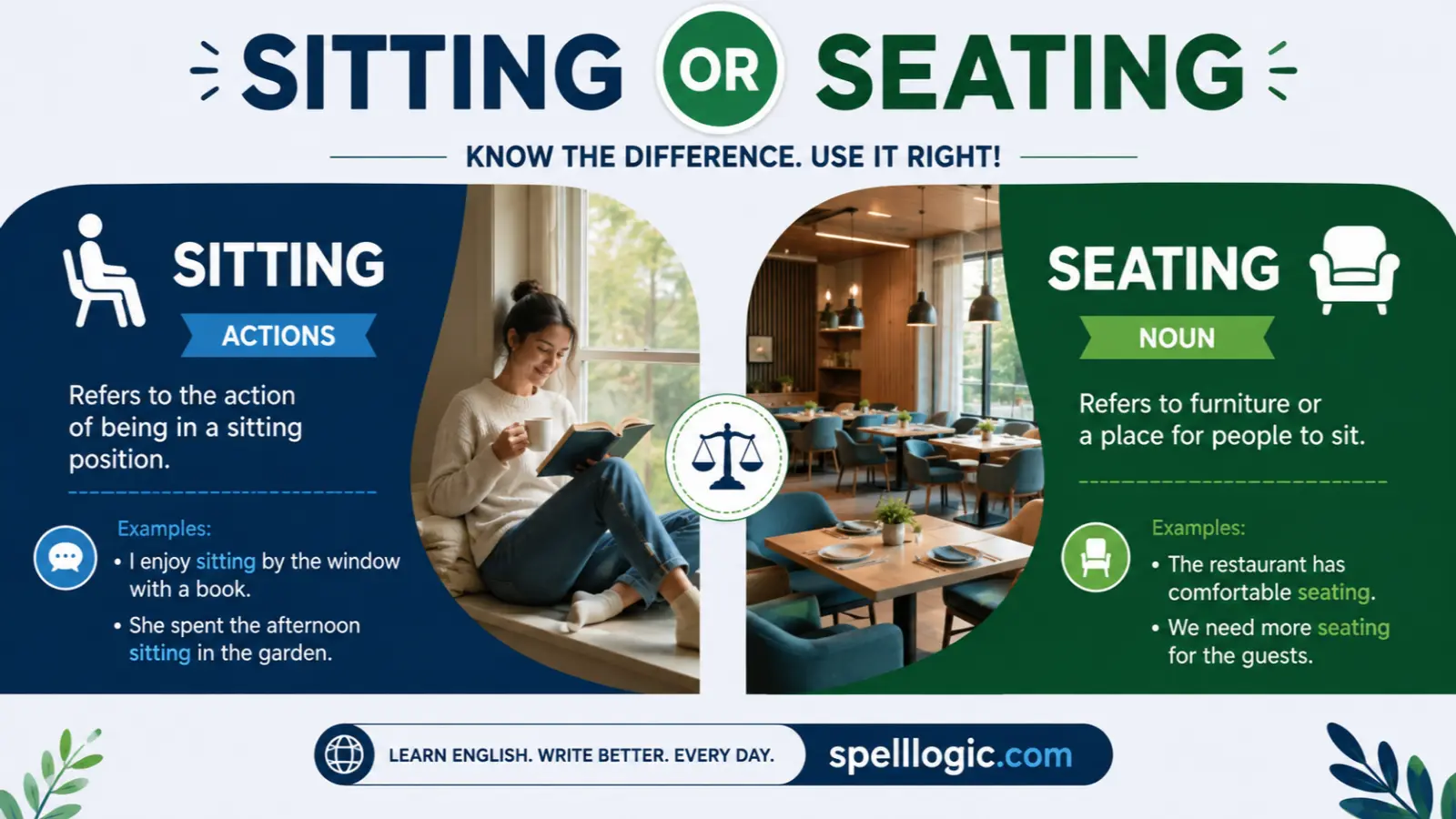
English learners often see the words sitting and seating in similar situations, especially when talking about chairs, classrooms, restaurants, meetings, or passengers. Because both words relate to being in a seated position, it is easy to use one when the other is needed. However, they do not have the same grammatical role or meaning.
Understanding the difference can make everyday English more natural and precise. The key is simple: one word usually describes the action or state of being seated, while the other commonly refers to the arrangement or process of providing places to sit. Once this distinction becomes familiar, many confusing sentences become much easier.
Why “sitting” and “seating” Are Confusing
The question of sitting or seating usually comes from choosing between a person’s action and an arrangement of seats. Learners often connect these words because they come from the same basic verb, sit, and both appear around chairs and people in seated positions. The difference becomes clearer when you look at what each word focuses on.
Similar pronunciation
In sitting or seating questions, listening carefully to the ending can help. The words are not pronounced identically, but their sounds are close enough to cause confusion in fast speech. In particular, the first syllables can sound similar to learners who are still developing listening skills.
Similar spelling
Seeing sitting or seating in writing makes the shared root especially noticeable. Both words begin with “sit-” and contain the letters “-ing.” This visual similarity can make them seem interchangeable even though their grammatical functions differ.
Context confusion
Context quickly separates sitting or seating when you ask who or what the sentence describes. A restaurant may talk about seating capacity, while a customer may say, “We are sitting near the window.” Both statements concern chairs and places, but they describe different things. The first focuses on available places or arrangement; the second focuses on the people who are seated.
Common learner mistakes
A frequent mistake is using seating when describing a person’s current position or using sitting when discussing the number or arrangement of places. Another error is treating the words as if they were nouns with exactly the same meaning.
“Sitting” vs “Seating” Explained Simply
A quick comparison of sitting or seating helps learners choose confidently. The easiest way to understand the difference is to ask what the sentence is focusing on. If it focuses on a person being in a chair or on the act of sitting down, sitting is normally appropriate. If it focuses on places for people to sit, their arrangement, or the act of helping people find places, seating is usually the better choice.
One-line distinction: Sitting describes being seated or the act of sitting; seating usually describes places, arrangements, capacity, or the process of placing people in seats.
Two quick examples show the contrast:
- “Maria is sitting beside the door.” Here, the sentence describes Maria’s position.
- “The theater has seating for 500 people.” Here, the sentence describes the theater’s capacity.
In short, sitting is generally about the person or action, while seating is generally about seats, arrangements, or capacity.
Understanding Homophones in English
Learning about sitting or seating also helps learners notice that similar-looking words are not always homophones. The pair may sound similar, but they are not homophones. This distinction matters because learners sometimes assume that any two similar-sounding words are homophones.
What Are Homophones?
Homophones are words that sound the same but have different meanings, and often different spellings. For example, right and write sound alike but have different meanings.
Why Homophones Cause Confusion
When two words sound exactly alike, listeners must use context and spelling to identify the intended meaning. For example, in “Please write your name,” the surrounding words show that write means to put words on paper. Since sitting and seating have different sounds, their main challenge is not homophony but their similar form, shared root, and overlapping context.
What Does “Sitting” Mean?
Most everyday examples of sitting or seating become clear once the speaker identifies the person involved.
Definition and Core Meaning
Sitting is the present participle of the verb sit. It can describe the action of moving into or remaining in a seated position. It can also function as a noun or adjective in certain contexts.
When someone says, “I am sitting at my desk,” the word tells us what the person is doing. The focus is on the person’s position or activity rather than on the number or arrangement of chairs.
Origin and Historical Use
Sit is an old English verb with roots going back to Old English sittan. The basic idea has remained stable: to be supported by a seat or to place the body in a seated position. Over time, the word has also developed figurative uses, such as sitting for an examination or sitting on a committee.
Modern Usage and Synonyms
Everyday conversations provide many natural examples of sitting or seating. Today, sitting is common in everyday conversation, formal writing, instructions, and descriptions of body position.
Useful related words and expressions include:
- seated — already in a sitting position
- resting — relaxing or taking a break
- remaining — staying in a place
- occupying a seat — using a particular chair or place
- sitting down — moving into a seated position
Example sentences
- “The children are sitting on the floor.”
- “I was sitting beside my friend during the lecture.”
- “Please remain sitting until the bus stops.”
- “She spent an hour sitting in the waiting room.”
- “He is sitting at the front of the classroom.”
Notice that these examples focus on people and their positions or actions.
What Does “Seating” Mean?
Venue information often uses sitting or seating language when discussing chairs and capacity.
Definition and Core Meaning
Seating is the present participle of seat, and it can also function as a noun. As a noun, it commonly refers to seats collectively, the arrangement of seats, the capacity of a place, or the process of placing people in seats.
For example, “The restaurant offers outdoor seating” refers to the seats or seating facilities. “The host is seating the guests” refers to the process of placing them in appropriate seats.
Origin and Historical Context
Seat comes from Old English sete, meaning a place for sitting, and the verb seat developed from the idea of placing someone in a seat.
Modern Usage and Synonyms
When reading event information, sitting or seating may describe the facilities provided. Common meanings include:
- the arrangement of chairs or seats
- the number of people a venue can accommodate
- the process of placing guests or passengers
- seats or places provided for an audience
- an area designed for people to sit
Depending on context, related expressions include accommodation, capacity, arrangement, placement, and seats.
Example sentences
- “The restaurant offers outdoor seating.”
- “Please check the seating chart before the ceremony.”
- “The hall has seating for 300 guests.”
- “The staff is seating customers now.”
- “The airline changed our seating arrangement.”
These examples show that seating often has a broader focus than a single person’s position.
“Sitting” vs “Seating”: Key Differences at a Glance
This table makes sitting or seating easier to compare at a glance.
| Word | Part of Speech | Meaning | Example Context |
|---|---|---|---|
| Sitting | Verb form, noun, adjective in some uses | Being in a seated position or performing the action of sit | “They are sitting near the stage.” |
| Seating | Verb form or noun | Placing people in seats, or seats/arrangement/capacity as a group | “The venue has seating for 800.” |
The most useful distinction is the focus. Sitting normally tells us what a person is doing or where someone is positioned. Seating often tells us about available seats, an arrangement, capacity, or the act of assigning people to seats.
How to Remember the Difference Between “Sitting” and “Seating”
Use the person-versus-place rule whenever sitting or seating feels confusing. A simple memory trick is to connect sit with a person and seat with a place.
- Sitting = someone is sitting. Think about a person already in a chair.
- Seating = seats or a seating plan. Think about chairs, capacity, or an arrangement.
- If you can replace the word with “being seated,” sitting is often the natural choice.
- If you can replace it with “places to sit” or “arrangement of seats,” seating is often correct.
Association technique
The classroom picture is a useful way to remember sitting or seating. Imagine a classroom. A student is sitting at a desk. The teacher checks the seating plan. This small mental picture separates the two words.
One memorable example
“Ali is sitting in his assigned seat, according to the seating chart.”
The first word describes Ali’s position. The second refers to the organized plan of seats.
Common Mistakes and Confusions
Most errors with sitting or seating disappear after a few focused examples. Learners often make mistakes when they focus only on the shared idea of chairs instead of the grammatical role of each word.
Wrong: “The theater is sitting for 1,000 people.”
Correct: “The theater has seating for 1,000 people.”
Explanation: A theater does not sit. The sentence needs a word describing its capacity or available places.
Wrong: “I am seating on the sofa.”
Correct: “I am sitting on the sofa.”
Explanation: The speaker is describing their own position, so sitting is needed.
Wrong: “We are sitting customers now.”
Correct: “We are seating customers now.”
Explanation: Staff members are placing customers in seats, so seating is the correct verb form.
Wrong: “The restaurant has outdoor sitting.”
Correct: “The restaurant has outdoor seating.”
Explanation: In this context, the phrase refers to an area or provision of seats.
One important point is that seat itself can be a verb. Therefore, “She is seating the guests” is grammatically correct when she is putting them into seats. The meaning depends on the object and context.
Examples Section: Correct and Incorrect Usage
Practice makes sitting or seating choices more automatic. Here are several practical examples to reinforce the distinction.
✔ Correct: “The students are sitting quietly in the classroom.”
The sentence describes what the students are doing.
✘ Incorrect: “The students are seating quietly in the classroom.”
“Seating” does not normally describe students simply being in their chairs.
✔ Correct: “The conference room has seating for 40 people.”
The sentence describes capacity.
✘ Incorrect: “The conference room has sitting for 40 people.”
The intended meaning is available places, so seating is appropriate.
✔ Correct: “The host is seating the guests.”
The host is placing guests in seats.
✘ Incorrect: “The host is sitting the guests.”
This is not the normal standard construction for this meaning.
✔ Correct: “We were sitting near the entrance.”
The speakers describe their location.
✘ Incorrect: “We were seating near the entrance.”
The sentence does not describe an act of assigning people to seats.
✔ Correct: “Please follow the seating arrangement.”
The phrase refers to an organized plan for seats or people.
✘ Incorrect: “Please follow the sitting arrangement.”
This is usually not the standard expression when discussing an organized plan of seats.
Self Assessment: Test Your Knowledge
These questions check whether you can choose sitting or seating from context.
Fill in each blank with sitting or seating.
- The guests are ______ near the window.
- The stadium has ______ for more than 50,000 people.
- The staff are ______ the customers now.
- We were ______ in the back row during the movie.
Self Assessment Answers
- sitting — It describes the guests’ position.
- seating — It refers to the stadium’s capacity.
- seating — The staff are placing customers in seats.
- sitting — It describes where the speakers were positioned.
FAQs
These answers cover common questions about sitting or seating in everyday English.
Is “sitting” or “seating” correct for a person in a chair?
The sitting or seating choice is simple here: describe the person’s position with sitting. Sitting is normally correct. For example, “She is sitting in a chair.”
Is “seating” a noun or a verb?
It can be both. As a noun, it can mean seats, capacity, or arrangement. As a verb form, it can describe placing people in seats.
Can “sitting” be a noun?
Yes. For example, “The sitting lasted two hours” can describe a period or session, depending on context. It can also appear in expressions such as “a sitting of Parliament.”
Which word should I use for restaurant tables and chairs?
Use seating when discussing the places or arrangement available to customers. “The restaurant has limited seating” is natural.
Are “sitting” and “seating” homophones?
No. They have related meanings and similar forms, but they are pronounced differently and are not homophones.
Is “seating arrangement” correct?
Yes. “Seating arrangement” is a standard phrase for the planned or organized position of seats or people.
Is “sitting arrangement” ever possible?
It can appear in some contexts, especially when referring to how people are positioned, but seating arrangement is usually the more natural phrase when discussing an organized plan of seats.
Final Conclusion: Using “Sitting” and “Seating” Correctly
Understanding sitting or seating becomes much easier when you focus on what the sentence describes. Sitting usually relates to a person being in a seated position, moving into that position, or spending time in a seat. Seating, by contrast, commonly refers to seats as a group, the arrangement or capacity of seats, or the process of placing people in them. This distinction appears everywhere in everyday English: classrooms, restaurants, theaters, offices, airplanes, buses, and public events.
A useful memory rule is simple: think person = sitting and places or arrangement = seating. For example, “Sara is sitting near the door” describes Sara’s position, while “The room has seating for 30 people” describes its capacity. Also remember that seating can be a verb when someone is assigning or placing people in seats, as in “The host is seating the guests.”
With regular practice, these forms will quickly become natural. Keep noticing how native speakers use sitting or seating in real sentences, and you will become more confident choosing the right word in both speaking and writing. The more you read, listen, and practice these examples, the easier it will be to recognize the correct form automatically. Keep learning, keep practicing, and do not worry about making occasional mistakes—every new example helps strengthen your English.