English learners often hesitate when they need to show possession with a word that already ends in s. The question of congress’s or congress’ can seem especially confusing because both forms appear in writing, and different style guides sometimes handle possessives differently. The main issue in congress’s or congress’ is not pronunciation but the rule for forming a possessive noun.
In most modern English usage, Congress’s is the clearest choice when you mean something belonging to the U.S. Congress. Understanding when to use each form can help you write more naturally in academic, professional, and formal contexts. Once you learn the basic rule, this spelling choice becomes much easier.
Why “congress’s or congress’” Are Confusing
The question of congress’s or congress’ often arises because the noun Congress already ends in the letter s. English learners may wonder whether they should add only an apostrophe or add ‘s. This is a common problem with possessive nouns ending in s.
Similar pronunciation
The two written forms are usually pronounced differently in careful speech. Congress’s normally has an additional /ɪz/ or /əz/ sound at the end, while congress’ may be pronounced like the base word in styles that use the shortened possessive spelling. However, in fast speech, the distinction can be easy to miss.
Similar spelling
The forms in congress’s or congress’ look almost identical. The only visible difference is the extra s after the apostrophe. That small difference can make learners unsure about which form follows standard English grammar.
Context confusion
Possessive forms in congress’s or congress’ appear in phrases such as Congress’s decision, Congress’s role, and Congress’ decision. Because both forms can be found in published material, readers may think they are always equally preferred. In reality, usage depends partly on whether the noun is singular or plural and partly on the style guide being followed.
Common learner mistakes
A frequent mistake is assuming that every noun ending in s should receive only an apostrophe. That rule works for many plural nouns, such as the students’ books, but not for ordinary singular nouns. Another mistake is treating the two forms as completely interchangeable in every publication.
“congress’s or congress’” Explained Simply
The easiest way to understand congress’s or congress’ is to begin with the noun’s grammatical number. When Congress is treated as a singular noun, the standard possessive form in many modern style guides is Congress’s. Some style systems permit or prefer Congress’, especially for certain proper names or in journalistic writing.
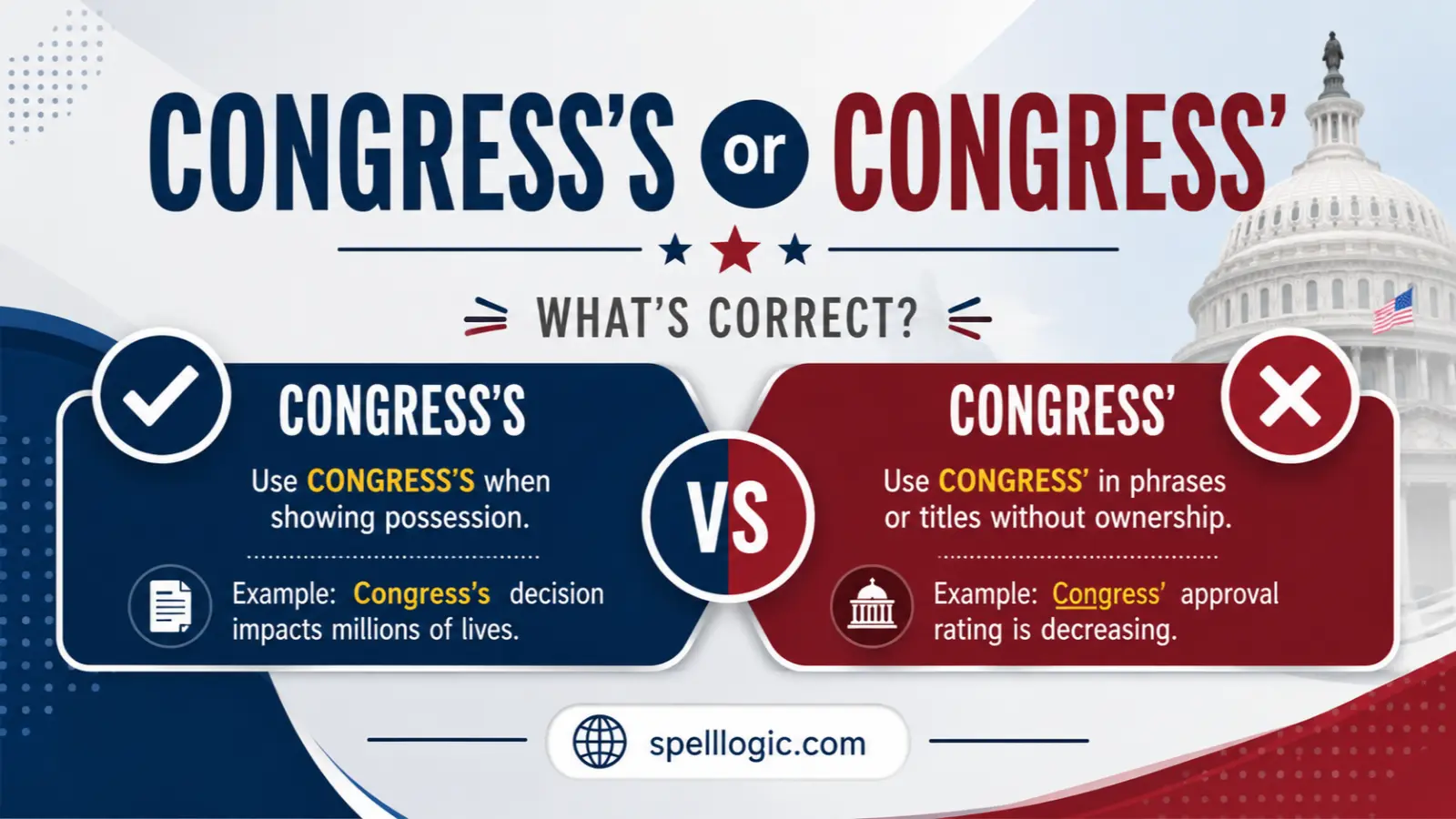
One-line distinction: Congress’s is the standard singular possessive form in many modern styles, while Congress’ is an accepted alternative in some style systems.
Examples:
- Congress’s new proposal received public attention.
- The article discussed Congress’ role in the investigation.
The first example follows the common modern rule for singular nouns. The second can be correct when the writer is following a style guide that drops the final s after the apostrophe for a singular proper name ending in s.
In short, congress’s or congress’ is mainly a question of possessive style, not a difference in meaning. Both forms can indicate that something is associated with or belongs to Congress.
Understanding Homophones in English
Possessive spelling can be confusing, but this particular issue is not really a homophone problem. It is a punctuation and style problem. Still, understanding homophones helps learners avoid confusing similar-looking or similar-sounding English words.
What Are Homophones?
Homophones are words that sound the same but have different meanings or spellings. For example, right and write sound alike, but their meanings and spellings are different.
Why Homophones Cause Confusion
Learners often rely on pronunciation when deciding how to spell a word. For example, someone who hears write may not know whether the speaker means write or right. With congress’s or congress’, however, the main clue is grammatical structure and style, not homophony.
What Does “congress’s” Mean?
Definition and Core Meaning
Congress’s is the possessive form of the singular noun Congress. It shows that something belongs to, comes from, or is associated with Congress.
In American English, Congress commonly refers to the national legislative body made up of the Senate and the House of Representatives. When writers treat it as one singular institution, they can form its possessive with ‘s.
For example:
- Congress’s budget was approved after a long debate.
- The report examined Congress’s response to the crisis.
- Congress’s authority is defined by the Constitution.
- The journalist analyzed Congress’s recent decision.
Origin and Historical Use
The word congress comes from Latin congressus, related to the idea of coming together or meeting. It entered English through French and Latin influences. Over time, congress developed meanings connected with meetings, assemblies, and legislative bodies.
The capitalized form Congress is especially associated with the United States federal legislature. As a singular proper noun ending in s, it creates the familiar possessive question addressed by congress’s or congress’.
Modern Usage and Synonyms
In contemporary American English, Congress’s is widely used when the writer wants to make the possessive relationship explicit.
Related words and phrases include:
- legislature
- federal legislature
- legislative body
- lawmakers
- congressional body
- Congress
Remember that these words are not always exact synonyms. Lawmakers, for instance, refers to people, while Congress refers to the institution.
What Does “congress’” Mean?
Definition and Core Meaning
Congress’ is another possessive spelling used for the singular proper noun Congress. It can express the same basic possessive relationship as Congress’s.
For example:
- The committee reviewed Congress’ spending plan.
- The documentary explored Congress’ history.
- The article questioned Congress’ role in the matter.
In discussions of congress’s or congress’, this form is especially likely to appear when a publication follows a style guide that omits the additional s after the apostrophe for certain singular proper nouns ending in s.
Origin and Historical Context
English has long had variation in how possessives of names and singular nouns ending in s are written. Some traditional and journalistic styles favor an apostrophe alone in particular cases, while many modern general-purpose style guides favor ‘s for singular nouns.
That variation explains why readers encounter both forms and why the question congress’s or congress’ does not have one universal answer across every style manual.
Modern Usage and Synonyms
Congress’ remains understandable and can be correct within a specified editorial style. However, writers should avoid switching randomly between possessive systems in the same document.
Useful related terms include:
- congressional
- legislature
- lawmakers
- legislative branch
- federal government
Examples:
- The study focused on Congress’ legislative priorities.
- The newspaper reported on Congress’ latest proposal.
- The professor discussed Congress’ constitutional powers.
“congress’s or congress’”: Key Differences at a Glance
| Word | Part of Speech | Meaning | Example Context |
|---|---|---|---|
| Congress’s | Possessive singular noun | Something belonging to or associated with Congress | Congress’s decision |
| Congress’ | Possessive singular noun | Same basic possessive meaning, used by some style guides | Congress’ decision |
The key point in congress’s or congress’ is that the meaning is generally the same. The difference is mainly spelling convention and editorial style.
A useful general rule is this: for a singular noun, many modern style guides add ‘s, even when the noun ends in s. For a plural noun that already ends in s, writers normally add only an apostrophe. Compare:
- the student’s book — singular
- the students’ books — plural
- Congress’s decision — singular institution
This rule is a helpful starting point, but proper names and established style conventions can create exceptions.
How to Remember the Difference Between congress’s and congress’
Easy memory tricks
Think of Congress as one institution. If you would normally add ‘s to a singular noun, use Congress’s in a style that follows the standard singular possessive rule.
A simple formula is:
Singular noun + ‘s = possessive
So:
Congress + ‘s = Congress’s
Association techniques
Connect the extra s with the idea of a singular noun. For example:
- teacher → teacher’s
- student → student’s
- Congress → Congress’s
If a publication’s style guide tells you to omit the extra s for certain singular proper nouns, then Congress’ may be the house style.
One memorable example
Remember this sentence:
Congress’s decision affected the whole country.
If you remember that Congress is being treated as one institution, Congress’s becomes easier to recognize.
Common Mistakes and Confusions
The biggest confusion around congress’s or congress’ comes from applying a plural possessive rule to a singular noun.
Wrong example
✘ Congress’ are debating the bill.
Correct version
✔ Congress is debating the bill.
The issue here is not possession. Congress is the subject, so it does not need an apostrophe at all.
Another common mistake
✘ The Congresss decision was controversial.
Correct version
✔ Congress’s decision was controversial.
The correct possessive requires an apostrophe. The extra s belongs after the apostrophe when using the common singular possessive form.
Style inconsistency
A writer may use Congress’s in one paragraph and Congress’ in another without following a consistent editorial rule. Neither choice should be made randomly.
For formal writing, check the required style guide. If no specific guide is required, Congress’s is a clear modern choice for the singular possessive.
Examples Section: Correct and Incorrect Usage
The following examples show how congress’s or congress’ work in real sentences.
Example 1
✔ Correct: Congress’s new bill attracted national attention.
✘ Incorrect: Congresss new bill attracted national attention.
Explanation: The possessive needs an apostrophe. The common singular possessive spelling is Congress’s.
Example 2
✔ Correct: Congress’ role was discussed in the report.
✘ Incorrect: Congress role was discussed in the report.
Explanation: Congress’ can be correct under a style guide that uses an apostrophe alone for this singular proper noun.
Example 3
✔ Correct: Congress’s members debated the proposal.
✘ Incorrect: Congress’s members debated the proposal, if the intended meaning is simply “members of Congress” under a house style that avoids this construction.
Explanation: Although the possessive is grammatically possible, members of Congress is often clearer and more natural.
Example 4
✔ Correct: The article explains Congress’s constitutional powers.
✘ Incorrect: The article explains Congress constitutional powers.
Explanation: The possessive relationship needs an apostrophe construction when Congress directly modifies constitutional powers.
Self Assessment: Test Your Knowledge
Fill in each blank with Congress’s or Congress’. Choose the form that best fits standard modern usage, unless a style guide says otherwise.
- The report examined ______ response to the proposal.
- The historian discussed ______ role during the period.
- The newspaper analyzed ______ spending priorities.
- The professor explained ______ constitutional powers.
Self Assessment Answers
- Congress’s — It is the common singular possessive form.
- Congress’s — The noun is singular and possessive.
- Congress’s — The phrase shows that the priorities are associated with Congress.
- Congress’s — The phrase identifies powers associated with Congress.
If your workplace or publication follows a style guide that prefers Congress’, that form may be used consistently instead.
FAQs
1. Is “congress’s or congress’” a grammar or style question?
The question congress’s or congress’ is mainly about possessive grammar combined with editorial style.
2. Is “Congress’s” grammatically correct?
Yes. Congress’s is grammatically correct and is the standard singular possessive form in many modern English style guides.
3. Is “Congress’” also correct?
Yes, in some style systems. Congress’ is an accepted alternative when the relevant editorial style drops the additional s after the apostrophe.
4. Which is better for formal writing?
When no specific style guide is required, Congress’s is a clear and widely accepted choice. For professional or academic work, follow the style guide requested by your institution.
5. Is Congress singular or plural?
When referring to the U.S. legislative institution, Congress is normally treated as a singular noun in American English: Congress is considering the bill.
6. Should I write “Congress’s decision” or “Congress’ decision”?
Both can be found, but Congress’s decision follows the common singular possessive pattern. Congress’ decision may be preferred by particular style guides.
7. Is “Congress” a proper noun?
Yes, when it refers specifically to the U.S. federal legislature, it is normally capitalized as Congress. The lowercase congress can refer more generally to a meeting, assembly, or formal gathering.
8. Does the apostrophe change the meaning?
Usually, no. In congress’s or congress’, the apostrophe marks possession or association. The main difference is the spelling convention used by the writer or publication.
Final Conclusion: Using “congress’s or congress’” Correctly
The choice between congress’s or congress’ becomes much easier once you separate grammar from style. Both forms in congress’s or congress’ can express possession by the singular noun Congress, so the main difference is the convention used to write the possessive. In many modern English styles, Congress’s is the preferred form because singular nouns normally take ‘s, even when they already end in s. Some style guides, especially certain journalistic or traditional systems, use Congress’ instead. Therefore, neither form should be judged without considering the style guide being followed.
For everyday, academic, and general professional writing, Congress’s is usually the clearest default when no special house style applies. Remember the simple pattern: a singular noun normally takes ‘s, while a plural noun that already ends in s normally takes only an apostrophe. Also, do not add an apostrophe simply because you see the word Congress; use one only when the word is possessive. Finally, consistency matters. Choose the form your style guide recommends and use it throughout your document. With this rule in mind, learners can confidently handle this common English punctuation question and make their writing clearer and more accurate.