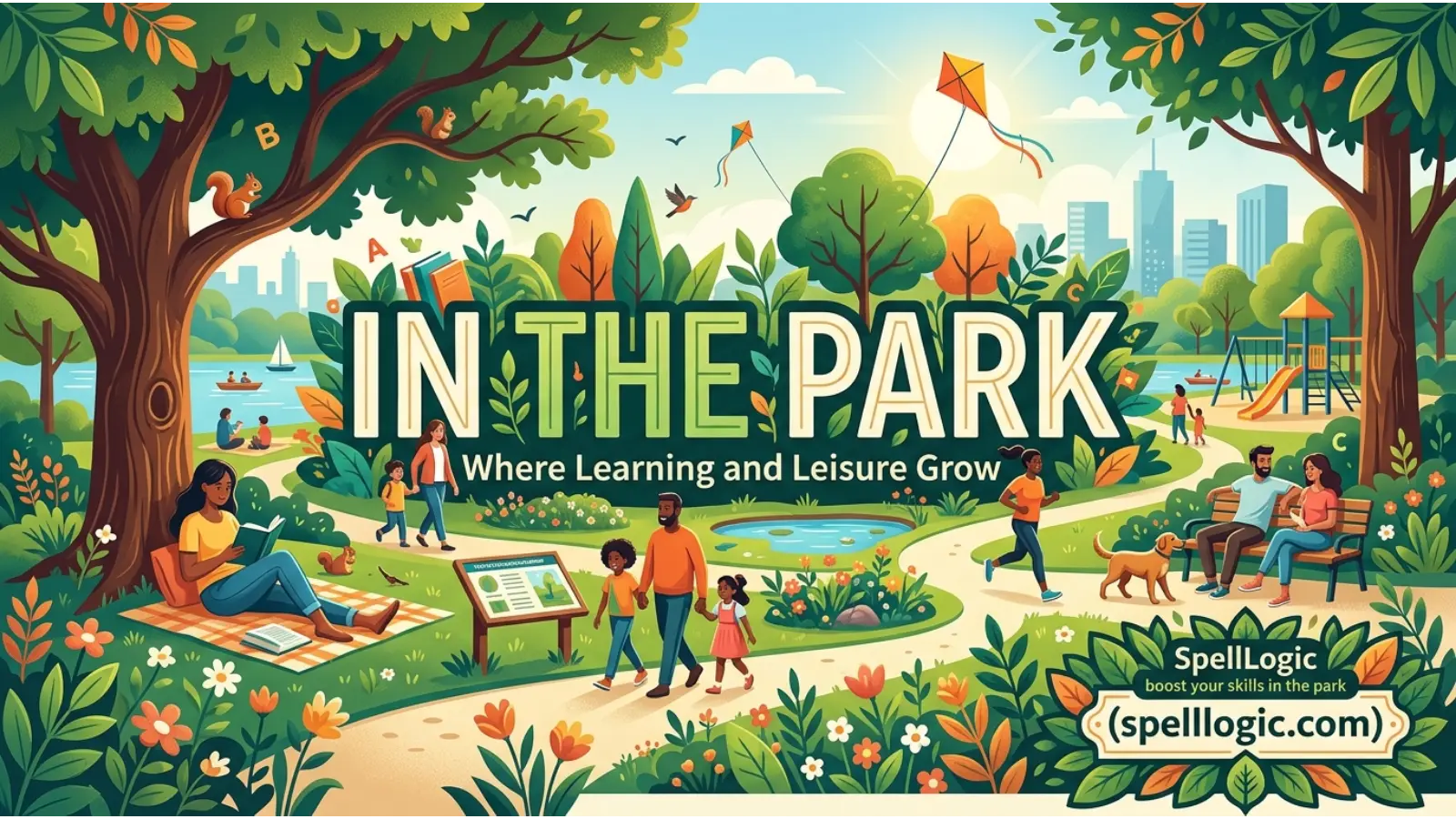
English learners often wonder whether to say in the park or at the park. Both expressions are correct, but the small prepositions in and at change the focus: one usually emphasizes an area, while the other often identifies a location or meeting point.
Parks can be treated as both physical spaces and destinations, so context matters. Understanding this difference helps you speak and write more naturally when talking about activities, meetings, directions, and everyday plans. Once you understand how in and at work, choosing the natural expression becomes much easier.
Why “in the park or at the park” Are Confusing
The expressions in the park or at the park are confusing because both can point to the same general location. When learners study in the park or at the park, they are really learning how English prepositions change the focus of a location.
Similar pronunciation
When studying in the park or at the park, learners often notice the short prepositions more than the location meaning. The words in and at are short, common prepositions. They are easy to say quickly in connected speech, so learners may focus more on the noun park than on the preposition.
Similar spelling
There is no major spelling similarity between in and at. However, both are very short prepositions, and learners often memorize them as fixed pairs with places instead of learning the meaning of each preposition. A search for in the park or at the park may make the expressions look like a fixed pair, but their prepositions have different jobs.
Context confusion
A park is an open area, so it naturally works with in when you mean inside its boundaries. However, a park can also be a destination or meeting location, which makes at natural in many situations. The best way to master in the park or at the park is to connect each phrase to its context.
Common learner mistakes
Learners sometimes choose a preposition mechanically. For example, they may always use in for places or always use at for destinations. English is more flexible than that. The meaning and context should guide the choice. Practice with in the park or at the park helps learners avoid choosing a preposition mechanically.
“in the park or at the park” Explained Simply
The simplest way to understand in the park or at the park is to ask what you want to emphasize. This quick approach makes in the park or at the park easier to choose in everyday conversation.
- In the park usually focuses on being within the park area.
- At the park usually focuses on the park as a location, destination, or meeting point.
One-line distinction
“In the park” emphasizes being inside the park area, while “at the park” emphasizes the park as a place or location.
Example sentences
- We had a picnic in the park under a large tree.
- I will meet Sarah at the park at six o’clock.
The first sentence highlights an activity happening within the park. The second identifies the place where two people will meet.
Understanding Homophones in English
It is useful to understand homophones when learning confusing English words. However, this particular pair is not a pair of homophones.
What Are Homophones?
Homophones are words that sound the same but have different meanings, spellings, or both. For example, flower and flour have the same pronunciation but different meanings.
Why Homophones Cause Confusion
Homophones can confuse learners because hearing the word does not always tell you which spelling or meaning is intended. For example, someone hearing “flour” may need context to know whether the speaker means the baking ingredient or the similarly pronounced word flower.
By contrast, in and at have different sounds and different meanings. Their confusion comes from similar grammatical roles, not from identical pronunciation.
What Does “in the park” Mean?
Definition and Core Meaning
In the park means within the physical area of a park. The phrase normally presents the park as a space that contains people, objects, or activities.
For example, if children are playing on the grass, you can say they are in the park. The phrase can also describe movement, events, or conditions occurring within the park.
Origin and Historical Use
The preposition in comes from Old English in, with the basic idea of being inside or within. Over time, English kept and expanded this meaning, allowing in to describe physical spaces, periods, situations, and conditions.
The noun park has historical links to an enclosed area of land.
Modern Usage and Synonyms
Related expressions include:
- within the park
- inside the park
- around the park area
- in a public park
Example sentences
- The children are playing in the park.
- We walked in the park after breakfast.
- There is a small café in the park.
- Many people exercise in the park every morning.
In each example, the park is treated as an area in which something happens.
What Does “at the park” Mean?
Definition and Core Meaning
At the park identifies the park as a location. It often answers the question “Where?” without emphasizing the exact position of someone or something inside the park.
For example, “I am at the park” tells the listener where you are. It does not necessarily explain whether you are near the entrance, on a path, beside a playground, or somewhere else within the grounds.
Origin and Historical Context
The preposition at comes from Old English æt, which expressed a location or position. Its modern uses include points, places, events, addresses, and destinations.
The word park has historical links to an enclosed area of land.
Modern Usage and Synonyms
Depending on context, related expressions include:
- at the park entrance
- at the park
- near the park
- by the park
- at a local park
These expressions can help describe location more precisely.
Example sentences
- I am at the park with my brother.
- Let’s meet at the park at noon.
- She is waiting at the park.
- We saw our neighbors at the park yesterday.
The focus is generally on the park as the relevant location.
“in the park or at the park”: Key Differences at a Glance
| Word | Part of Speech | Meaning | Example Context |
|---|---|---|---|
| In the park | Prepositional phrase | Within the park area | We are playing in the park. |
| At the park | Prepositional phrase | At the park as a location or destination | We will meet at the park. |
The difference between in the park or at the park is often one of focus rather than a strict rule. In everyday speech, native speakers may use at the park when the physical boundaries are not important. They may choose in the park when they want to highlight activity or position within the grounds.
How to Remember the Difference Between in the park or at the park
For in the park or at the park, remember that in points toward an area. Here are simple memory tricks.
1. Think “inside” for in
If you can naturally imagine someone or something inside the park area, choose in.
Memory link: in = inside.
Example: “The children are playing in the park.”
2. Think “location” for at
For in the park or at the park, remember that at can point to a location.
If you are simply naming the place where someone is, where something happens, or where people will meet, at is often a good choice.
Memory link: at = a point or location.
Example: “Meet me at the park.”
3. Ask a quick question
If in the park or at the park still feels difficult, ask whether you mean an area or a location.
- Area → in the park
- Location/meeting point → at the park
One memorable example
“Tom is in the park playing football, but his parents are waiting at the park entrance.”
Common Mistakes and Confusions
Mistake 1: Treating in and at as interchangeable everywhere
Wrong: I am in the park at the entrance.
Better: I am at the park entrance.
Here, at identifies a specific point: the entrance.
Mistake 2: Assuming at is always wrong with a park
Wrong idea: A park is an area, so only in can be correct.
That is not true. At the park is very common when the park is treated as a destination, meeting place, or general location.
Mistake 3: Assuming in always means indoors
Wrong idea: We cannot use in because a park is outside.
English uses in for many outdoor areas with boundaries or recognizable limits, such as in the garden, in the field, and in the park.
Mistake 4: Choosing the preposition without considering meaning
Compare:
- “We had lunch in the park.” → The activity happened within the park.
- “We met at the park.” → The park was the meeting location.
Both sentences are natural because the context changes the focus.
Examples Section: Correct and Incorrect Usage
Example 1
The choice in in the park or at the park becomes clearer when you identify the activity being described.
✔ Correct: The children are playing in the park.
✘ Incorrect: The children are playing at the park.
Explanation: The first version clearly emphasizes the park grounds. The second can occur in casual speech but is less precise here.
Example 2
This pair, in the park or at the park, can change the focus without changing the basic location.
✔ Correct: Let’s meet at the park at 5 p.m.
✘ Incorrect: Let’s meet in the park at 5 p.m.
Explanation: The second can be natural if the speaker means somewhere inside the park. However, at is usually better for a general meeting location.
Example 3
Use the context of in the park or at the park to decide whether the area or location matters more.
✔ Correct: We saw many birds in the park.
✘ Incorrect: We saw many birds at the park.
Explanation: In clearly emphasizes the birds being within the park area. In gives the more specific spatial meaning.
Example 4
This final example shows why in the park or at the park cannot always be reduced to one universal rule.
✔ Correct: I am at the park now.
✘ Incorrect: I am in the park now.
Explanation: Both can be correct. The first simply identifies the location. The second emphasizes that the speaker is inside the park area. The choice depends on meaning, not a simple right-or-wrong rule.
Self Assessment: Test Your Knowledge
Fill in each blank with in or at.
- The children are running ___ the park.
- We will meet ___ the park after work.
- She found a quiet bench ___ the park.
- I am waiting ___ the park entrance.
Self Assessment Answers
- in — The children are within the park area.
- at — The park is the meeting location.
- in — The bench is located within the park.
- at — The entrance is treated as a specific location or point.
FAQs
1. Is in the park or at the park grammatically correct?
Yes. Both expressions are grammatical. The correct choice depends on whether you want to emphasize the park as an area or as a location.
2. Is in the park or at the park grammatically correct?
Yes. In the park is natural for something located within the grounds, while at the park commonly identifies the park as a destination or location.
3. Which is more common: “in the park” or “at the park”?
Both are common. The better choice depends on what you want to emphasize. Use in for the area and at for the location or meeting point.
4. Can I say “I am in the park”?
Yes. This clearly suggests that you are within the park grounds.
5. Can I say “I am at the park”?
Yes. This simply tells the listener that the park is your current location. It does not specify your exact position.
6. Should I say “meet in the park” or “meet at the park”?
Both can be correct. Meet at the park is natural when the park is the meeting location. Meet in the park suggests meeting somewhere within the park.
7. Are “in” and “at” homophones?
No. They are different prepositions with different pronunciations. The confusion comes from their similar grammatical function in location phrases.
Final Conclusion: Using “in the park or at the park” Correctly
Understanding in the park or at the park becomes much easier when you focus on the idea behind each preposition. The key to in the park or at the park is recognizing whether you mean an area or a location. In the park normally emphasizes being within the physical area of the park. It is especially natural for activities, objects, people, and events located inside the park grounds. At the park, on the other hand, usually treats the park as a general location, destination, or meeting point. Neither expression is automatically correct in every sentence; context decides which one sounds more natural.
A useful memory trick is simple: think in = inside and at = location. If you are describing where an activity happens within the grounds, in is often the best choice. If you are identifying where someone is or where people will meet, at is often more suitable. Still, everyday English allows some overlap, so do not worry if you hear native speakers use both forms in similar situations. Pay attention to the speaker’s focus and practice with real examples. With regular exposure, choosing the right preposition will become natural. Keep practicing, and these small differences will become much easier to recognize and use confidently.