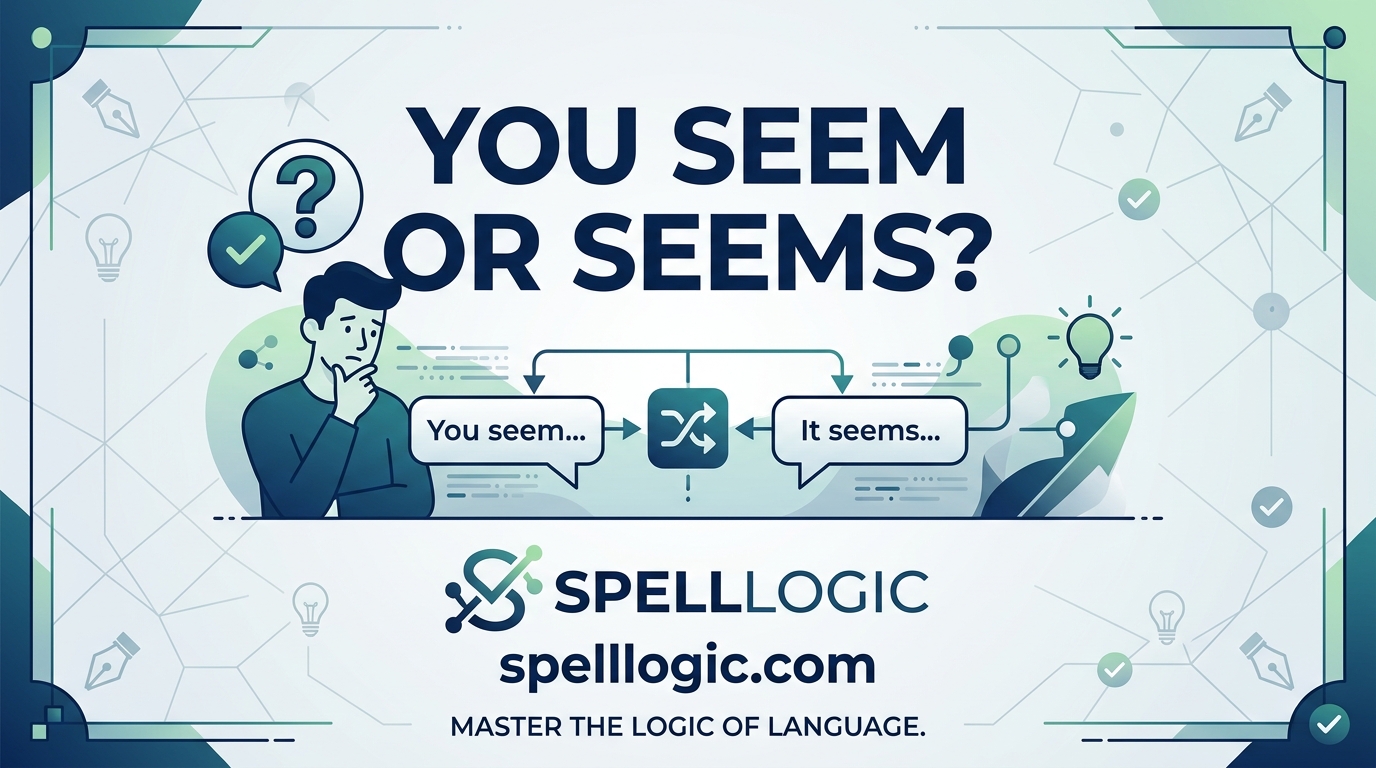
English learners often hesitate when choosing between you seem or seems because both forms look almost identical. The difference is small, but it depends on one important grammar rule: subject–verb agreement. When the subject is you, the verb normally stays in its base form, so seem is correct.
Seems is used with singular third-person subjects such as he, she, or it. Understanding this distinction helps you write natural sentences and avoid a common subject–verb agreement error. Once you learn the pattern, choosing the correct form becomes simple. This guide explains the rule, meaning, examples, common mistakes, and useful memory tricks.
Why “you seem” and “seems” Are Confusing
The expressions you seem and seems are easy to mix up because they come from the same verb, seem. The main difference is grammatical rather than semantic.
Similar Pronunciation
Seem and seems sound very similar. The final s in seems creates only a small sound difference. In fast conversation, learners may not notice it clearly.
Similar Spelling
Both forms are built from the same verb. Seem is the base form, while seems is the third-person singular present form.
Context Confusion
Learners sometimes focus on the meaning instead of the subject. Since the meaning remains related to appearance or impression, it can be difficult to remember which verb form belongs with which subject.
For example:
- You seem tired.
- She seems tired.
The meaning is similar, but the verb changes because the subject changes.
Common Learner Mistakes
A frequent mistake is adding -s after you. English learners may think that a singular person requires a singular verb ending. However, English grammar does not work that way with you. The correct pattern is you seem, not you seems.
You Seem vs Seems Explained Simply
The easiest way to understand you seem and seems is to look at the subject.
You seem or seems can be understood through this simple rule: use seem after you, while seems is used after he, she, or it.
One-Line Distinction
You seem is correct with you, while seems is correct with a singular third-person subject.
Examples
- You seem happy today.
- She seems happy today.
The verb seem means to give an impression or appear to be a particular way.
Compare these patterns:
- I seem tired.
- You seem tired.
- We seem tired.
- They seem tired.
- He seems tired.
- She seems tired.
- It seems difficult.
This pattern makes the difference much easier to recognize.
Understanding Homophones in English
The confusion surrounding you seem or seems is sometimes described as a pronunciation problem, but these words are not true homophones. Grammar is the main issue.
What Are Homophones?
Homophones are words that have the same pronunciation but different meanings, spellings, or both.
For example, flower and flour sound alike but have different meanings.
Seem and seems are not homophones because the final s changes the pronunciation slightly. They are simply different grammatical forms of the same verb.
Why Homophones Cause Confusion
English learners often depend on sound when speaking or listening. When two forms sound very similar, it can be easy to overlook a grammatical difference.
For example, a learner may hear a sentence quickly and later write the wrong verb form. Learning subject–verb patterns is therefore more reliable than depending only on pronunciation.
What Does “You Seem” Mean?
Definition and Core Meaning
You seem means that someone gives a particular impression or appears to have a particular quality, feeling, or condition.
For example:
- You seem busy.
- You seem worried.
- You seem confident.
- You seem interested in the topic.
Here, seem does not necessarily state a proven fact. Instead, it describes what the speaker observes or believes from someone’s behavior, appearance, voice, or actions.
The expression you seem is especially common when making polite observations.
For example:
You seem very knowledgeable about this subject.
This does not necessarily mean the speaker has complete proof. It means the person’s behavior or comments create that impression.
Origin and Historical Use
The verb seem has a long history in English. It developed from older Germanic forms related to the idea of appearing or being perceived in a certain way. Over time, it became a common English verb used to describe impressions and appearances.
Today, seem is a standard part of everyday English.
Modern Usage and Synonyms
Depending on context, useful alternatives include:
- appear
- look
- sound
- appear to be
- give the impression
- come across as
However, these words are not always interchangeable. Seem is often useful when the speaker is expressing an impression rather than making a definite statement.
Example Sentences
- You seem ready for the examination.
- You seem more relaxed today.
- You seem to understand the lesson.
- You seem interested in learning English.
- You seem nervous about the presentation.
- You seem like a thoughtful person.
The structure you seem to + verb is also common:
- You seem to know the answer.
- You seem to understand the instructions.
- You seem to enjoy reading.
Remember that you seem or seems is resolved by looking at the subject. With you, use seem.
What Does “Seems” Mean?
Definition and Core Meaning
Seems is the present-tense form of seem used with a singular third-person subject.
It can mean appears, gives the impression, or looks as though something is true.
For example:
- He seems tired.
- She seems happy.
- It seems strange.
- The plan seems reasonable.
Origin and Historical Context
Like seem, seems comes from the historical development of the English verb seem. The -s ending is a grammatical marker used with singular third-person subjects in the simple present tense.
This same pattern appears with many English verbs:
- He works.
- She walks.
- It looks.
- The machine runs.
Modern Usage and Synonyms
Common alternatives for seems include:
- appears
- looks
- sounds
- appears to be
- gives the impression
The best choice depends on the context.
Example Sentences
- She seems confident.
- He seems busy this morning.
- It seems impossible.
- The answer seems correct.
- Your idea seems practical.
- The weather seems pleasant.
Notice that seems belongs with he, she, and it, as well as singular nouns.
For example:
- The student seems prepared.
- My brother seems tired.
- The computer seems slow.
A plural subject takes seem:
- The students seem prepared.
- My brothers seem tired.
- The computers seem slow.
You Seem vs Seems: Key Differences at a Glance
| Word | Part of Speech | Meaning | Example Context |
|---|---|---|---|
| You seem | Verb phrase | You appear or give an impression | You seem happy. |
| Seems | Verb | Appears or gives an impression with a singular third-person subject | She seems happy. |
The most important difference is subject–verb agreement. The meaning of seem does not change significantly; the verb form changes because the grammatical subject changes.
A useful comparison is:
- You seem ready.
- He seems ready.
- They seem ready.
- It seems ready.
This demonstrates why you seem or seems is not really a choice based on meaning. It is a choice based on grammar.
How to Remember the Difference Between You Seem and Seems
Easy Memory Tricks
The simplest memory trick is:
You = seem.
Whenever the subject is you, use the base form seem.
Think of this short pattern:
I seem → You seem → We seem → They seem
Then remember:
He seems → She seems → It seems
Association Technique
Associate -s with he, she, and it.
For example:
- He seems.
- She seems.
- It seems.
But:
- I seem.
- You seem.
- We seem.
- They seem.
This technique works with many regular present-tense verbs, not just seem.
One Memorable Example
Remember this sentence:
You seem happy, but she seems happier.
The first subject is you, so the verb has no -s. The second subject is she, so the verb takes -s.
If you can remember this contrast, you can usually solve you seem or seems questions correctly.
Common Mistakes and Confusions
Mistake 1: Adding -s After You
✘ You seems tired.
✔ You seem tired.
Explanation: You takes the base form of the verb in the simple present.
Mistake 2: Removing -s After She
✘ She seem tired.
✔ She seems tired.
Explanation: She is a singular third-person subject, so the verb needs -s.
Mistake 3: Thinking Singular Subjects Always Take -s
English learners sometimes learn that singular subjects require verbs ending in -s. This rule is incomplete.
It applies to singular third-person subjects such as he, she, and it, but not to I or you.
For example:
- I seem ready.
- You seem ready.
- He seems ready.
Mistake 4: Confusing Meaning With Grammar
The meaning remains connected to appear or give an impression. The form changes because of the subject.
Therefore, you seem or seems should be solved by checking the subject first.
Examples Section: Correct and Incorrect Usage
Example 1
✔ Correct: You seem very confident.
✘ Incorrect: You seems very confident.
Why? The subject you requires seem.
Example 2
✔ Correct: She seems very confident.
✘ Incorrect: She seem very confident.
Why? The singular subject she requires seems.
Example 3
✔ Correct: You seem to understand the lesson.
✘ Incorrect: You seems to understand the lesson.
Why? The subject is you, so the base verb seem is required.
Example 4
✔ Correct: It seems like a good idea.
✘ Incorrect: It seem like a good idea.
Why? It is a singular third-person subject, so seems is correct.
More Examples
- You seem ready for the meeting.
- You seem to know what happened.
- He seems concerned about the result.
- They seem excited about the trip.
- She seems interested in the course.
- We seem to have enough time.
These examples show that the verb form depends on the subject, not on the meaning of the sentence.
Self Assessment: Test Your Knowledge
Fill in each blank with seem or seems.
- You ______ tired after the long journey.
- She ______ excited about the new job.
- They ______ ready to leave.
- It ______ difficult at first.
Before checking the answers, identify the subject in each sentence. This is the quickest way to decide whether the verb should have -s.
Self Assessment Answers
- seem — The subject is you.
- seems — The subject is she.
- seem — The subject is they.
- seems — The subject is it.
The pattern is clear: you and plural subjects use seem, while singular third-person subjects use seems.
FAQs
1. Is “you seem” grammatically correct?
Yes. You seem is the correct form when you is the subject.
2. Is “you seems” ever correct?
No. In standard English, you seems is incorrect. Use you seem.
3. Why do we say “you seem” instead of “you seems”?
English uses the base form of the verb after you in the simple present. The -s form is generally used with singular third-person subjects.
4. Is “she seems” correct?
Yes. She seems is correct because she is a singular third-person subject.
5. What is the difference between seem and seems?
Seem is the base form, while seems is the present-tense form used with singular third-person subjects such as he, she, and it.
6. Can I say “you seem to be”?
Yes. You seem to be is a very common and natural construction.
For example:
You seem to be enjoying the course.
7. Is “you seem” used in everyday English?
Yes. It is extremely common in both spoken and written English when describing an impression or appearance.
Final Conclusion: Using “You Seem” and “Seems” Correctly
Understanding you seem or seems becomes much easier when you focus on the subject rather than the meaning. You seem is the correct form when the subject is you. Seems is used with singular third-person subjects such as he, she, and it. The verb seem means to appear or give a particular impression, so the basic meaning stays the same while the grammatical form changes.
A simple memory rule can prevent most mistakes: you = seem; he, she, it = seems. You can extend the same pattern to plural subjects: we seem and they seem. For example, say “You seem happy”, but “She seems happy.” This small difference is important because subject–verb agreement makes your English sound natural and grammatically correct. When you are unsure, identify the subject first and then choose the verb form. With a little practice, this pattern will become automatic. Keep noticing these structures in conversations, books, and everyday writing, and your English grammar will become more accurate and confident over time.