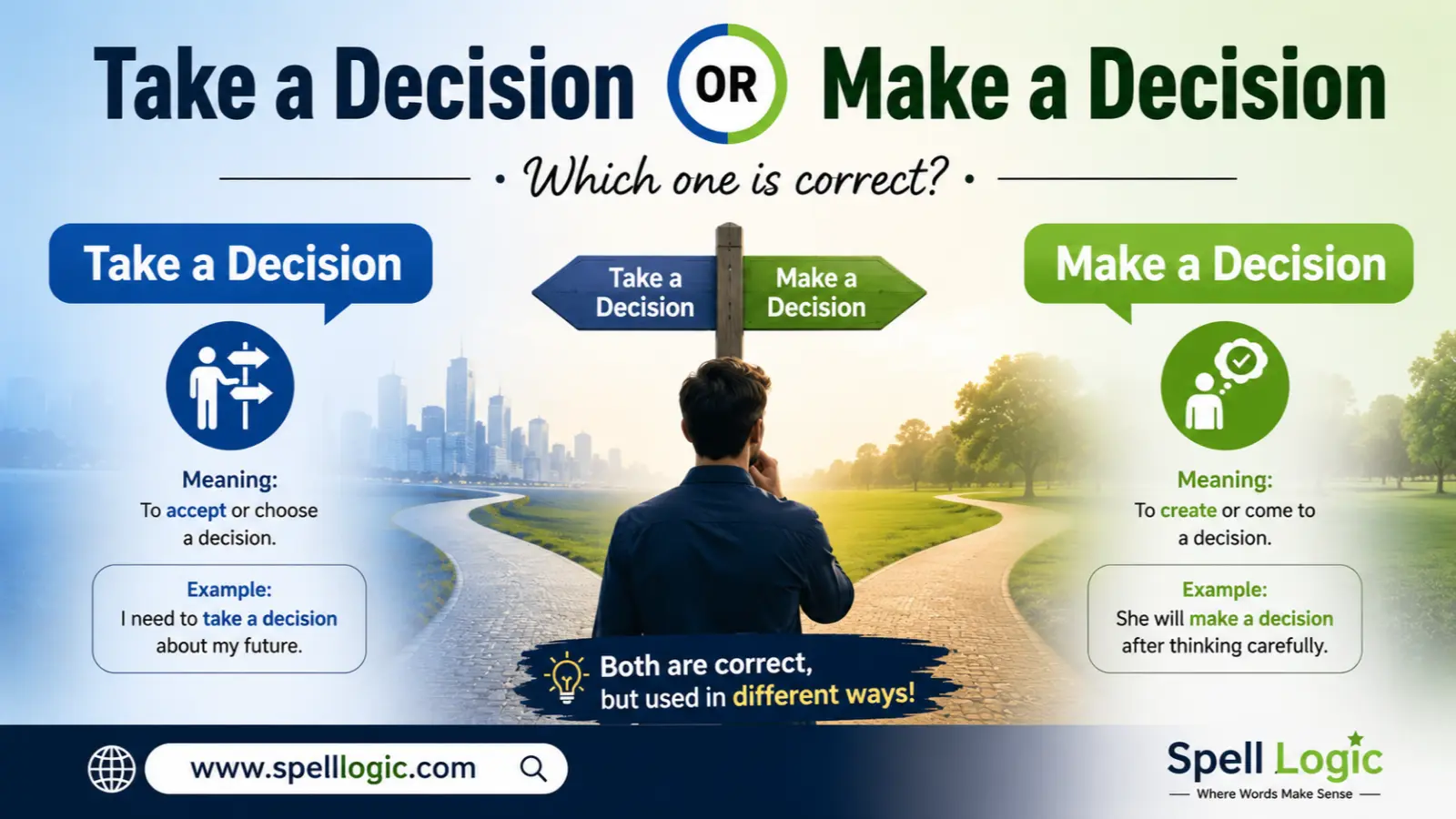
English learners often wonder whether take a decision or make a decision is the correct expression. Both forms are understandable, and both are used by English speakers, but they do not have the same level of naturalness in all varieties of English. The confusion mainly comes from the fact that English uses different verb combinations with similar nouns.
In standard modern English, make a decision is the usual and most widely accepted expression, especially in American and international English. Take a decision is also grammatical and is common in British English and some other varieties. Understanding this difference helps you sound more natural and confident in everyday, academic, and professional English.
Why “Take a Decision or Make a Decision” Are Confusing
Many English learners mix up take a decision or make a decision because both expressions communicate the same basic idea: choosing one option after thinking about a situation.
Similar pronunciation
The words take and make are short, common English verbs, so learners may focus more on the noun decision than on the verb that naturally goes with it. This can make both combinations seem equally logical.
Similar spelling
There is no major spelling similarity between take and make. However, both are short irregular verbs that frequently appear with nouns describing actions, choices, or results.
For example:
- take action
- make a choice
- take responsibility
- make a plan
- take a decision
- make a decision
Because English uses different verb-noun combinations, learners may not know which verb belongs with decision.
Context confusion
The biggest problem is context and regional usage. Make a decision is the safest choice for most English learners because it is extremely common across international English. Take a decision is also used correctly, particularly in British English and in some formal contexts.
Therefore, neither expression should automatically be treated as a serious grammatical error.
Common learner mistakes
A common mistake is assuming that only one expression can ever be correct. Another is using take because learners translate directly from another language.
For general international communication, remember this practical rule: use make a decision as your default expression. Recognize take a decision as a legitimate alternative, especially in British English.
“Take a Decision or Make a Decision” Explained Simply
The simplest explanation is that both expressions can be grammatical, but make a decision is more widely preferred in modern international English.
One-line distinction: Make a decision is the standard and most broadly natural expression, while take a decision is also correct and is especially common in British English.
Consider these examples:
- I need to make a decision before Friday.
- The committee took a decision after a long discussion.
So, take a decision or make a decision does not always have a simple “right versus wrong” answer. The better choice depends partly on regional English and context.
Understanding Homophones in English
The expression take a decision or make a decision involves two different verbs, but these verbs are not homophones. Still, understanding homophones helps explain why English learners sometimes expect similar-looking or similar-sounding words to behave in predictable ways.
What Are Homophones?
Homophones are words that sound the same, or almost the same in some accents, but have different meanings, spellings, or both.
For example:
- right — correct
- write — to form words with a pen or keyboard
These words sound alike in many varieties of English but have different meanings.
Why Homophones Cause Confusion
Homophones can confuse learners because listening alone may not reveal which word a speaker means.
For example, when someone says, “Write the answer,” learners must understand the context to distinguish write from right.
However, take and make are not homophones. They have different sounds and meanings. The confusion here comes from verb choice and collocation rather than pronunciation.
What Does “Take a Decision” Mean?
Definition and Core Meaning
“Take a decision” means to decide something after considering available information, choices, or circumstances. It expresses the act of reaching a decision.
The expression is grammatically valid and is particularly common in British English, Indian English, and some other varieties influenced by British usage.
For example:
- The board took a decision after reviewing the report.
- We must take a decision before the meeting ends.
- She took a difficult decision about her career.
In American English, however, speakers generally prefer make a decision.
Origin and Historical Use
The verb take has been used with nouns in many established English combinations for centuries. English commonly uses take to describe accepting, receiving, undertaking, or carrying out something.
Examples include:
- take responsibility
- take action
- take control
- take a step
- take a chance
The expression take a decision developed within this broader pattern and remains established in British usage.
Modern Usage and Synonyms
Today, take a decision can sound natural in British English and formal institutional writing. In other varieties, it may sound less familiar or slightly formal.
Related expressions include:
- reach a decision
- arrive at a decision
- come to a decision
- settle on a decision
- decide
Notice that reach a decision and arrive at a decision are also natural alternatives.
Example Sentences
- The directors took a decision after several hours of discussion.
- She finally took a decision about where to study.
- The government took a decision to review the policy.
- We need to take a decision soon.
These sentences are understandable and grammatically acceptable, especially in British-oriented English.
What Does “Make a Decision” Mean?
Definition and Core Meaning
“Make a decision” means to choose or determine what you will do after considering different possibilities. It is the most common expression in many varieties of English and is the safest choice for learners.
For example:
- I need to make a decision today.
- He made a difficult decision.
- They made the right decision.
The verb make often combines with nouns representing something produced, created, formed, or established. A decision is viewed as something a person forms through thought and judgment.
Origin and Historical Context
The use of make with decision fits a long-established English pattern in which make means to create, form, establish, or bring something about.
English contains many similar combinations:
- make a plan
- make a choice
- make an agreement
- make a promise
- make a mistake
- make a judgment
Over time, make a decision became especially widespread and is now the dominant choice in many forms of contemporary English.
Modern Usage and Synonyms
In everyday conversation, education, business, journalism, and international communication, make a decision is extremely common.
Useful alternatives include:
- decide
- reach a decision
- arrive at a decision
- come to a decision
- make up your mind
Example Sentences
- We need to make a decision before the deadline.
- Maria made a decision to change her course.
- The manager made the final decision.
- Have you made a decision yet?
For English learners, make a decision is usually the best default choice.
“Take a Decision or Make a Decision”: Key Differences at a Glance
| Word | Part of Speech | Meaning | Example Context |
|---|---|---|---|
| Take | Verb | To choose or reach a decision; common in British English | The committee took a decision after discussion. |
| Make | Verb | To form or reach a decision; widely used internationally | The committee made a decision after discussion. |
The key difference is not basic meaning. Both expressions can describe reaching a choice. The main difference is usage and regional preference.
If you are writing for an international audience, make a decision is generally the safest option. If you are writing specifically in British English, take a decision can sound completely natural.
This is why take a decision or make a decision should be understood as a question of collocation and regional preference rather than a simple grammatical error.
How to Remember the Difference Between Take a Decision and Make a Decision
Easy memory tricks
The easiest memory trick is:
You make a decision, just as you make a choice.
Both decision and choice describe something you form mentally.
Think of these common combinations:
- make a choice
- make a plan
- make a decision
- make a mistake
This pattern makes make a decision easier to remember.
Association techniques
Connect make with the idea of creating or forming something.
You can make:
- a plan
- a promise
- a choice
- a decision
- a suggestion
Connect take with the idea of accepting, carrying, or undertaking something.
You can take:
- action
- responsibility
- control
- a risk
- a step
This distinction is not perfect for every English expression, but it provides a useful learning strategy.
One memorable example
Remember this sentence:
“I made a decision to take action.”
Here, make naturally goes with decision, while take naturally goes with action. This helps learners remember the two collocations together.
Common Mistakes and Confusions
Learners sometimes believe that take a decision is always wrong. That is not accurate. It is a recognized expression, particularly in British English.
Wrong example
✘ I need to make up a decision today.
Correct version
✔ I need to make a decision today.
Explanation: Make up can mean invent or reconcile, but it is not normally used as make up a decision.
Wrong example
✘ She did a decision yesterday.
Correct version
✔ She made a decision yesterday.
Explanation: English uses the collocation make a decision, not do a decision.
Regional confusion
✘ You must never use “take a decision.”
✔ “Take a decision” is acceptable in varieties of English where this collocation is standard.
The important point is to understand your audience.
For American English, international business English, and general learner writing, make a decision is usually the safest choice. For British English, take a decision may be entirely natural.
Another common mistake
Learners sometimes change the verb according to the perceived seriousness of the decision. That is unnecessary.
Both make and take can be used with decisions depending on variety and context. The choice is not normally determined by whether the decision is easy, difficult, personal, or professional.
Examples Section: Correct and Incorrect Usage
Example 1
✔ Correct: I need to make a decision about my university course.
✘ Incorrect: I need to do a decision about my university course.
The natural collocation is make a decision.
Example 2
✔ Correct: The committee took a decision after reviewing the evidence.
✘ Incorrect: The committee did a decision after reviewing the evidence.
Take a decision is acceptable, especially in British English.
Example 3
✔ Correct: Have you made a decision yet?
✘ Incorrect: Have you made decision yet?
The singular countable noun decision normally requires a determiner such as a, the, my, or your.
Example 4
✔ Correct: We finally made a decision to move forward.
✔ Also correct: We finally took a decision to move forward.
Both are possible, although the first is more widely preferred across international English.
Example 5
✔ Correct: The manager made the final decision.
✘ Incorrect: The manager made the final decide.
Decision is a noun, while decide is a verb. You can say the manager decided or the manager made the decision.
Example 6
✔ Correct: It was difficult to make a decision.
✔ Also correct: It was difficult to take a decision.
Again, the first option is generally more familiar to a broad international audience.
Self Assessment: Test Your Knowledge
Fill in each blank with the most natural choice.
- I need to ______ a decision before tomorrow.
- The committee ______ a decision after a long meeting.
- Have you ______ a decision about the job offer?
- She finally ______ a decision after considering all the options.
For questions 1–4, choose make or take. Remember that context and regional English can sometimes allow both.
Self Assessment Answers
- make — “I need to make a decision before tomorrow” is the most broadly natural form.
- made/took — Both can be correct, although made is more widely used internationally.
- made — “Have you made a decision?” is the standard choice for most learners.
- made/took — Both can work depending on the variety of English.
For learners who want one simple default rule, choose make a decision.
FAQs
1. Is “take a decision” grammatically correct?
Yes. Take a decision is grammatically correct and is especially common in British English and some other varieties influenced by British usage.
2. Is “make a decision” correct?
Yes. Make a decision is fully correct and is the most widely preferred expression in many forms of modern English.
3. Which is better for English learners?
For most learners, make a decision is the safest and most internationally understood choice.
4. Do “take a decision” and “make a decision” have different meanings?
Usually, no. Both refer to reaching or choosing a decision. The main difference is regional preference and frequency.
5. Do Americans say “take a decision”?
American speakers generally prefer make a decision. Take a decision may be understood, but it is much less common in American English.
6. Do British people say “take a decision”?
Yes. Take a decision is a recognized and natural expression in British English, although make a decision is also understood and used.
7. Can I use “reach a decision” instead?
Yes. Reach a decision is another natural alternative. For example: After several hours, the team reached a decision.
Final Conclusion: Using Take a Decision and Make a Decision Correctly
The difference between take a decision or make a decision is mainly about collocation and regional usage rather than a simple matter of correct versus incorrect grammar. Both expressions can mean reaching a choice after thinking about different possibilities. However, make a decision is the safest and most widely used expression for English learners, especially in American English, international communication, education, and everyday conversation. Take a decision is also correct and is particularly common in British English and some other varieties.
If you are unsure which form to choose, remember the simple association: you make a decision, just as you make a choice, make a plan, and make a promise. At the same time, recognize that English has regional differences, so you should not assume that take a decision is an error when you hear or read it. The best approach is to consider your audience and follow the variety of English you are learning or using. Most importantly, keep practicing common verb-noun combinations in complete sentences. As your knowledge of English collocations grows, choices like these will become much easier and more natural.