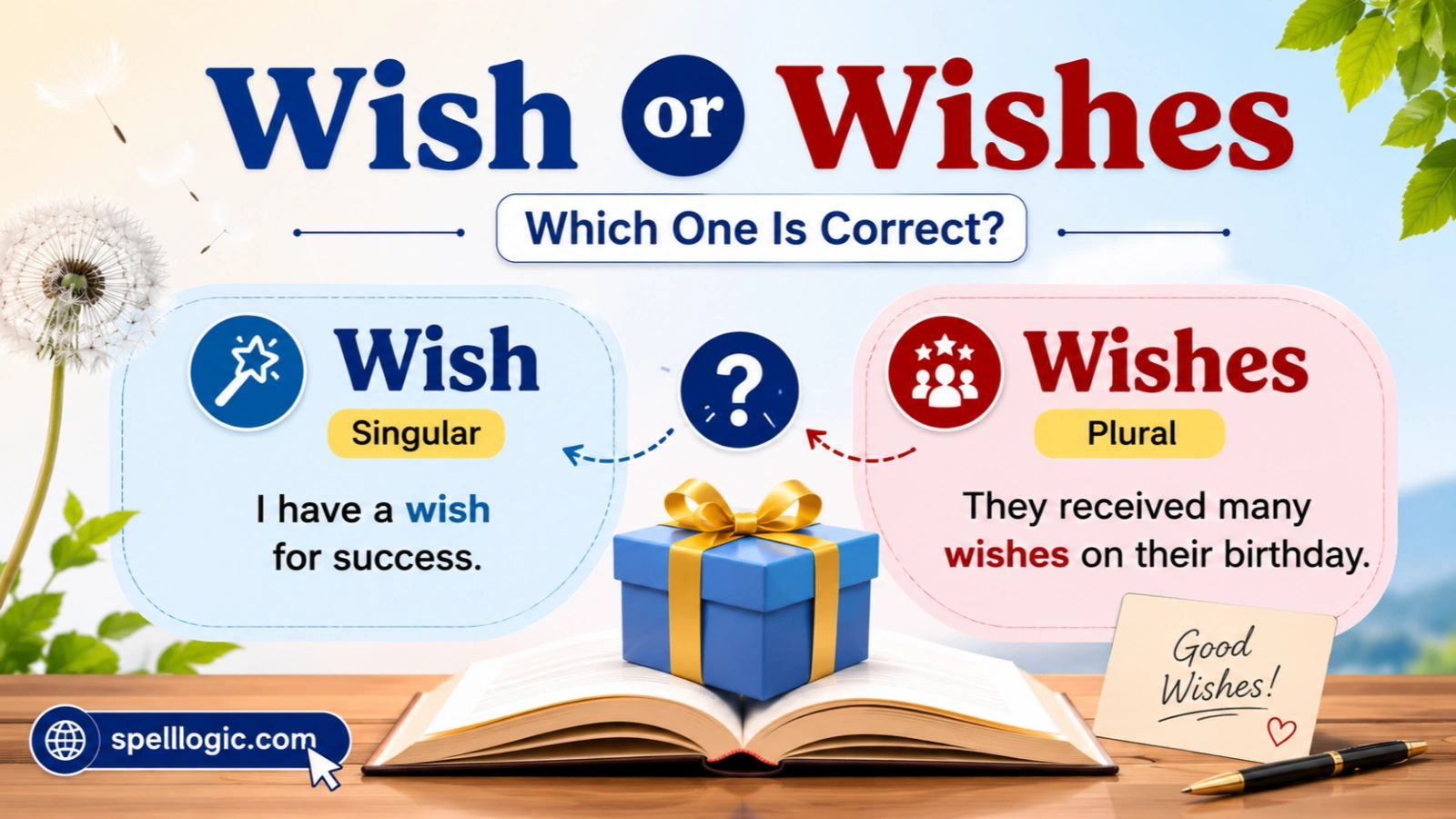
English learners often wonder whether to use “wish” or “wishes” when talking about hopes, desires, greetings, or polite expressions. The difference looks small, but the correct choice depends mainly on the subject of the sentence and the way the word is being used. Understanding wish or wishes helps you avoid common subject-verb agreement errors and makes your writing sound more natural.
Although both forms come from the same verb and can sometimes appear as nouns, they do not work in exactly the same grammatical situations. In this guide, you will learn the difference, see clear examples, and discover simple ways to choose the right form confidently.
Why “Wish” and “Wishes” Are Confusing
The forms are confusing because they have the same basic meaning and differ by only one letter. Learners may also see them in greetings, everyday statements, formal messages, and sentences about desires. That variety can make the grammar seem harder than it is.
Similar pronunciation
The pronunciation is very similar, especially when the words are spoken quickly. However, the ending in “wishes” adds an extra syllable: /ˈwɪʃɪz/. The singular form “wish” has one syllable: /wɪʃ/.
Similar spelling
The spelling is almost identical. “Wishes” is simply the plural noun or third-person singular present-tense form of “wish,” depending on the sentence.
Context confusion
Context matters because “wish” can be a verb or a noun, while “wishes” can also be a verb or a plural noun. For example, “I wish you success” uses the verb, while “Her wishes were respected” uses a plural noun.
Common learner mistakes
A frequent mistake is adding -es after a plural subject. For example, “They wishes you luck” is incorrect. Another common error is using “wish” after a singular third-person subject: “She wish you happiness” should be “She wishes you happiness.”
Wish or Wishes Explained Simply
The easiest rule is to look at the subject and the grammatical role of the word. Use “wish” as the base form with I, you, we, and they, and use “wishes” with he, she, and it in the simple present. As nouns, “wish” means one desire, while “wishes” means more than one desire or expression of goodwill.
One-line distinction: “Wish” is the base form or singular noun, while “wishes” is the third-person singular verb form or plural noun.
Two examples make the pattern clear:
- I wish you a happy birthday.
- She wishes you a happy birthday.
The key is not the meaning alone; it is the grammatical position of the word.
Understanding Homophones in English
The question of wish or wishes usually has a simple grammatical answer.
What Are Homophones?
Homophones are words that sound the same but have different spellings and meanings. For example, “flower” and “flour” are homophones. They are pronounced alike but refer to different things.
“Wish” and “wishes” are not homophones because their pronunciation is different. They are related forms of the same word, so the important issue here is grammar rather than homophone confusion.
Why Homophones Cause Confusion
For learners, wish or wishes is mainly a question of subject-verb agreement.
Homophones can cause problems because listeners may know the meaning but not know which spelling to write. For instance, someone might hear “flour” and write “flower.” With “wish” and “wishes,” however, the ending can be heard, so learners should focus on subject-verb agreement and singular versus plural meaning.
What Does “Wish” Mean?
When checking wish or wishes, first identify the subject of the sentence.
Definition and Core Meaning
“Wish” can function as a verb or a noun.
As a verb, it means to want something to happen, although the desired event may be unlikely, imaginary, or simply hoped for. It is also used in polite expressions such as “I wish you success.”
As a noun, “wish” means a desire, hope, or request.
Origin and Historical Use
The word “wish” has a long history in English. It comes from Old English wyscan, meaning to desire or wish for something. Over time, it developed into the modern verb and noun used for desires, hopes, blessings, and polite expressions.
Modern Usage and Synonyms
Today, “wish” appears in everyday conversation, formal writing, greetings, cards, and personal statements.
Useful synonyms and related words include:
- desire
- hope
- want
- longing
- request
- aspiration
The best synonym depends on the context. “Hope” is often more realistic, while “wish” can suggest something uncertain or unlikely.
Example Sentences
- I wish I had more free time.
- We wish you good luck.
- You can wish for anything on your birthday.
- My wish is to travel around the world.
- He made a wish before blowing out the candles.
Notice that “wish” stays in the base form after I, we, you, and they.
What Does “Wishes” Mean?
Learning wish or wishes is easier when you separate verb use from noun use.
Definition and Core Meaning
“Wishes” has two main grammatical uses. First, it is the third-person singular present form of the verb “wish.” Second, it is the plural form of the noun “wish.”
As a verb:
- She wishes she could stay longer.
- He wishes you well.
As a noun:
- His wishes were clearly stated.
- We respected her final wishes.
Origin and Historical Context
“Wishes” comes from the same historical English word as “wish.” The -es ending developed as part of English grammar for third-person singular verbs and plural nouns. Modern English uses this ending regularly with words ending in sounds such as /ʃ/, as in “wish → wishes.”
Modern Usage and Synonyms
In modern English, “wishes” is common in both spoken and written language. It can describe several desires or polite expressions of goodwill.
Related words include:
- desires
- hopes
- preferences
- requests
- intentions
- aspirations
Example Sentences
- She wishes she knew the answer.
- The manager wishes everyone a productive day.
- Their wishes were taken into account.
- He sent his best wishes to the new couple.
- The child wishes for a new bicycle.
Wish or Wishes: Key Differences at a Glance
Understanding wish or wishes can improve accuracy in greetings and everyday writing.
The main difference between the two forms is grammatical number and subject agreement. The table below gives a quick reference.
| Word | Part of Speech | Meaning | Example Context |
|---|---|---|---|
| Wish | Verb | Want or hope for something | I wish you success. |
| Wish | Noun | One desire or hope | My wish came true. |
| Wishes | Verb | Wants or hopes with he, she, or it | She wishes you well. |
| Wishes | Noun | More than one desire or expression of goodwill | Best wishes to you. |
This comparison shows why the correct choice depends on the sentence. “Wish” is not always singular in meaning when it is a verb; it is simply the base form. Likewise, “wishes” does not always mean several desires because it can be a singular verb form.
How to Remember the Difference Between Wish and Wishes
In grammar exercises, wish or wishes often tests whether you recognize singular and plural subjects.
Use these simple memory tricks:
- I/You/We/They → wish. Think: “I wish,” “you wish,” “we wish,” and “they wish.”
- He/She/It → wishes. The third-person singular subject needs the -es ending in the simple present.
- One desire → wish. More than one desire → wishes.
- Greeting clue: “Best wishes” normally uses the plural noun because it expresses multiple good thoughts or hopes.
Association Technique
Remember the sentence: “She wishes, but they wish.” The subject tells you which form to choose.
One Memorable Example
“I wish for a better job, but my friend wishes for a longer vacation.” Seeing both forms in one sentence makes the grammatical contrast easier to remember.
Common Mistakes and Confusions
One useful way to study wish or wishes is to compare the forms in complete sentences.
Mistake 1: Using “wishes” with a plural subject
✘ They wishes you good luck.
✔ They wish you good luck.
Explanation: “They” is plural, so the base verb “wish” is required.
Mistake 2: Using “wish” with a singular third-person subject
✘ She wish you a happy birthday.
✔ She wishes you a happy birthday.
Explanation: “She” is third-person singular, so the present-tense verb takes -es.
Mistake 3: Confusing a noun with a verb
✘ My wishes is to travel.
✔ My wish is to travel.
Explanation: One personal desire is a singular noun, so “wish” is correct.
Mistake 4: Forgetting the plural noun
✘ Best wish to you.
✔ Best wishes to you.
Explanation: The traditional expression uses the plural noun “wishes.”
Mistake 5: Assuming “wishes” always means multiple desires
“Wishes” can be a verb, as in “He wishes he were here.” Here, the word does not mean several desires; it agrees with the singular subject “he.”
Examples Section: Correct and Incorrect Usage
The choice between wish or wishes becomes clear when you look at who performs the action.
Here are several practical examples to make the rule easier to apply.
✔ Correct: I wish you a safe journey.
✘ Incorrect: I wishes you a safe journey.
✔ Correct: She wishes she could join us.
✘ Incorrect: She wish she could join us.
✔ Correct: We wish you all the best.
✘ Incorrect: We wishes you all the best.
✔ Correct: His wishes were respected.
✘ Incorrect: His wish were respected.
✔ Correct: My greatest wish is to see the ocean.
✘ Incorrect: My greatest wishes is to see the ocean.
✔ Correct: They wish to improve their English.
✘ Incorrect: They wishes to improve their English.
These examples show that both forms are correct words. The important point is choosing the form that matches the subject or noun number.
Self Assessment: Test Your Knowledge
Context can make wish or wishes easier to understand because the surrounding words reveal the role.
Fill in each blank with wish or wishes.
- I ______ you a happy birthday.
- She ______ she had more time.
- They ______ to learn English quickly.
- His ______ were respected by everyone.
Self Assessment Answers
A quick grammar check for wish or wishes is to ask whether the word is a verb or a noun.
- wish — “I” takes the base verb.
- wishes — “She” is third-person singular.
- wish — “They” takes the base verb.
- wishes — “His” refers to multiple desires in this sentence.
FAQs
When writing greetings, wish or wishes may look confusing, but common expressions provide useful clues.
1. Is “wish” singular or plural?
As a noun, “wish” is singular. As a verb, it is the base form used with I, you, we, and they.
2. When should I use “wishes”?
Use “wishes” as a present-tense verb with he, she, or it, or as the plural noun for more than one desire.
3. Is “best wish” correct?
Usually, the natural expression is “best wishes,” especially in greetings, cards, emails, and messages.
4. Is “I wishes you” correct?
No. The correct form is “I wish you.” The subject “I” takes the base verb.
5. Is “she wish” correct?
No, not in the simple present. Say “she wishes.”
6. Are “wish” and “wishes” homophones?
No. They are pronounced differently, and they are grammatical forms of the same word rather than homophones.
7. Can “wishes” be a noun?
Yes. “Wishes” is the plural noun, as in “Her wishes were fulfilled.” It can also be a verb, as in “She wishes to leave.”
Final Conclusion: Using Wish and Wishes Correctly
The distinction in wish or wishes is small in spelling but important in grammar. Choosing between “wish” and “wishes” becomes much easier once you focus on grammar instead of trying to memorize every expression separately. “Wish” is the base verb used with I, you, we, and they, and it is also the singular noun for one desire or hope. “Wishes” is the third-person singular present form used with he, she, and it, and it is also the plural noun for multiple desires.
For example, we say “I wish you success,” but “She wishes you success.” In expressions such as “best wishes,” the plural noun is standard because the phrase communicates several good thoughts or hopes. Remember the simple pattern: I/you/we/they wish; he/she/it wishes. Then check whether the word is acting as a noun and whether you mean one desire or several. With a little practice, this small grammar distinction will become automatic. Keep reading, writing, and testing yourself with real sentences, and you will soon use both forms naturally and confidently.