agency’s or agencies can confuse English learners because the two forms look very similar, but they have different grammatical meanings. One form is a possessive singular noun, while the other is the plural form of agency. The apostrophe is the main clue, but understanding what the sentence means is even more important.
Knowing the difference helps you write clearly in emails, business documents, academic work, and everyday communication. Whether you are talking about one company’s ownership or several organizations, choosing the correct form prevents grammatical mistakes. This guide explains the difference in simple English and provides practical examples to help you use both forms confidently.
Why “Agency’s or Agencies” Are Confusing
The difference between agency’s or agencies mainly involves an apostrophe and a change in meaning. English learners may see both forms in similar sentences and assume that they are simply different spellings of the same word. However, they perform different grammatical jobs.
Similar pronunciation
The two forms can sound similar in fast speech, especially when the surrounding words make the ending less noticeable. This can make it difficult for learners to identify which form they should write.
For example:
- “The agency’s policy has changed.”
- “Several agencies have changed their policies.”
When spoken quickly, the final sounds may not make the grammatical difference obvious.
Similar spelling
Both forms begin with agency, so their spelling naturally looks related. The important difference is the ending:
- agency’s = agency + apostrophe + s
- agencies = plural spelling of agency
The spelling change from y to ies is a standard English plural pattern.
Context confusion
Context determines whether you are discussing possession or more than one organization. If one organization owns, controls, provides, or has something, the possessive form is needed. If you are talking about two or more organizations, the plural form is appropriate.
For example:
The agency’s website is easy to use.
Here, one agency has a website.
The agencies work together on the project.
Here, more than one agency is involved.
Common learner mistakes
Learners often add an apostrophe simply because they see a word ending in s, or they use agencies when they actually mean possession.
A common mistake is:
✘ The agencies website is unavailable.
If one organization owns or operates the website, the correct form is:
✔ The agency’s website is unavailable.
The apostrophe tells the reader that the website belongs to or is associated with one agency.
Agency’s or Agencies Explained Simply
The easiest way to understand agency’s or agencies is to ask yourself whether you mean one agency’s possession or more than one agency.
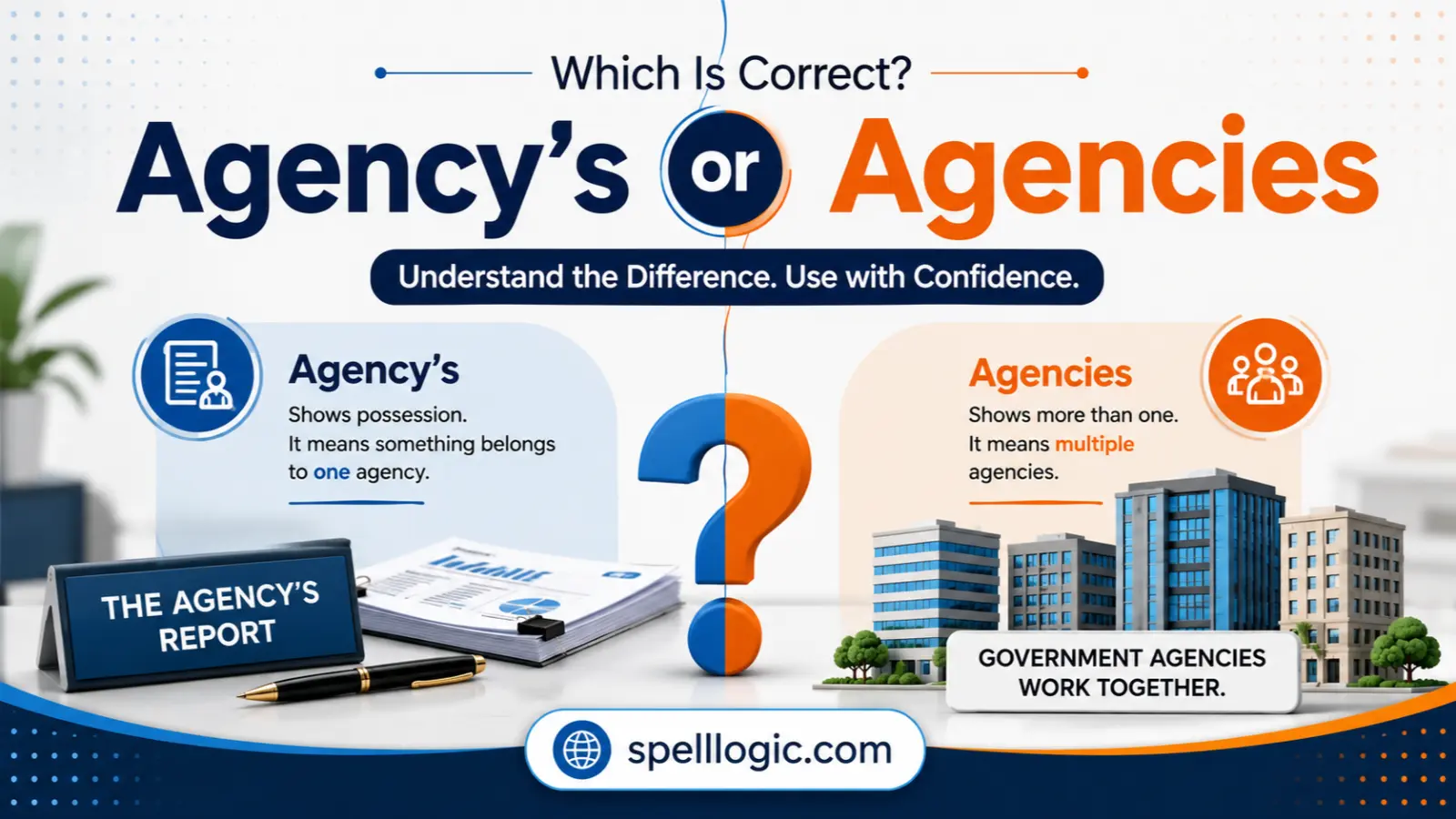
Agency’s is the possessive form of the singular noun agency. It shows that something belongs to, relates to, or is associated with one agency.
Agencies is the plural form of agency. It means two or more agencies.
One-line distinction
Agency’s shows possession or association with one agency, while agencies means more than one agency.
Examples
- The agency’s manager approved the proposal.
One agency has a manager. - Several agencies approved the proposal.
More than one agency approved it.
In short, agency’s answers the question “Whose?” whereas agencies answers the question “How many?”
Understanding Homophones in English
The issue of agency’s or agencies is sometimes mistaken for a homophone problem. However, these two forms are not true homophones. They are related grammatical forms that may sound somewhat similar in connected speech, but their meanings and spellings are different.
What Are Homophones?
Homophones are words that have the same pronunciation but different meanings, spellings, or both.
For example:
- flower — a plant bloom
- flour — a powder used in baking
These words sound the same but have different meanings and spellings.
Why Homophones Cause Confusion
Homophones can cause problems because listeners cannot rely on pronunciation alone to determine the correct spelling. They must use context.
For example:
She bought some flour.
The context tells us that the speaker means the baking ingredient, not a flower.
With agency’s or agencies, however, the problem is primarily grammatical rather than true homophony. Looking at the sentence and identifying whether the noun is singular possessive or plural usually solves the problem.
What Does “Agency’s” Mean?
Definition and Core Meaning
Agency’s is the possessive form of the singular noun agency. An agency can be an organization, business, government department, or group that provides a particular service or performs a particular function.
The possessive form indicates that something belongs to, comes from, or is connected with one agency.
For example:
The agency’s decision surprised everyone.
The decision is associated with one agency.
Another example is:
We reviewed the agency’s report.
The report belongs to or was produced by one agency.
Origin and Historical Use
The noun agency comes from the Latin agentia, related to the idea of doing or acting. It entered English through French and developed meanings connected with action, influence, and organizations that perform specific tasks.
Over time, agency became widely used for organizations that act on behalf of others or provide specialized services.
The possessive construction with ‘s follows a standard English grammatical pattern. For a singular noun, adding ‘s normally creates the possessive form.
Compare:
- the company → the company’s policy
- the school → the school’s principal
- the agency → the agency’s policy
Modern Usage and Synonyms
Today, the possessive form appears frequently in business, government, advertising, employment, law, and everyday communication.
Depending on context, possible related words for agency include:
- organization
- firm
- department
- bureau
- service
- office
- company
These words are not always exact synonyms, so choose them according to the context.
Common uses
- the agency’s office
- the agency’s employees
- the agency’s policy
- the agency’s website
- the agency’s client
- the agency’s decision
Example sentences
- The agency’s new policy begins next month.
- I contacted the agency’s customer service team.
- The agency’s website contains useful information.
- The agency’s director announced the changes.
- We accepted the agency’s recommendation.
Notice that each example refers to one agency and something connected with it.
What Does “Agencies” Mean?
Definition and Core Meaning
Agencies is the plural form of agency. It refers to two or more agencies.
An agency may be a government body, private business, employment service, advertising company, or another organization. When more than one such organization is being discussed, agencies is the appropriate form.
For example:
Several agencies are investigating the issue.
The sentence refers to multiple organizations.
Origin and Historical Context
The word agency developed from terms associated with acting, doing, or having the power to act. English later used the noun for an organization or representative that acts for another person or performs a particular service.
The plural spelling follows an important English spelling rule. When a noun ends in a consonant followed by y, the y usually changes to ies when forming the plural.
For example:
- agency → agencies
- company → companies
- library → libraries
- country → countries
This is why the plural is agencies, not “agencys.”
Modern Usage and Synonyms
Agencies is common in professional and public contexts. It can describe government departments, advertising firms, recruitment organizations, travel businesses, and many other types of organizations.
Depending on the context, related terms may include:
- organizations
- departments
- firms
- bureaus
- offices
- companies
- institutions
Common uses
- government agencies
- advertising agencies
- travel agencies
- employment agencies
- international agencies
- public agencies
Example sentences
- Several agencies are working on the project.
- Government agencies released new guidelines.
- The company contacted three advertising agencies.
- Local agencies provide support to small businesses.
- These agencies specialize in international recruitment.
In each sentence, the word refers to more than one agency.
Agency’s or Agencies: Key Differences at a Glance
| Word | Part of Speech | Meaning | Example Context |
|---|---|---|---|
| Agency’s | Singular possessive noun | Belonging to or associated with one agency | The agency’s office is downtown. |
| Agencies | Plural noun | Two or more agencies | Several agencies attended the meeting. |
A useful test is to replace the word with “of the agency.” If that makes sense, the possessive form may be correct.
For example:
The agency’s report was published.
This means:
The report of the agency was published.
For the plural, ask whether you mean multiple organizations:
Several agencies attended.
Here, the sentence clearly refers to more than one organization.
How to Remember the Difference Between Agency’s and Agencies
Learning agency’s or agencies becomes easier when you connect each spelling with its grammatical purpose.
Easy memory tricks
1. Apostrophe = ownership
Think of ‘s as a small sign that something belongs to one person, organization, or thing.
- the agency’s website
- the agency’s manager
- the agency’s office
Ask: Whose?
Answer: The agency’s.
2. “Agencies” = many
The ending -ies is a common plural ending. When you see agencies, think about multiple organizations.
- two agencies
- several agencies
- many agencies
Ask: How many?
Answer: More than one.
Association technique
Remember this simple pair:
One owner → agency’s
Many organizations → agencies
One memorable example
Consider this sentence:
The agency’s representatives met with representatives from several agencies.
The first form refers to one organization and its representatives. The second refers to multiple organizations.
That single sentence demonstrates the difference clearly.
Common Mistakes and Confusions
One of the most common errors is using agencies when the writer means that something belongs to one organization.
Mistake 1
✘ The agencies website is difficult to navigate.
This is incorrect if the writer means the website belonging to one agency.
✔ The agency’s website is difficult to navigate.
The apostrophe shows possession.
Mistake 2
✘ Several agency’s attended the conference.
This is incorrect because several requires a plural noun, not a singular possessive form.
✔ Several agencies attended the conference.
The sentence refers to multiple organizations.
Mistake 3
✘ The agencies policy was updated.
If one agency has one policy, the possessive form is needed.
✔ The agency’s policy was updated.
Mistake 4
✘ Two agency’s signed the agreement.
The number two tells us that the noun must be plural.
✔ Two agencies signed the agreement.
Mistake 5
✘ The agencies’ manager approved the plan.
This sentence is grammatically possible, but it means that a manager is associated with multiple agencies. If the writer means one organization, it should be:
✔ The agency’s manager approved the plan.
Notice the difference between agency’s and agencies’. The latter is the plural possessive form.
Examples Section: Correct and Incorrect Usage
Example 1
✔ Correct: The agency’s director called me yesterday.
✘ Incorrect: The agencies director called me yesterday.
Explanation: One agency has one director, so the singular possessive form is required.
Example 2
✔ Correct: Several agencies provide this service.
✘ Incorrect: Several agency’s provide this service.
Explanation: “Several” refers to more than one, so the plural agencies is needed.
Example 3
✔ Correct: We reviewed the agency’s proposal.
✘ Incorrect: We reviewed the agencies proposal.
Explanation: The proposal belongs to or comes from one agency.
Example 4
✔ Correct: International agencies often cooperate on major projects.
✘ Incorrect: International agency’s often cooperate on major projects.
Explanation: The sentence discusses multiple organizations, so agencies is correct.
Example 5
✔ Correct: The agency’s clients received an email.
✘ Incorrect: The agencies clients received an email.
Explanation: The clients are associated with one agency, so an apostrophe is needed.
Example 6
✔ Correct: Three agencies submitted applications.
✘ Incorrect: Three agency’s submitted applications.
Explanation: The number three requires the plural noun agencies.
Self Assessment: Test Your Knowledge
Fill in each blank with agency’s or agencies.
- The ________ new office opened last week.
- Several government ________ issued statements.
- We are waiting for the ________ response.
- Two international ________ signed the agreement.
Self Assessment Answers
- agency’s — The office belongs to or is associated with one agency.
- agencies — “Several” indicates more than one.
- agency’s — The response comes from one agency.
- agencies — “Two” requires the plural form.
FAQs About “Agency’s and Agencies”
Is “agency’s” singular or plural?
Agency’s is singular possessive. It refers to one agency and shows possession or association.
Is “agencies” the plural of agency?
Yes. Agencies is the standard plural form of agency and refers to two or more organizations.
What is the difference between agency’s and agencies?
The difference is grammatical. Agency’s means something belongs to or is associated with one agency, while agencies means more than one agency.
Is “agencys” correct?
No. Agencys is not the standard plural spelling. The correct plural is agencies, because the final consonant + y changes to -ies.
When should I use the apostrophe in agency’s?
Use the apostrophe when one agency owns, has, provides, controls, or is associated with something. For example, “the agency’s report.”
What is the plural possessive form of agency?
The plural possessive form is agencies’. For example, “the agencies’ representatives” means representatives associated with multiple agencies.
Are agency’s and agencies homophones?
No. They are not true homophones. They are different grammatical forms, although their pronunciation may sound somewhat similar in some contexts.
Final Conclusion: Using “Agency’s” and “Agencies” Correctly
Understanding agency’s or agencies is much easier when you focus on meaning instead of spelling alone. Agency’s is the singular possessive form, so use it when one agency owns, has, produces, or is connected with something. For example, “The agency’s website was updated” tells us that one agency is associated with the website. Agencies, on the other hand, is the plural form and refers to two or more organizations, as in “Several agencies participated in the program.”
A simple memory rule can help: apostrophe + s means one agency’s possession, while -ies means multiple agencies. When you are unsure, ask two questions: “Whose?” and “How many?” If the answer to “Whose?” is one agency, choose the possessive form. If the answer to “How many?” is two or more, choose the plural form.
Also remember that these forms are not true homophones; the main challenge is recognizing their grammatical roles. With regular practice, examples, and careful attention to apostrophes, you can quickly distinguish them in professional writing, academic work, emails, and everyday English. Keep practicing, and these two forms will soon feel completely natural.

Naveed Ahmed is a Master’s graduate, content writer, and contributor at SpellLogic.com. He specializes in spelling, grammar, and English language content, helping readers improve their writing with clear and accurate guidance. His goal is to make language learning simple, practical, and accessible for students, writers, and professionals.