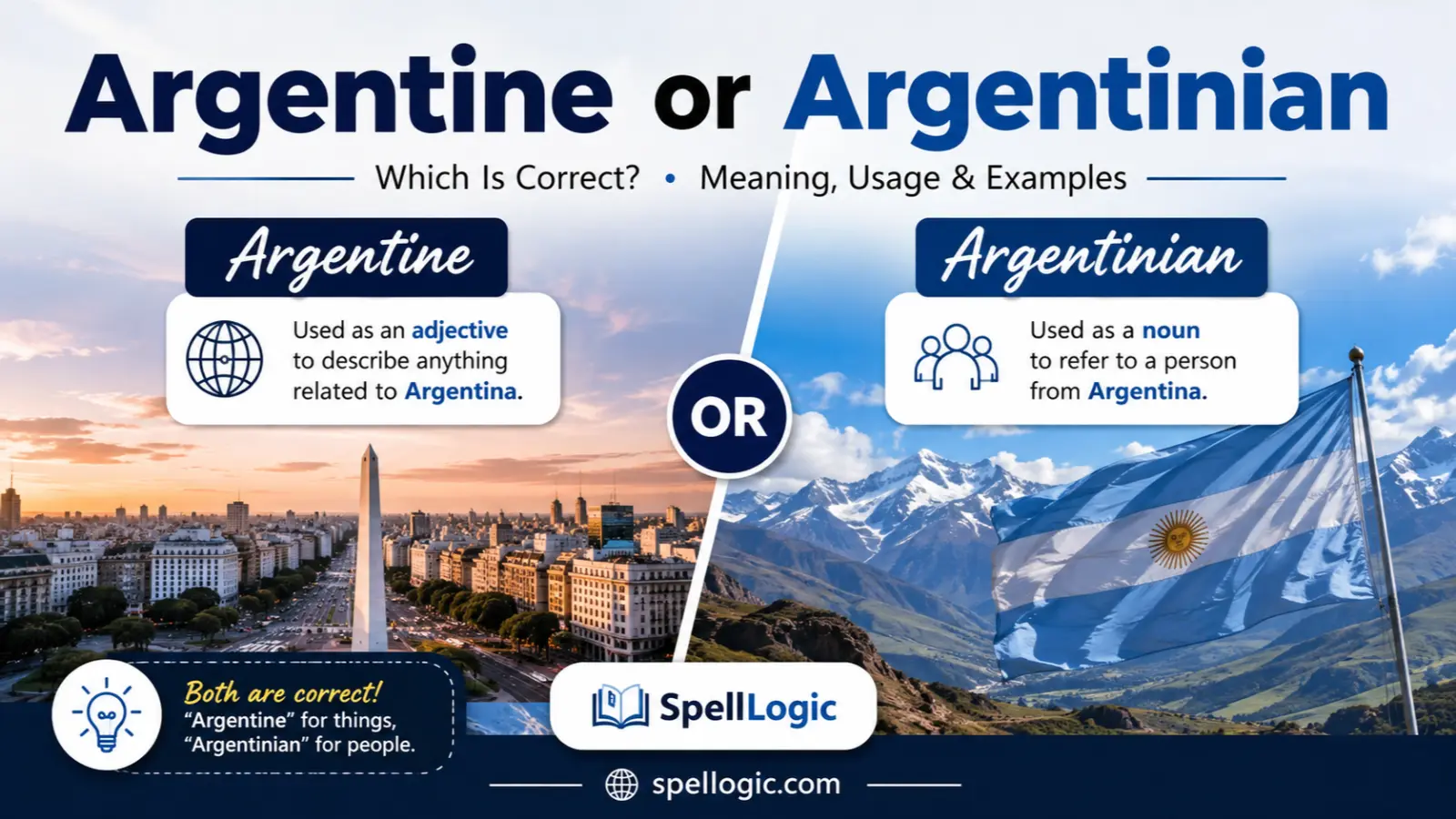
English learners often wonder whether Argentine or Argentinian is the correct word for describing something or someone from Argentina. Both forms are widely used, and this can make the choice seem more complicated than it really is. The good news is that neither word is automatically wrong. They can both describe people, culture, food, history, and things connected with Argentina.
However, their usage and popularity can vary depending on context and regional preference. Understanding argentine or argentinian helps you write more naturally and avoid unnecessary confusion when discussing South American countries, nationalities, and cultures. This guide explains the difference in simple English and provides practical examples.
Why “Argentine” and “Argentinian” Are Confusing
The words Argentine and Argentinian are confusing because they have almost the same meaning and are both associated with Argentina. For learners, choosing between them can feel like choosing between two completely different grammatical forms. In reality, both are established English words.
Similar pronunciation
The two words begin with the same sound and refer to the same country. Their pronunciation is different at the end, but the difference is not large enough to prevent confusion.
Similar spelling
Both words contain Argentin-, making their written forms look closely related. The main difference is the ending: -e in Argentine and -ian in Argentinian.
Context confusion
Both forms can refer to a person from Argentina or something associated with Argentina. Therefore, learners may see one form in a newspaper and another in a textbook and wonder whether one is incorrect.
Common learner mistakes
A common mistake is assuming that one form must be grammatically wrong. Another is believing that the two words have completely different meanings. In most everyday contexts, that is not the case.
For the question of argentine or argentinian, the key point is simple: both forms are correct, although Argentine is often preferred in formal and standard usage, especially as a noun for a person.
Argentine vs Argentinian Explained Simply
The simplest explanation is that both words are adjectives and demonyms connected with Argentina. Argentine is traditionally the more established form, while Argentinian is also common and widely accepted.
The distinction between argentine or argentinian is therefore mainly one of usage and preference rather than meaning.
One-line distinction: Argentine and Argentinian can both mean “from Argentina” or “related to Argentina,” but Argentine is often the more traditional choice.
Examples
- She is Argentine and lives in Buenos Aires.
- He enjoys Argentinian food, especially empanadas.
So, when asking argentine or argentinian, remember that you generally do not need to worry about choosing between “correct” and “incorrect.” The choice often depends on style, context, and personal or regional preference.
Understanding Homophones in English
What Are Homophones?
Homophones are words that sound the same or nearly the same but have different meanings, spellings, or origins.
For example, flower and flour sound the same but have completely different meanings.
However, Argentine and Argentinian are not homophones. They are simply alternative demonyms and adjectives related to Argentina.
Why Homophones Cause Confusion
Homophones can confuse learners because pronunciation alone does not tell you which spelling to use. For example, someone may hear “flour” and incorrectly write “flower.”
The confusion surrounding argentine or argentinian is different because these words are spelled differently and are not true homophones. Their meanings overlap instead.
What Does “Argentine” Mean?
Definition and Core Meaning
Argentine means “from Argentina” or “connected with Argentina.” It can describe a person, culture, product, tradition, place, or other feature associated with the country.
As a noun, Argentine can mean a person from Argentina.
For argentine or argentinian, Argentine is often considered the more traditional and concise form.
Origin and Historical Use
The word Argentine comes from the name Argentina, which ultimately relates to the Latin word argentum, meaning “silver.” The country’s name has historical connections with the idea of a land associated with silver.
The demonym Argentine has been used in English for a long time. It is especially common in formal writing, news reporting, sports coverage, and descriptions of national identity.
Modern Usage and Synonyms
Modern examples include:
- Argentine citizens
- Argentine culture
- Argentine history
- Argentine literature
- Argentine football
- Argentine cuisine
- an Argentine writer
- an Argentine athlete
Depending on the sentence, related expressions can include from Argentina, of Argentina, or Argentinean, although Argentinean is generally less common than the two forms being compared here.
Example Sentences
- The Argentine team performed well in the tournament.
- She studies Argentine history at university.
- An Argentine artist created the painting.
- They enjoyed traditional Argentine cuisine.
When considering argentine or argentinian, these examples show why Argentine is a very natural choice, particularly in formal contexts.
What Does “Argentinian” Mean?
Definition and Core Meaning
Argentinian also means “from Argentina” or “related to Argentina.” Like Argentine, it can describe both people and things associated with the country.
The word is formed with the familiar -ian ending used in many nationality words, such as Canadian, Brazilian, and Mexican. This familiar pattern may make Argentinian feel more intuitive to some English learners.
Origin and Historical Context
Argentinian developed as an alternative English demonym using the productive -ian suffix. Although Argentine has a long history in English, Argentinian has also become firmly established through widespread usage.
The two forms can therefore coexist without creating a major difference in meaning.
Modern Usage and Synonyms
In modern English, Argentinian appears in many contexts, including:
- Argentinian people
- Argentinian culture
- Argentinian food
- Argentinian traditions
- Argentinian music
- an Argentinian author
- an Argentinian footballer
When deciding between argentine or argentinian, it is useful to understand that Argentinian is not simply a learner’s mistake. It is a recognized and commonly used English form.
Example Sentences
- My colleague is Argentinian.
- We tried several Argentinian dishes.
- The museum featured Argentinian artists.
- She is interested in Argentinian literature.
Thus, Argentinian is a perfectly understandable and widely accepted choice in everyday English.
Argentine vs Argentinian: Key Differences at a Glance
| Word | Part of Speech | Meaning | Example Context |
|---|---|---|---|
| Argentine | Noun, adjective | A person from Argentina; related to Argentina | Argentine culture, an Argentine writer |
| Argentinian | Noun, adjective | A person from Argentina; related to Argentina | Argentinian culture, an Argentinian writer |
The main difference in argentine or argentinian is not a major difference in meaning. Instead, it concerns usage, style, and preference. Argentine is often preferred in formal or traditional contexts, while Argentinian is very common in general English.
Neither word should automatically be treated as an error.
How to Remember the Difference Between Argentine and Argentinian
Learning argentine or argentinian becomes easier when you use a few simple memory techniques.
Easy memory tricks
- Argentine is the shorter traditional form.
- Argentinian follows the familiar -ian nationality pattern.
- Both words connect directly to Argentina.
- Neither form means a different nationality.
Association techniques
Think of Argentine as the compact form: Argentina → Argentine.
Think of Argentinian as the expanded form: Argentina → Argentinian.
You can also remember that both forms answer the same basic question: “Is this person or thing connected with Argentina?”
One memorable example
The Argentine chef prepared an Argentinian-style meal.
Although repeating both forms in one sentence is not always necessary, this example makes the similarity clear: both can describe something associated with Argentina.
The easiest rule for argentine or argentinian is to recognize both as valid and then follow the style used by your publication, teacher, employer, or audience.
Common Mistakes and Confusions
Learners often make mistakes because they assume nationality words must follow one fixed pattern.
Mistake 1: Calling one form incorrect
Wrong assumption: “Argentinian is always wrong.”
Correct understanding: Argentinian is widely used and accepted in English.
Mistake 2: Thinking the words describe different nationalities
Incorrect idea: “Argentine means one thing, while Argentinian refers to a different group.”
Correct understanding: Both can refer to people or things connected with Argentina.
Mistake 3: Using an unnecessary article before a nationality
Incorrect: “She is an Argentine.”
This sentence can actually be grammatical when Argentine is used as a noun. However, learners should not assume that every nationality adjective requires an.
Also correct: “She is Argentine.”
The exact construction depends on whether the word functions as a noun or adjective.
Mistake 4: Changing the meaning unnecessarily
Incorrect assumption: “Argentinian food and Argentine food are completely different.”
Correct: Both expressions can describe food from Argentina.
Understanding argentine or argentinian means recognizing that the difference is mostly about usage rather than a difference in nationality.
Examples Section: Correct and Incorrect Usage
Example 1
✔ Correct: She is Argentine.
✘ Incorrect: She is Argentina.
Explanation: Argentine is the nationality adjective or noun, while Argentina is the country’s name.
Example 2
✔ Correct: We enjoyed Argentinian cuisine.
✘ Incorrect: We enjoyed Argentina cuisine.
Explanation: A nationality adjective is needed before cuisine.
Example 3
✔ Correct: He is an Argentine writer.
✔ Correct: He is an Argentinian writer.
Explanation: Both forms can correctly describe a writer from Argentina.
Example 4
✔ Correct: Argentine culture has many regional traditions.
✔ Correct: Argentinian culture has many regional traditions.
Explanation: Both forms can describe culture associated with Argentina.
Example 5
✔ Correct: She is an Argentinian student.
✘ Incorrect: She is an Argentinian.
Explanation: The second sentence is not necessarily impossible, but it sounds less natural in many contexts when referring simply to nationality. “She is Argentinian” is usually more straightforward.
Example 6
✔ Correct: The newspaper published an article about Argentine history.
✔ Correct: The newspaper published an article about Argentinian history.
Explanation: Both forms can work, although a particular publication may prefer one style.
These examples demonstrate why argentine or argentinian should usually be treated as a question of preference and context rather than a simple right-versus-wrong grammar rule.
Self Assessment: Test Your Knowledge
Fill in each blank with Argentine or Argentinian.
- Maria is __________ and grew up in Córdoba.
- We ordered __________ food at the restaurant.
- He is an __________ writer.
- The class studied __________ history.
Self Assessment Answers
- Argentine — “Maria is Argentine” is correct.
- Argentinian — “Argentinian food” is correct, although “Argentine food” is also possible.
- Argentine — “an Argentine writer” is a natural formal construction.
- Argentinian — “Argentinian history” is correct, while “Argentine history” is also widely used.
The important lesson is that both forms may work depending on the sentence and preferred style.
FAQs About “Argentine and Argentinian”
1. Is Argentine or Argentinian correct?
Both Argentine and Argentinian are correct. Argentine is traditionally established and is often preferred in formal contexts, while Argentinian is also widely used.
2. Is an Argentine the same as an Argentinian?
Yes. In most contexts, both terms can refer to a person from Argentina. The difference is primarily stylistic and related to usage preference.
3. Which is more common, Argentine or Argentinian?
Usage varies by region and context. Argentine is especially common in formal writing and some varieties of English, while Argentinian is also frequent in everyday usage.
4. Should I say Argentine food or Argentinian food?
Both are possible. Argentine food and Argentinian food can describe cuisine from Argentina. Follow the style preferred by your audience or publication.
5. Is Argentine an adjective or a noun?
It can be both. It can describe something connected with Argentina, as in “Argentine culture,” and it can refer to a person from Argentina, as in “an Argentine.”
6. Is Argentinian an adjective or a noun?
It can also function as both an adjective and a noun. For example, “Argentinian music” uses it as an adjective, while “She is Argentinian” uses it as a noun-like nationality expression.
7. Are Argentine and Argentinian homophones?
No. They are not homophones. They are alternative English forms associated with the same country, and their meanings largely overlap.
Final Conclusion: Using “Argentine” and “Argentinian” Correctly
Understanding argentine or argentinian is much easier once you know that both forms are accepted in English. Argentine is the traditional and concise form and is particularly common in formal writing, journalism, sports, and discussions of national identity. Argentinian is also a well-established form and is widely used in everyday English. Both can describe a person from Argentina or something connected with the country, including its culture, history, food, literature, and traditions.
When choosing between argentine or argentinian, do not assume that one is automatically wrong. Instead, consider your context and the style preferred by your audience. If you are writing formally, Argentine may be the safest traditional choice. If you naturally use Argentinian, it is generally understandable and acceptable as well.
A simple memory trick is to connect both words with Argentina: Argentine is the shorter traditional form, while Argentinian uses the familiar -ian ending. Most importantly, remember that they do not represent two different nationalities. With regular reading and practice, choosing between these two forms will become much more natural. Keep noticing how native speakers and reputable publications use them, and your confidence in English will continue to grow.

Naveed Ahmed is a Master’s graduate, content writer, and contributor at SpellLogic.com. He specializes in spelling, grammar, and English language content, helping readers improve their writing with clear and accurate guidance. His goal is to make language learning simple, practical, and accessible for students, writers, and professionals.