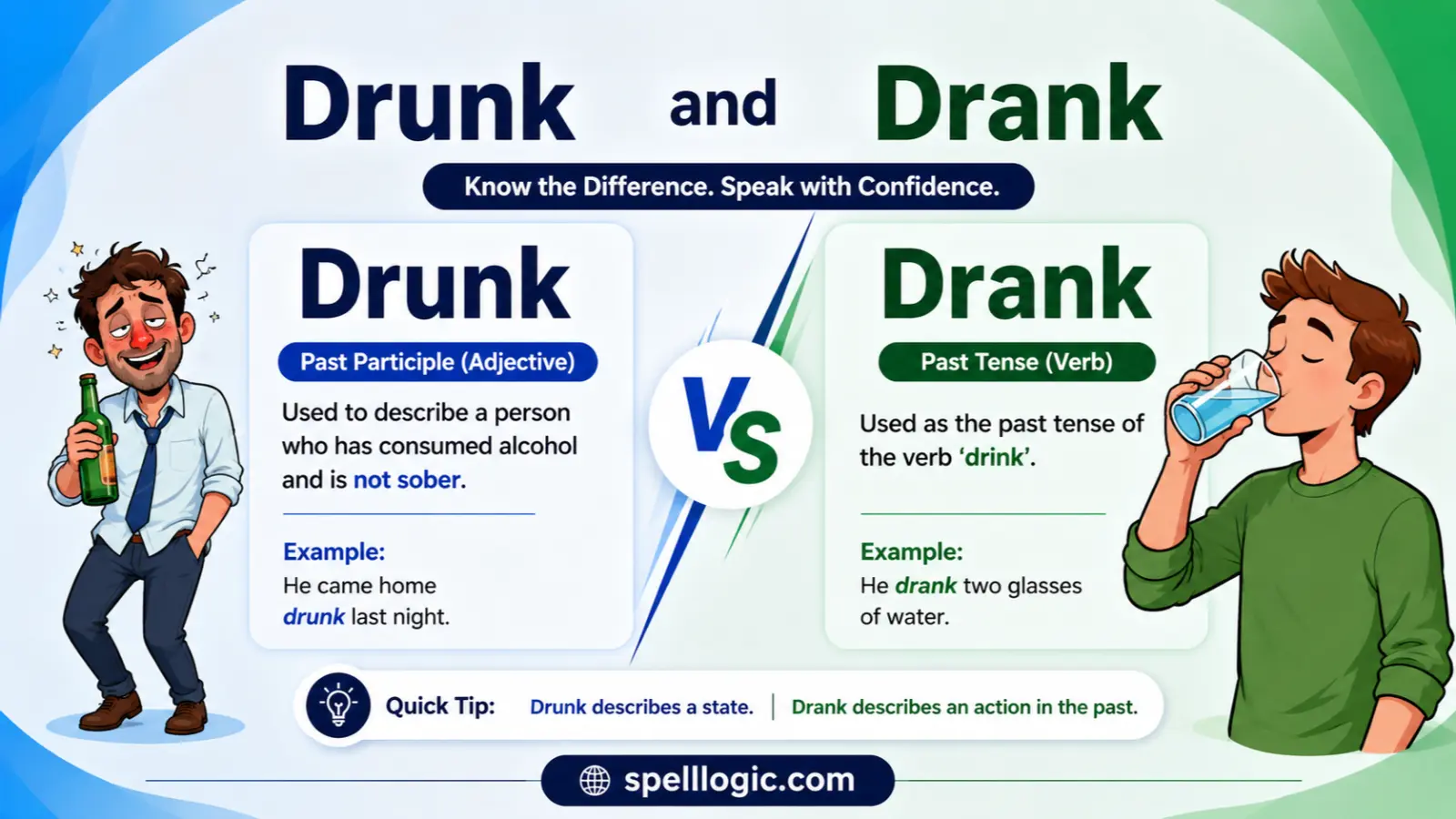
Drunk or drank can be confusing for English learners because both words come from the verb drink, but they have different grammatical functions. The main difference is simple: drank is the simple past tense of drink, while drunk is the past participle and normally appears with helping verbs such as have, has, or had.
Choosing the wrong form can make a sentence sound grammatically incorrect. Once you understand how English verb forms work, however, the difference becomes easy to remember. This guide explains the meanings, grammar, pronunciation, common mistakes, and everyday uses of both forms with clear examples.
Why “Drunk or Drank” Are Confusing
English learners often mix up these forms because they belong to the same irregular verb: drink – drank – drunk. Since the three forms are related, learners may use one form where another is required.
Similar Pronunciation
The two words do not sound exactly the same, but their pronunciation is similar enough to cause uncertainty, especially for learners who are still developing listening skills.
- Drank is pronounced approximately like drangk.
- Drunk is pronounced approximately like drungk.
The vowel sound is different, but fast speech can make the distinction harder to notice.
Similar Spelling
Both words begin with dr- and contain the letters dr and n/k sounds. Because they are different forms of the same verb, learners naturally connect them.
Context Confusion
The biggest problem is grammar, not meaning. Drank describes a completed action in the simple past, while drunk usually works as a past participle.
Compare:
- I drank coffee this morning.
- I have drunk three cups of coffee today.
The first sentence uses the simple past. The second uses the present perfect.
Common Learner Mistakes
Some frequent errors include:
- Using drunk alone as a simple past verb: “I drunk tea yesterday.”
- Using drank after have: “I have drank tea.”
- Forgetting that drink has three different principal forms.
- Assuming that all past-tense forms can be used interchangeably.
Understanding the verb pattern drink → drank → drunk prevents most of these mistakes.
“Drunk or Drank” Explained Simply
The easiest way to understand the difference is to focus on the verb forms.
Drunk or drank becomes much easier when you remember that drank is the simple past form, whereas drunk is the past participle.
One-line distinction:
Drank = simple past; drunk = past participle.
Examples:
- She drank a glass of water after exercising.
- She has drunk a glass of water after exercising.
The first sentence talks about a completed past action. The second uses has + past participle.
A useful basic pattern is:
Drink → present
Drank → simple past
Drunk → past participle
For example:
- I drink tea every morning.
- I drank tea yesterday morning.
- I have drunk tea already.
This pattern is one of the most important things to remember.
Understanding Homophones in English
The difference between these two forms is sometimes incorrectly described as a homophone issue. However, drunk and drank are not homophones because they do not have the same pronunciation.
What Are Homophones?
Homophones are words that have the same pronunciation but different meanings, spellings, or both.
For example:
- right and write
- flower and flour
- sea and see
These pairs sound alike even though their meanings are different.
Why Homophones Cause Confusion
Homophones can be difficult because listeners cannot always identify the correct word from sound alone. They must use the surrounding context.
For example:
She went to see the doctor.
The listener knows that see is correct because the sentence refers to looking at or visiting someone.
Although drunk and drank are not homophones, they can still confuse learners because they are closely related forms of the same irregular verb.
What Does “Drunk” Mean?
Definition and Core Meaning
Drunk is primarily the past participle of the verb drink. It is used with auxiliary verbs such as have, has, and had.
Examples:
- I have drunk enough water.
- She has drunk all the juice.
- They had drunk coffee before the meeting began.
The word drunk can also function as an adjective meaning affected by alcohol.
For example:
He was drunk after the party.
Here, drunk does not describe the action of drinking. Instead, it describes the person’s condition.
Origin and Historical Use
The verb drink comes from Old English drincan, a word related to drinking liquids. Over the development of English, it kept an irregular pattern rather than adopting a regular -ed ending.
The historical forms developed into the modern pattern:
drink → drank → drunk
This type of irregular verb pattern is common in English and must usually be learned rather than predicted.
Modern Usage and Synonyms
As a verb form, drunk can be connected with ideas such as:
- consumed
- taken as a beverage
- swallowed as a liquid
- finished drinking
As an adjective, it can mean:
- intoxicated
- under the influence of alcohol
- inebriated
Examples:
- Have you drunk enough water?
- She has drunk her tea.
- He was too drunk to drive safely.
- They had drunk the entire bottle before dinner.
Remember that when drunk is the past participle of drink, it normally needs a helping verb in perfect constructions.
What Does “Drank” Mean?
Definition and Core Meaning
Drank is the simple past tense of the verb drink. It describes an action that happened and was completed in the past.
Examples:
- I drank milk before school.
- We drank coffee yesterday.
- She drank a glass of water after lunch.
Unlike drunk, drank does not normally require have, has, or had before it.
Origin and Historical Context
Like drunk, drank developed from the older forms of the English verb drink. English preserved different vowel patterns to show different grammatical forms.
The modern sequence is:
- drink — present
- drank — simple past
- drunk — past participle
Learning these three forms together is more effective than memorizing either word separately.
Modern Usage and Synonyms
Drank can describe many types of liquid consumption in the past, including:
- water
- tea
- coffee
- juice
- milk
- soft drinks
- alcoholic beverages
Examples:
- He drank some water after running.
- Maria drank coffee before work.
- We drank orange juice at breakfast.
- The children drank milk with their meal.
The important point is that drank refers to a completed past action.
“Drunk or Drank”: Key Differences at a Glance
| Word | Part of Speech | Meaning | Example Context |
|---|---|---|---|
| Drunk | Past participle / adjective | Past participle of drink; also means intoxicated as an adjective | I have drunk enough water. |
| Drank | Simple past verb | Describes drinking that happened in the past | I drank water yesterday. |
A quick grammar comparison makes the distinction even clearer:
| Verb Form | Example |
|---|---|
| Present | I drink tea every day. |
| Simple past | I drank tea yesterday. |
| Past participle | I have drunk tea already. |
This pattern is useful for both speaking and writing.
How to Remember the Difference Between “Drunk” and “Drank”
The easiest memory technique is to connect each form with its grammatical job.
Easy Memory Tricks
1. Remember “drank = past.”
If you are describing something that happened yesterday, last night, last week, or at another completed time in the past, drank is usually the form you need.
I drank tea yesterday.
2. Remember “drunk = have/has/had.”
When you see have, has, or had before the verb, use drunk.
I have drunk tea.
She had drunk the water.
Association Technique
Think of the three forms as a small chain:
Drink → Drank → Drunk
You can associate them with three time patterns:
- Drink = now or regularly
- Drank = completed past
- Drunk = used with a helping verb in perfect tenses
One Memorable Example
Remember this three-sentence sequence:
I drink coffee every morning.
I drank coffee this morning.
I have drunk two cups today.
If you memorize this sequence, you can apply the same grammar pattern to many other sentences.
Common Mistakes and Confusions
One of the most common problems is using the past participle as though it were the simple past.
Mistake 1
✘ I drunk coffee yesterday.
✔ I drank coffee yesterday.
Explanation: Yesterday identifies a completed past action, so the simple past drank is needed.
Mistake 2
✘ I have drank three glasses of water.
✔ I have drunk three glasses of water.
Explanation: After have, use the past participle drunk.
Mistake 3
✘ She had drank the juice before lunch.
✔ She had drunk the juice before lunch.
Explanation: Had requires the past participle in the past perfect tense.
Mistake 4
✘ They drunk tea last night.
✔ They drank tea last night.
Explanation: A specific completed past time calls for the simple past drank.
A useful question to ask yourself is: Is there a helping verb such as have, has, or had? If yes, drunk is generally required as the past participle.
Examples Section: Correct and Incorrect Usage
Example 1
✔ Correct: I drank a cup of tea this morning.
✘ Incorrect: I drunk a cup of tea this morning.
Why? The sentence describes a completed past action, so the simple past form is needed.
Example 2
✔ Correct: She has drunk all the juice.
✘ Incorrect: She has drank all the juice.
Why? The verb follows has, so the past participle is required.
Example 3
✔ Correct: We drank coffee after dinner.
✘ Incorrect: We drunk coffee after dinner.
Why? The sentence describes an event that happened in the past.
Example 4
✔ Correct: They had drunk the water before the journey started.
✘ Incorrect: They had drank the water before the journey started.
Why? Had introduces the past perfect, which requires the past participle.
Example 5
✔ Correct: He drank some milk before bed.
✘ Incorrect: He drunk some milk before bed.
Why? The sentence uses a straightforward past action.
Example 6
✔ Correct: I have drunk enough water today.
✘ Incorrect: I have drank enough water today.
Why? The present perfect construction uses have + past participle.
Self Assessment: Test Your Knowledge
Fill in each blank with drank or drunk.
- I ________ a glass of water after the workout.
- She has ________ all her coffee.
- They ________ juice at breakfast yesterday.
- We had ________ tea before the guests arrived.
Self Assessment Answers
- drank — The sentence describes a completed past action.
- drunk — Has requires the past participle.
- drank — Yesterday indicates the simple past.
- drunk — Had requires the past participle.
FAQs About “Drunk and Drank”
1. Is “drank” the past tense of drink?
Yes. Drank is the simple past form of drink.
I drank water yesterday.
2. Is “drunk” the past tense of drink?
No. Drunk is normally the past participle of drink. It is used with auxiliary verbs in perfect tenses.
I have drunk water.
3. Can I say “I drunk water”?
In standard English, no. For a simple past sentence, say:
I drank water.
4. Can I say “I have drank water”?
No. After have, use the past participle:
I have drunk water.
5. Is “drunk” ever an adjective?
Yes. Drunk can be an adjective meaning intoxicated or affected by alcohol.
The man was drunk.
This is a different grammatical use from the past participle.
6. What is the easiest way to remember the forms?
Memorize the complete sequence:
drink → drank → drunk
Think of drank as the simple past and drunk as the past participle.
7. Are “drunk” and “drank” homophones?
No. They have different pronunciations. The confusion comes from their similar spelling, meaning, and relationship as forms of the same irregular verb.
Final Conclusion: Using “Drunk and Drank” Correctly
Understanding drunk or drank becomes much easier when you learn the complete verb pattern drink → drank → drunk. Drank is the simple past form, so use it when you describe a completed action in the past: “I drank coffee yesterday.” Drunk, on the other hand, is the past participle, so it normally follows helping verbs such as have, has, or had: “I have drunk coffee today.” The word drunk can also be an adjective describing someone who is intoxicated, which gives it another common meaning.
The most useful memory trick is to connect drank with a straightforward past event and drunk with have, has, or had. When you see a sentence such as “She ___ tea yesterday,” choose drank. When you see “She has ___ tea,” choose drunk. With regular practice, this distinction will become automatic. Keep reviewing the three forms together, create your own sentences, and pay attention to how native speakers use them in everyday conversations. Learning irregular verbs takes practice, but each small distinction makes your English more accurate and confident.

Naveed Ahmed is a Master’s graduate, content writer, and contributor at SpellLogic.com. He specializes in spelling, grammar, and English language content, helping readers improve their writing with clear and accurate guidance. His goal is to make language learning simple, practical, and accessible for students, writers, and professionals.