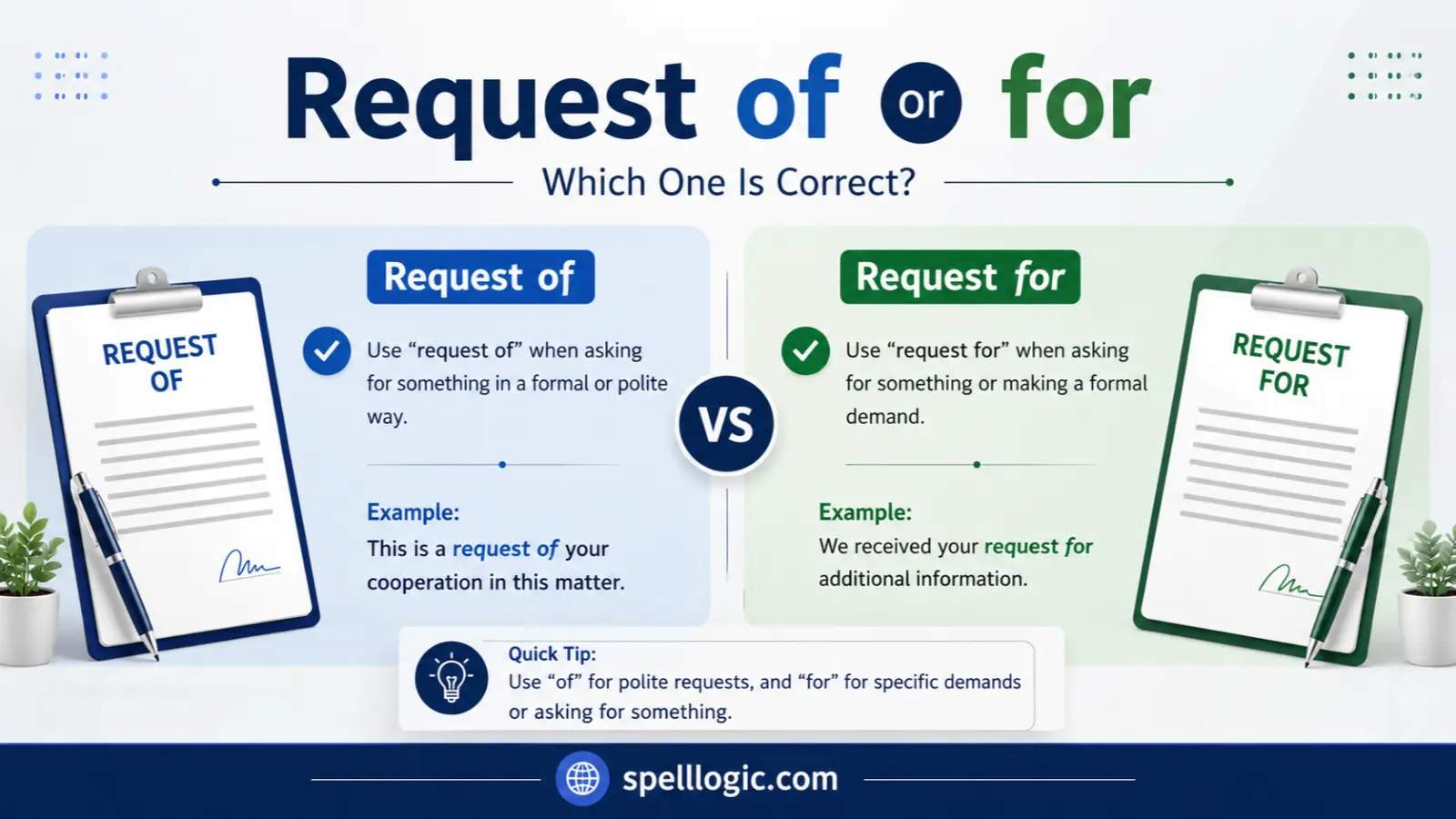
The phrases request of or for can confuse English learners because both use the noun request, yet the preposition that follows can change the meaning and structure of the sentence. In everyday English, request for is usually the more common choice when someone asks for something.
However, request of is also correct in certain situations, especially when referring to a request made of a person or describing something required from someone. Understanding this difference can make your writing clearer, more natural, and more accurate. This guide explains when to use each phrase with simple definitions, examples, common mistakes, and easy memory tips.
Why “Request of” and “Request for” Are Confusing
English learners often mix up request of or for because the two phrases contain the same main noun and can appear in similar situations.
Similar pronunciation
The words of and for are short function words. In fast spoken English, they may sound less clear than the words around them. Learners may understand the word request but become unsure about which preposition should follow.
Similar spelling
The phrases begin with exactly the same word: request. Only the preposition changes. However, prepositions in English often depend on meaning and common usage rather than a simple rule.
Context confusion
Both phrases involve asking for something. For example, a person can make a request for information, while another person may make a request of an employee. Because both situations involve asking, learners may think the phrases are interchangeable.
Common learner mistakes
A frequent mistake is choosing of when the speaker is asking for an object, service, or piece of information. In most cases, English naturally uses for before the thing being requested.
Another mistake is assuming that request of is always incorrect. It is less common, but it has valid uses when the focus is on the person from whom something is requested.
Request of vs Request for Explained Simply
The easiest way to understand the difference is to focus on what comes after the phrase.
A request for usually identifies the thing someone wants.
A request of usually identifies the person from whom something is expected or asked.
One-line distinction
Request of focuses on the person asked, while request for focuses on the thing being asked for.
For example:
- Request of means a request made to or expected from a person.
- Request for means an application, demand, or appeal for something.
Example sentences
- The manager made a request of all employees to arrive on time.
- The company received a request for additional information.
In short, request of points toward a person or group, while request for points toward a thing, action, service, or information.
Understanding Homophones in English
Although request of and request for are not homophones, English learners can still confuse them because both expressions sound similar in sentence patterns and have related meanings.
What Are Homophones?
Homophones are words that have the same pronunciation but different meanings, spellings, or both.
For example:
- write — to produce written words
- right — correct or the opposite of left
These words sound the same but have different meanings.
Why Homophones Cause Confusion
Homophones can confuse learners because pronunciation alone does not always reveal the correct word. For example, if someone hears the sound /raɪt/, they need the context to know whether the speaker means write or right.
Similarly, preposition choices can also depend heavily on context. With request, the meaning of the sentence helps you decide whether the focus is on the person being asked or the thing being requested.
What Does “Request of” Mean?
Definition and Core Meaning
Request of is used when a request is directed toward a person, group, organization, or authority.
It often appears in formal English. The phrase can suggest that someone is asking another person to do something or provide something.
For example:
The teacher made a request of the students.
Here, the focus is on the students, who are the people receiving the request.
Origin and Historical Use
The noun request entered English through French and ultimately has roots connected with the idea of seeking or asking. Over time, English developed different preposition patterns after request.
The preposition of commonly expresses a relationship involving a source, person, or group. Therefore, formal expressions may use it to identify the person from whom something is requested.
Modern Usage and Synonyms
Today, request of is less common than request for, especially in everyday conversation. However, it remains useful in formal writing and certain sentence structures.
Depending on the context, similar expressions include:
- appeal to
- demand from
- ask of
- requirement of
- expectation of
Example sentences
- The committee made a request of the government.
- I have one small request of you.
- The job makes many requests of its employees.
- The coach had a simple request of the team.
Notice that the phrase is often followed by a person or group.
What Does “Request for” Mean?
Definition and Core Meaning
Request for is used when the focus is on the thing, service, action, document, or information that someone wants.
This is the most common structure in modern English.
For example:
She submitted a request for leave.
The word leave identifies the thing being requested.
Origin and Historical Context
As English developed, for became strongly associated with purpose, benefit, and desired objects. This makes it a natural choice when describing something that a person wants to receive or obtain.
Because of this pattern, request for is widely used in business, education, government, customer service, and everyday communication.
Modern Usage and Synonyms
Common related expressions include:
- application for
- appeal for
- demand for
- call for
- ask for
The exact synonym depends on the strength and purpose of the request.
Example sentences
- We received a request for technical support.
- His request for a meeting was approved.
- The library received a request for more books.
- Please send your request for information by email.
In these examples, the phrase is followed by the thing being requested.
Request of vs Request for: Key Differences at a Glance
| Word | Part of Speech | Meaning | Example Context |
|---|---|---|---|
| Request of | Noun phrase | A request directed toward a person or group | A request of the employees |
| Request for | Noun phrase | A request seeking something | A request for information |
The most important difference is the direction of meaning.
- Of often points to the person who is expected to respond.
- For usually points to the thing that someone wants.
This distinction is especially useful in formal writing.
How to Remember the Difference Between Request of and Request for
A simple memory trick is to ask yourself one question:
Who or what comes next?
If you are naming the thing you want, choose for.
Request for help
Request for information
Request for permission
If you are emphasizing the person or group you are asking, of may be appropriate.
A request of the manager
A request of the employees
A request of the public
Association technique
Remember:
- FOR = the thing you are looking FOR
- OF = the person you are asking something OF
One memorable example
I made a request of my manager for more time.
This sentence shows both patterns together:
- of my manager = the person receiving the request
- for more time = the thing being requested
This example is an excellent way to remember the difference.
Common Mistakes and Confusions
Mistake 1: Using “of” before the requested thing
✘ I submitted a request of information.
✔ I submitted a request for information.
Explanation: Information is the thing being requested, so for is the natural preposition.
Mistake 2: Using “for” when emphasizing the person asked
✘ The manager made a request for the employees to cooperate.
✔ The manager made a request of the employees.
Explanation: In the second sentence, the focus is on the employees as the people receiving the request.
Mistake 3: Thinking “request of” is always wrong
✘ Request of is never correct.
✔ Request of is correct in certain formal contexts.
Explanation: The phrase is less common, but it is grammatically valid when the sentence focuses on the person or group from whom something is asked.
Mistake 4: Forgetting natural alternatives
Sometimes neither phrase is the clearest option.
For example:
I requested my manager to approve the document.
Depending on the context, a clearer sentence may be:
I asked my manager to approve the document.
Choosing natural wording is just as important as choosing the correct preposition.
Examples Section: Correct and Incorrect Usage
Example 1
✔ Correct: The customer sent a request for a refund.
✘ Incorrect: The customer sent a request of a refund.
Explanation: A refund is the thing the customer wants.
Example 2
✔ Correct: The teacher made a request of the students.
✘ Incorrect: The teacher made a request for the students.
Explanation: The focus is on the students as the people receiving the request.
Example 3
✔ Correct: We received a request for additional documents.
✘ Incorrect: We received a request of additional documents.
Explanation: The documents are the requested items.
Example 4
✔ Correct: She had an important request of her brother.
✘ Incorrect: She had an important request for her brother.
Explanation: The first sentence focuses on the brother as the person being asked.
Example 5
✔ Correct: The office approved my request for a new computer.
✘ Incorrect: The office approved my request of a new computer.
Explanation: A new computer is the object being requested.
Self Assessment: Test Your Knowledge
Fill in each blank with of or for.
- The student submitted a request ___ an extension.
- The manager made an important request ___ the staff.
- We received a request ___ more information.
- She had one small request ___ her parents.
Self Assessment Answers
- for — The extension is the thing being requested.
- of — The staff are the people receiving the request.
- for — More information is the thing requested.
- of — The parents are the people from whom something is requested.
If you answered all four correctly, you have understood the basic distinction well.
FAQs
1. Which is correct: request of or request for?
Both can be correct, but they are used differently. Request for is generally used for the thing being requested, while request of can focus on the person or group being asked.
2. Is “request for information” correct?
Yes. This is one of the most common and natural uses of the phrase. Information is the thing being requested.
3. Can I say “a request of help”?
Usually, no. The natural expression is a request for help because help is the thing being requested.
4. Is “request of” formal English?
Yes, it often appears more formal than request for. It is especially common in expressions that emphasize expectations, demands, or appeals directed toward people.
5. What is the easiest way to choose between “of” and “for”?
Ask whether the next word refers to the person being asked or the thing being requested. Use this meaning to guide your choice.
6. Can both “of” and “for” appear in the same sentence?
Yes. For example: She made a request of her supervisor for additional training. The first phrase identifies the person, while the second identifies what she wants.
7. Is “request for” more common in everyday English?
Yes. In most everyday situations involving services, information, permission, or objects, English speakers naturally use request for.
Final Conclusion: Using “Request of” and “Request for” Correctly
Understanding request of or for becomes much easier when you focus on the direction of the request. The preposition for normally introduces the thing, service, information, action, or permission that someone wants. That is why phrases such as request for help, request for information, and request for approval are common in both formal and everyday English. On the other hand, of can direct attention toward the person or group from whom something is being asked, especially in formal expressions such as a request of the employees or a request of the government.
A useful memory trick is simple: think of for as the thing you are looking for and of as the person you are asking something of. When you are unsure, identify what comes after the preposition and ask whether it is a person or the object of the request. With practice, this choice will become more natural. English prepositions can sometimes seem difficult because their meanings depend heavily on context, but learning through real examples is one of the best ways to improve. Keep reading, writing, and comparing sentence patterns. Every small distinction you learn will help you communicate more clearly and confidently in English.

Naveed Ahmed is a Master’s graduate, content writer, and contributor at SpellLogic.com. He specializes in spelling, grammar, and English language content, helping readers improve their writing with clear and accurate guidance. His goal is to make language learning simple, practical, and accessible for students, writers, and professionals.