English learners often confuse short words that sound similar or appear in the same sentence. To and too are a common example, and adding funny can make the correct expression harder to identify. The question to funny or too funny usually appears when someone wants to describe something as very amusing.
Although the two expressions look almost identical, they have completely different grammatical functions. Learning the difference helps you write clearer sentences, avoid common spelling mistakes, and communicate naturally in everyday English. In this guide, you will learn when to use to and when to use too, with simple explanations, examples, memory tricks, and practice questions.
Why “to funny” and “too funny” Are Confusing
The confusion around to funny or too funny mainly comes from the words to and too. They differ by only one letter, and in some accents their pronunciation can sound similar in fast speech. However, their grammatical roles are different.
Similar Pronunciation
To is commonly pronounced /tə/ when it is unstressed, while too is pronounced /tuː/. In casual speech, learners may hear both quickly and fail to notice the difference.
For example:
- I want to laugh.
- That is too funny.
The first word connects a verb with another verb. The second expresses excess or adds emphasis.
Similar Spelling
The spelling is another reason learners make mistakes. Both words begin with t and contain the vowel sound associated with the letter o. The extra o in too is easy to overlook when writing quickly.
Context Confusion
Context is especially important. To usually works as a preposition or infinitive marker, while too commonly means “also” or “more than necessary.”
That is why to funny or too funny cannot normally be treated as two equally correct versions of the same expression.
Common Learner Mistakes
Common mistakes include:
- Writing to funny when the intended meaning is “very funny.”
- Using too before a verb when to is required.
- Assuming too always means “very.”
- Choosing a spelling based only on how the word sounds.
The key is to identify the grammatical job of the word before choosing its spelling.
To Funny vs Too Funny Explained Simply
When learners ask to funny or too funny, the correct choice depends on what they want to say.
To is normally used before a base-form verb, as in “to laugh,” “to smile,” or “to joke.” Funny is an adjective, so the standalone phrase to funny is not standard English.
Too is an adverb. It can mean “more than necessary” or “extremely,” depending on context. Therefore, too funny is a grammatically correct phrase when you mean that something is excessively or extremely funny.
One-Line Distinction
To usually introduces an infinitive or shows direction, while too means “also” or indicates an excessive degree.
Two Example Sentences
- I want to laugh because the story is funny.
- That comedian is too funny to watch without laughing.
So, in the expression to funny or too funny, too funny is correct when you want to describe something as very or excessively amusing.
Understanding Homophones in English
What Are Homophones?
Homophones are words that have the same pronunciation but different meanings or spellings. For example, right and write are homophones in standard English pronunciation.
However, to and too are not perfect homophones in careful speech. To is often pronounced weakly as /tə/, whereas too normally has a strong /tuː/ sound. In rapid everyday speech, however, learners may perceive them as similar.
Why Homophones Cause Confusion
Words with similar sounds can create spelling problems because listeners may remember the sound but not the grammatical function.
For example, someone may hear “I want to go” and later confuse to with too when writing. The solution is to look at meaning and sentence structure rather than sound alone.
What Does “To Funny” Mean?
Definition and Core Meaning
The phrase to funny does not normally have a standard meaning in English. The problem is not that to is always wrong; rather, to generally cannot be placed directly before the adjective funny in this way.
To has several important grammatical uses. It can introduce an infinitive:
- to laugh
- to smile
- to understand
- to enjoy
It can also function as a preposition showing movement, direction, or a relationship:
- We went to school.
- She gave the book to Ali.
- They traveled to Lahore.
Therefore, learners should not use to funny when they mean that something is extremely amusing.
Origin and Historical Use
The word to comes from Old English tō, which was used to express ideas such as movement, direction, and relationship. Over time, English developed the modern infinitive construction in which to appears before the base form of a verb.
Today, it remains one of the most frequently used words in English.
Modern Usage and Synonyms
Because to performs several grammatical functions, it does not have one simple synonym. Depending on context, related expressions may include:
- toward
- in the direction of
- in order to
- for
However, these alternatives cannot replace to in every sentence.
Key Points
- To is often used before a base-form verb.
- To can show direction or movement.
- To can connect one word or phrase with another.
- To funny is not the standard expression for “very funny.”
- The correct phrase for excessive amusement is usually too funny.
Example Sentences
- I want to laugh at the joke.
- She went to the theater.
- He tried to explain the funny story.
- They came to see the comedian.
- I was ready to laugh when the actor entered.
Notice that to is followed by verbs such as laugh, explain, and see, not directly by the adjective funny.
What Does “Too Funny” Mean?
Definition and Core Meaning
The phrase too funny is grammatically correct. Here, too is an adverb modifying the adjective funny.
Too can indicate that something has a degree that is higher than expected, necessary, or acceptable. For example:
- The joke is too funny to ignore.
In informal conversation, too funny can also be used as an emphatic reaction meaning something is extremely amusing.
Origin and Historical Context
The word too developed from Old English forms related to the idea of “also” or “in addition.” Over time, it developed its modern uses, including the meaning “more than is desirable or appropriate.”
The word has therefore had a long history in English and remains extremely common.
Modern Usage and Synonyms
Depending on context, too can mean:
- also
- excessively
- more than necessary
- extremely, especially in informal speech
For example:
- I want to come too.
- The coffee is too hot.
- That video is too funny!
When too comes before funny, it modifies the adjective and tells the reader or listener about the degree of amusement.
Key Points
- Too is an adverb.
- It can mean “also.”
- It can express excess.
- It can intensify an adjective in informal speech.
- Too funny is the standard expression when the intended meaning concerns a high degree of amusement.
Example Sentences
- That movie was too funny to watch quietly.
- Your story is too funny!
- The children thought the cartoon was too funny.
- She shared a video that was too funny to ignore.
- His expression was too funny for everyone to stay serious.
To Funny vs Too Funny: Key Differences at a Glance
| Word | Part of Speech | Meaning | Example Context |
|---|---|---|---|
| To | Preposition / infinitive marker | Shows direction, relationship, or introduces a verb | I want to laugh. |
| Too | Adverb | Means “also” or indicates excess/intensity | That joke is too funny. |
The important distinction is grammatical. To normally does not directly modify an adjective such as funny. Too, on the other hand, can modify an adjective, making too funny a natural expression.
How to Remember the Difference Between To Funny and Too Funny
A simple memory trick can make this distinction much easier.
Easy Memory Tricks
Remember this rule:
One “o” = to a verb. Two “o”s = too much or also.
For example:
- I want to laugh.
- I need to smile.
- It is too funny.
- She is coming too.
Another useful trick is to associate the two os in too with “extra.” If something has an extra degree of something, think of the extra o.
Association Techniques
Ask yourself what comes after the word.
If the next word is a base-form verb, to is often the correct choice:
- to laugh
- to cry
- to learn
- to smile
If the word is modifying an adjective or adverb and means “excessively,” too may be correct:
- too funny
- too loud
- too difficult
- too quickly
One Memorable Example
Think about this sentence:
The joke was too funny to ignore.
Here, the first word is too because it modifies funny. The second word is to because it introduces the verb ignore.
This single sentence demonstrates the difference clearly.
Common Mistakes and Confusions
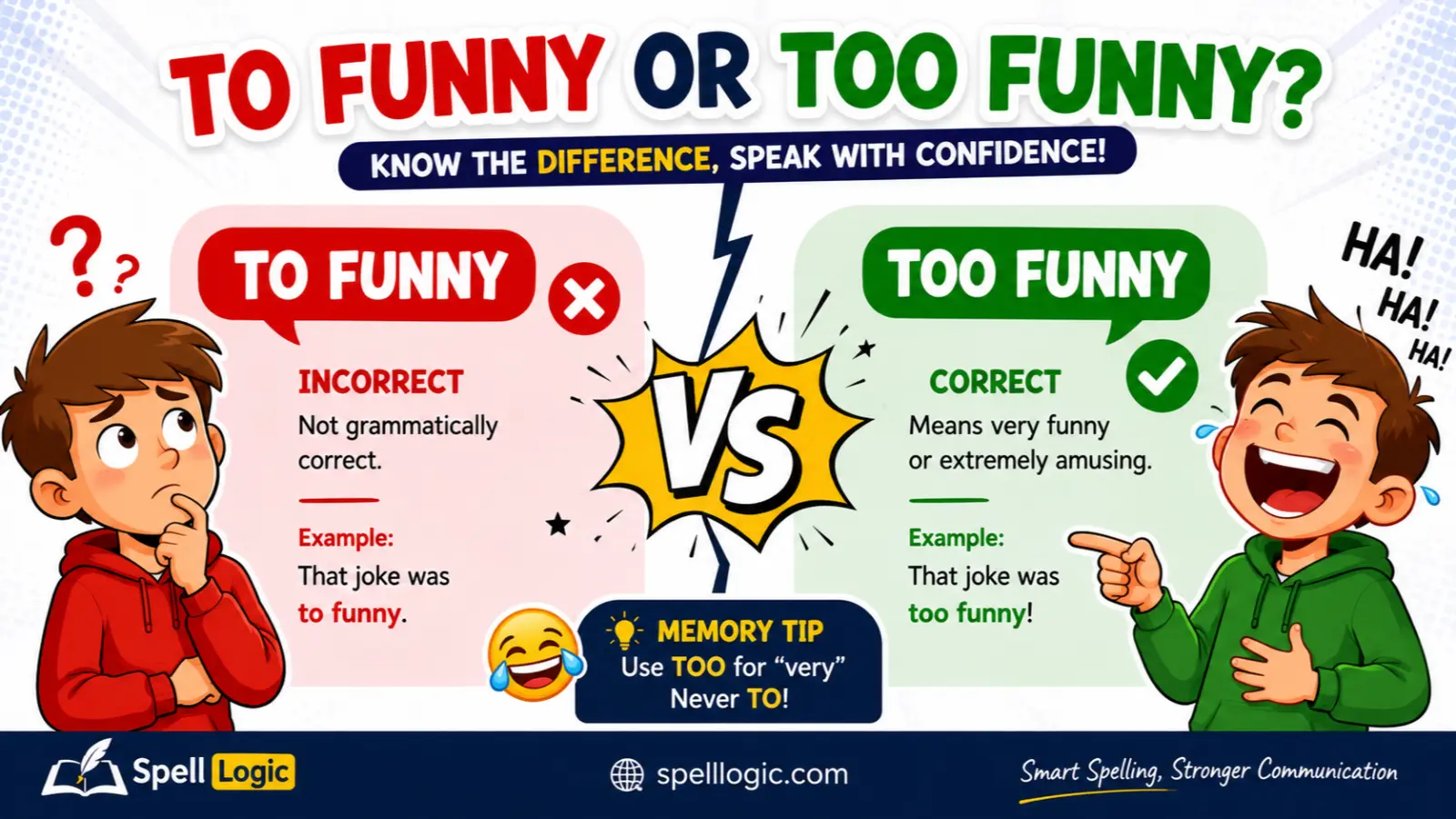
One frequent mistake is writing to funny when the writer means “very funny.”
Wrong:
That video is to funny.
Correct:
That video is too funny.
The reason is simple: funny is an adjective, and too can modify an adjective to express degree.
Another mistake is replacing to with too before a verb.
Wrong:
I want too laugh.
Correct:
I want to laugh.
Here, to introduces the base-form verb laugh.
A third mistake occurs when learners assume that too always means “very.” It does not. In “I like it too,” too means “also.”
Compare:
- She laughed too. = She also laughed.
- The joke was too funny. = The joke was excessively or extremely funny.
Therefore, context determines the exact meaning.
Examples Section: Correct and Incorrect Usage
Example 1
✔ Correct: That comedian is too funny.
✘ Incorrect: That comedian is to funny.
Explanation: Too modifies the adjective funny.
Example 2
✔ Correct: I want to watch the funny video.
✘ Incorrect: I want too watch the funny video.
Explanation: To introduces the base-form verb watch.
Example 3
✔ Correct: The story was too funny to forget.
✘ Incorrect: The story was to funny too forget.
Explanation: The first word modifies funny, while the second introduces the verb forget.
Example 4
✔ Correct: My brother laughed too.
✘ Incorrect: My brother laughed to.
Explanation: Here, too means “also.”
Example 5
✔ Correct: She tried to tell a funny story.
✘ Incorrect: She tried too tell a funny story.
Explanation: To comes before the base-form verb tell.
Example 6
✔ Correct: That joke is too funny to explain seriously.
✘ Incorrect: That joke is to funny to explain seriously.
Explanation: Too modifies funny, and to introduces explain.
Self Assessment: Test Your Knowledge
Fill in each blank with to or too.
- That video is ___ funny to watch without laughing.
- I want ___ tell you a funny story.
- She laughed ___ when she heard the joke.
- The comedian was ___ funny for the audience to remain serious.
Self Assessment Answers
- too — It modifies the adjective funny and expresses a high degree.
- to — It introduces the base-form verb tell.
- too — It means “also.”
- too — It modifies funny and indicates an excessive or very high degree.
FAQs
Is “to funny” correct English?
No, not when you mean that something is very or excessively amusing. In that context, too funny is the correct expression.
Is “too funny” grammatically correct?
Yes. Too is an adverb that can modify the adjective funny, as in “That movie is too funny.”
What is the difference between “to” and “too”?
To commonly introduces an infinitive or shows direction, while too can mean “also” or indicate excess.
Why do people write “to funny”?
People often make this mistake because to and too look and sound similar, especially in fast speech.
Does “too” always mean “very”?
No. Too can mean “also,” as in “I want to go too.” It can also express excess, as in “The bag is too heavy.”
Can “to” come before “funny”?
Not normally in the expression describing something as amusing. You can use to elsewhere in a sentence involving funny, such as “I want to laugh at the funny joke.”
Which spelling should I use when describing something as extremely funny?
Use too funny. For example, “That video is too funny!”
Final Conclusion: Using “To Funny” and “Too Funny” Correctly
Understanding the difference between to funny or too funny becomes much easier when you focus on grammar instead of relying only on pronunciation. To is commonly used as an infinitive marker before a base-form verb, as in “to laugh,” “to smile,” or “to watch.” It can also function as a preposition showing direction or a relationship. Too, however, is an adverb. It can mean “also,” or it can describe something as excessive or unusually strong. Therefore, when you want to describe something as extremely or excessively amusing, too funny is the correct expression.
A useful memory trick is to remember that too has an extra o, just as it can suggest an extra amount. Meanwhile, to is often followed by a verb. For example, “The joke was too funny to ignore” contains both words correctly. The first too modifies funny, while the second to introduces ignore. Once you notice these grammatical patterns, the distinction becomes much more natural. Keep practicing with short sentences, and soon choosing between to and too will become automatic. English improves through consistent practice, so do not worry about making occasional mistakes—use them as opportunities to learn.

Naveed Ahmed is a Master’s graduate, content writer, and contributor at SpellLogic.com. He specializes in spelling, grammar, and English language content, helping readers improve their writing with clear and accurate guidance. His goal is to make language learning simple, practical, and accessible for students, writers, and professionals.