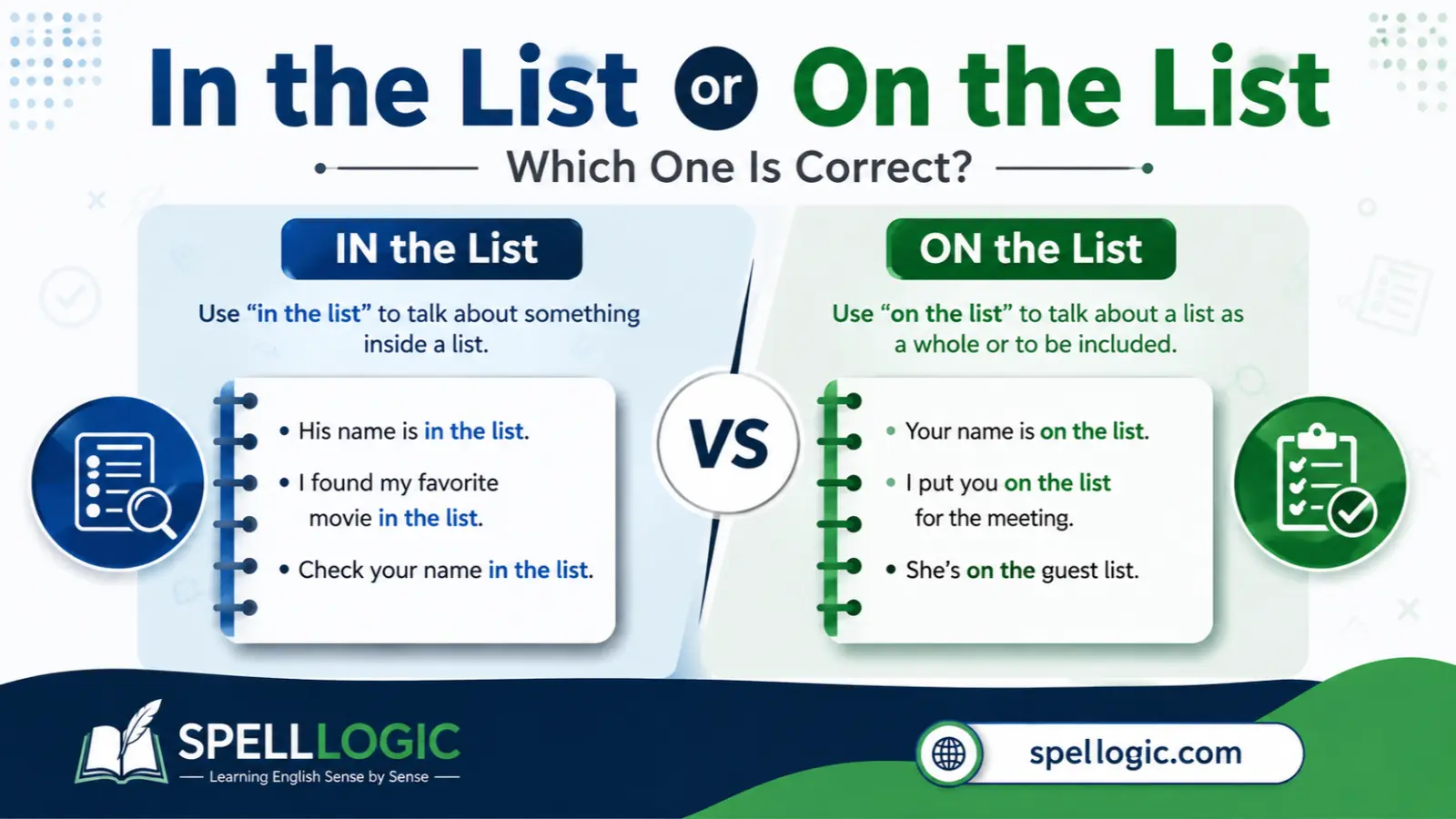
English learners often find prepositions difficult because small words can completely change the meaning of a sentence. The expressions in the list or on the list are a good example. Both are grammatically possible, but they are normally used in different situations.
The choice depends on what you want to describe: something included within a written collection or something that appears as an item on a particular list. Understanding this distinction can help you sound more natural when writing emails, making plans, discussing names, or talking about tasks. Once you understand the basic idea, choosing the right preposition becomes much easier.
Why “in the list or on the list” Are Confusing
Learners often mix up in the list or on the list because both expressions can describe something connected with a list. The difference is mainly related to how English speakers view the relationship between the item and the list.
Similar pronunciation
The words in and on are both short, common prepositions. Because they appear frequently in everyday speech, learners may choose one automatically without considering the meaning.
Similar spelling
There is no major spelling similarity between in and on. However, both are two-letter prepositions, and both can appear before nouns such as list, page, document, or record. This can make them easy to confuse.
Context confusion
Context is the biggest reason learners struggle with in the list or on the list. For example, someone may say that a person’s name is included in a document, while another person may naturally say that the same name is on a list.
English speakers commonly use on when treating a list as a surface or organized set of entries. They use in when emphasizing inclusion within a collection or written material.
Common learner mistakes
A common mistake is assuming that only one preposition is correct. In reality, both can be correct depending on the sentence.
For example:
- “Your name is on the list.”
- “Your name appears in the list of selected candidates.”
The first is the more natural everyday expression when referring to a person’s inclusion as an entry. The second focuses more on the contents of the written list.
“in the list or on the list” Explained Simply
The simplest way to understand in the list or on the list is to think about the focus of your sentence.
“In the list” generally emphasizes inclusion within the contents of a written or organized collection.
“On the list” generally emphasizes that something is recorded as an item or entry on a list.
One-line distinction
In focuses on being included within a collection, while on commonly focuses on appearing as an item on a list.
Example sentences
- “Several new names are in the list of approved applicants.”
- “My name is on the list of people invited to the meeting.”
In everyday English, on the list is usually the more natural choice when saying that a person, item, or task has been included as an entry.
Understanding Homophones in English
The expressions in the list or on the list are not homophones. This is important because learners sometimes assume that any confusing pair must be a homophone pair.
What Are Homophones?
Homophones are words that sound the same but have different meanings, spellings, or both.
For example, right and write sound alike but have different meanings and spellings.
Why Homophones Cause Confusion
Homophones can confuse learners because pronunciation does not always reveal which word a speaker means. For example, hearing “write” does not tell you whether the speaker means the verb write or is referring to another word with the same pronunciation.
The confusion between in the list or on the list, however, comes from preposition choice rather than pronunciation.
What Does “In the List” Mean?
Definition and Core Meaning
In the list means that something is included within the contents of a particular list or written collection. It can draw attention to the information contained in the list.
For example, if a document contains ten recommended books, you might say that a particular title is in the list of recommended books.
The expression can be especially useful when discussing the contents, wording, or structure of a list.
Origin and Historical Use
The preposition in has a long history in English and comes from an Old English preposition meaning “inside,” “within,” or “into.” Over time, its uses expanded beyond physical spaces to include abstract collections, situations, and written material.
This explains why English speakers can use in with concepts such as groups, records, documents, and collections.
Modern Usage and Synonyms
In modern English, in the list can be replaced in some contexts with expressions such as:
- included in the list
- contained in the list
- mentioned in the list
- appearing in the list
- included among the entries
However, these alternatives are not always interchangeable. The exact wording should depend on the context.
Example sentences
- “The information is in the list provided by the committee.”
- “Your name appears in the list of successful candidates.”
- “That product is in the list of recommended options.”
- “Several errors were found in the list.”
Notice that these sentences focus on the contents or information contained within the list.
What Does “On the List” Mean?
Definition and Core Meaning
On the list means that a person, thing, name, task, or item is recorded as an entry on a list.
This is the standard expression in many everyday situations. For example, if a person has been invited to an event, you can say, “Her name is on the list.”
Origin and Historical Context
The preposition on traditionally expresses contact with or position upon a surface. English later developed many figurative uses of on, including references to written pages, records, schedules, registers, and lists.
As a result, English speakers naturally describe something as being on a list when it is presented as an entry or item.
Modern Usage and Synonyms
Common alternatives include:
- listed
- included
- recorded
- entered
- named
- scheduled
Again, the best alternative depends on the context.
Example sentences
- “Your name is on the list.”
- “Is my name on the list?”
- “The new task is on the list for today.”
- “She was happy to see her favorite book on the list.”
This expression is particularly common in everyday speech, invitations, shopping, planning, school activities, and workplace communication.
“in the list or on the list”: Key Differences at a Glance
| Word | Part of Speech | Meaning | Example Context |
|---|---|---|---|
| In | Preposition | Within or included in the contents of something | “The detail is in the list.” |
| On | Preposition | Recorded as an item or entry on a list | “Your name is on the list.” |
The key point is that in the list or on the list are not simply interchangeable in every sentence. On the list is usually preferred when referring to an item as an entry, while in the list can emphasize the contents or information contained in a written collection.
How to Remember the Difference Between “in the list or on the list”
Easy memory tricks
A simple memory rule is:
An item is ON a list; information can be IN a list.
Think of a list as something that displays entries. Each entry is therefore commonly described as being on it.
For example:
- “Your name is on the guest list.”
- “The explanation is in the list.”
Association techniques
Imagine a shopping list written on paper. Each product appears as an individual entry on the paper. This makes on the list easy to connect with individual items.
Now imagine opening the list and examining its contents. The information is in the document.
One memorable example
Remember this sentence:
“My name is on the list, but my phone number is in the list.”
This creates a useful contrast between an entry and information contained in the document.
Common Mistakes and Confusions
One of the most common mistakes is using in automatically whenever something is included.
Wrong example
✘ “Is my name in the list?”
Correct version
✔ “Is my name on the list?”
The corrected sentence sounds more natural when asking whether your name has been included as an entry.
Another wrong example
✘ “The details are on the list.”
Better version
✔ “The details are in the list.”
Here, the focus is on information contained within the list.
However, context can sometimes make either expression possible. English prepositions are not mathematical formulas, so the intended meaning matters.
Another common error is believing that in the list or on the list has one universally correct answer. Instead, choose the preposition according to whether you are emphasizing an entry or the contents of the list.
Examples Section: Correct and Incorrect Usage
Example 1
✔ Correct: “Your name is on the list.”
✘ Incorrect: “Your name is in the list.”
Explanation: When referring to someone’s name as an entry, on the list is the normal choice.
Example 2
✔ Correct: “The information is in the list.”
✘ Incorrect: “The information is on the list.”
Explanation: When focusing on information contained within a written collection, in can be appropriate.
Example 3
✔ Correct: “Is this restaurant on the list of places to visit?”
✘ Incorrect: “Is this restaurant in the list of places to visit?”
Explanation: For an individual item included as an entry, on the list is generally more natural.
Example 4
✔ Correct: “Several useful details are in the list provided by the manager.”
✘ Incorrect: “Several useful details are on the list provided by the manager.”
Explanation: The sentence focuses on the contents of the written list, so in works naturally.
Self Assessment: Test Your Knowledge
Fill in each blank with in or on.
- Is your name ___ the guest list?
- The required information is ___ the list provided by the school.
- That book is ___ my reading list.
- Several important details are ___ the list of instructions.
Self Assessment Answers
- on — “Is your name on the guest list?”
- in — “The required information is in the list provided by the school.”
- on — “That book is on my reading list.”
- in — “Several important details are in the list of instructions.”
A useful way to check your answer is to ask whether you are talking about an individual entry or the information contained in the collection.
FAQs About “in the list or on the list”
Is “on the list” grammatically correct?
Yes. On the list is grammatically correct and is the usual expression when saying that a person or item appears as an entry.
Is “in the list” grammatically correct?
Yes. In the list can be correct when you are emphasizing something contained within the contents of a list or written collection.
Which is more common, “in the list or on the list”?
On the list is generally more common in everyday English when talking about names, tasks, products, people, or other individual entries.
Should I say “my name is in the list” or “my name is on the list”?
In most everyday situations, say “My name is on the list.” This is the natural way to say that your name appears as an entry.
Can “in the list or on the list” both be correct?
Yes. The correct choice depends on context. In emphasizes inclusion within contents, while on commonly identifies an entry appearing on a list.
Is “on the list” used in formal English?
Yes. It is completely acceptable in both everyday and formal English. For example, “The applicant’s name is on the approved list” is natural and professional.
What is an easy way to remember “in” and “on” with a list?
Think “items are on a list.” When you focus on information contained inside the written collection, in may be more suitable.
Final Conclusion: Using “in the list or on the list” Correctly
Understanding in the list or on the list becomes much easier when you focus on the relationship between the thing you are describing and the list itself. On the list is the standard and most natural expression when you are talking about a name, person, product, task, book, or other item that appears as an entry. For example, “Your name is on the list” is the normal way to say that someone has been included. In the list, on the other hand, can emphasize information, details, or content contained within a written or organized collection. Therefore, neither preposition is automatically wrong; the context determines the best choice.
For everyday communication, remember the simple rule: individual entries are usually on a list, while information can be in a list. This memory trick will help you choose the right preposition when writing emails, preparing schedules, checking invitations, creating shopping lists, or discussing documents. Also remember that these expressions are not homophones; the difficulty comes from choosing the appropriate preposition. With regular reading and practice, the difference will become natural. Keep noticing how native speakers use in and on, try making your own sentences, and do not worry about making occasional mistakes. Every small correction strengthens your English skills and makes your communication more accurate and confident.